In the 4th quarter of 2025
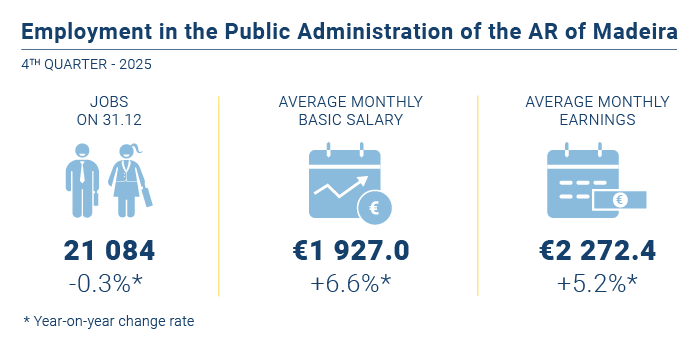
Number of jobs in the Regional Administration of Madeira stood at 21 084, decreasing by 0.3% year-on-year
According to information published by the Directorate-General for Administration and Public Employment (DGAEP) — the entity responsible for compiling information on the human resources of State administration bodies and services at national level — which published on 13 February the Statistical Summary of Public Employment (SIEP) for the 4th quarter of 2025, there were 21 084 jobs in the Regional Administration of Madeira (ARM) as at 31/12/2025. Compared to the previous quarter, the change was minus 35 jobs (-0.2%), with a year-on-year decrease of 58 jobs (-0.3%). Compared to the end of 2011, there was a reduction of 269 jobs (-1.3%).
In turn, the Social Security Institute of Madeira, which, according to the classification of institutional units, must be presented separately from the ARM, recorded 1 194 jobs as at 31/12/2025. There were 33 fewer jobs compared to the 3rd quarter of 2025 and compared to 31/12/2024, a decrease of 85 workers (-6.7%) was observed. Compared to 31/12/2011, there were 217 fewer workers (-15.4%) in this institutional sub-sector.
The analysis of data on employment in the institutional sector of general government at the national level for the period between December 2011 and December 2025 shows reductions only in the sub-sectors of Social Security Funds (-19.7%) and the Regional Administration of Madeira (-1.3%). The other sub-sectors recorded increases, with the largest in relative terms being that of Local Administration (+15.4%). Increases were also recorded in the Regional Administration of the Azores (+10.7%) and Central Administration (+3.7%). The change for General Government as a whole was +5.3%.
The sub-sectors that recorded growth compared to the end of 2024 were Local Administration (+2.9%) and Central Administration (+1.6%). The remaining sub-sectors recorded year-on-year decreases of 2.5% in Social Security Funds, 1.0% in the Regional Administration of the Azores and 0.3% in the Regional Administration of Madeira. The year-on-year change for General Government as a whole was +1.7%.
Compared to the previous quarter, Central Administration (+1.2%) recorded growth above the General Government average (+0.9%). Increases below that average were recorded in the Regional Administration of the Azores (+0.7%) and Local Administration (+0.1%). The remaining sub-sectors recorded decreases of around 0.2% in the Regional Administration of Madeira and 0.6% in Social Security Funds.
Between 2018 and 2023, the ARM recorded an annual positive balance between entries and exits of workers in ARM entities; however, in 2024 and 2025, a negative balance of 334 and 58 was observed, respectively.
With regard to the breakdown by post, career and group, the most representative is teaching staff at 27.8%, followed by operational assistants and technical assistants, accounting for 26.0% and 14.1% of total ARM employment, respectively. The exit of workers in the operational assistant career (net balance between entries and exits of -185), Tax and Customs Administration (-15) and technical assistants (-13) explains the overall year-on-year decrease recorded in the 4th quarter of 2025. The careers with the most significant increases were nursing (+53) and teaching staff (+47).
Compared to the end of 2011, the medical career (+74.7%), senior technician (+61.3%), diagnostic and therapeutic technician (+25.0%) and nursing (+21.6%) recorded the highest growth rates. In the opposite direction, registrars and notaries (-22.7%), other security personnel (-22.2%), pre-school and primary and secondary school teachers (-14.6%), technical assistants (-12.5%) and operational assistants (-8.6%) recorded the most significant decreases.
The breakdown by Regional Secretariat shows that the Regional Secretariat for Education, Science and Technology continue to account for the largest number of workers, with 9 682 jobs (45.9% of total ARM employment), whilst the remaining Secretariats maintain employment volumes ranging between 149 (Regional Secretariat for the Economy) and 951 (Regional Secretariat for Finance) jobs.
Adding to the ARM the Social Security Institute of Madeira, the Municipal Councils and Parish Councils of the ARM, it can be concluded that public employment in the Region represented, in the last quarter of 2025, 18.7% of the active population (19.8% in the same period of the previous year) and 19.6% of the employed population (21.0% in the same period of the previous year). It should be noted, however, that these percentages do not include public enterprises not classified within the ARM perimeter (i.e. those considered commercial), nor Services and entities under Central Administration that operate in the Region.
At the end of 2025, in terms of gender, the feminisation rate in the ARM was 69.0%, meaning that almost seven in every ten workers were female, a ratio above the national General Government average, where that rate stands at around 62.7%. The ARM thus presents a feminisation rate higher than all other sub-sectors, with the exception of Social Security Funds (82.2%).
The estimated average age of workers in the Regional Administration of Madeira was, in June 2025, 49.7 years, slightly above that of the previous year (49.5 years).
In June 2025, the careers of registrar and notary official and conservator and notary presented the highest average ages (55.8 and 54.5 years, respectively), whilst the scientific research (37.3 years) and medical (40.2 years) careers had the lowest average ages.
With regard to qualifications, more than half of the ARM workers (57.8%) hold higher education qualifications, 21.4% have only primary education and the remaining 20.8% have secondary education. Approximately 7.1% held a level of schooling above a bachelor's degree (6.8% with a master's degree and 0.3% with a doctorate).
It should be noted that women present a proportion above the 68.8% indicated by the aforementioned feminisation rate in the education levels of "secondary education" (70.8%), bachelor's degree (72.2%) and bachelor's degree (81.2%).
In October 2025, the average gross monthly earnings in the ARM was 1 927.0 euros, 2.2% above the overall General Government average, whilst the average monthly earnings (corresponding to the aggregate of base remunerations, bonuses, allowances or supplements) stood at 2 272.4 euros, also 0.8% above the overall average. Compared to October 2024, the average gross monthly earnings in the ARM grew by 6.6% and average monthly earnings by 5.2%.
Public enterprises not classified within the ARM had, as of 31 December 2025, 1 963 jobs, +61 year-on-year (+3.2%) and -343 compared to 31 December 2012 (-14.9%).
In the field of Local Administration, as of 31 December 2025, the eleven Municipal Councils of the ARM accounted for 3 758 jobs, +166 (+4.6%) compared to the end of 2024 and +565 (+17.7%) compared to December 2011. In turn, the 54 Parish Councils of the ARM had, as of 31 December 2025, 186 jobs, +5 (+2.8%) year-on-year and +17 (+10.1%) compared to 31 December 2011.
For further information, please visit: