In the 2nd quarter of 2026
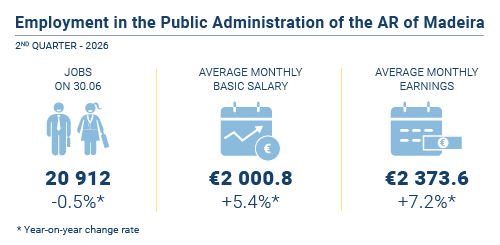
Number of jobs in the Regional Administration of Madeira decreased to 20 912
According to information released by the Directorate-General for Administration and Public Employment (DGAEP) — the entity responsible for compiling human resources information on State administration bodies and services at national level — which published the Statistical Summary of Public Employment (SIEP) for the 2nd quarter of 2026 on 14 August, there were 20 912 jobs in the Regional Administration of Madeira (ARM) as at 30/06/2026. This indicator therefore remains below the 21 000 threshold, having stood above that level continuously between the 1st quarter of 2023 and the 4th quarter of 2025.
Compared with the previous quarter, the change was -38 jobs (-0.2%), with a year-on-year decrease of 110 jobs (-0.5%). Compared with the end of 2011, there was a reduction of 441 jobs (-2.1%).
In turn, the Social Security Institute of Madeira, which, according to the classification of institutional units, should be presented separately from the ARM, recorded 1 170 jobs as at 30/06/2026, a decrease of 6 jobs (-0.5%) compared with the previous quarter. Year-on-year, there was a reduction of 79 jobs (-6.3%). Compared with 31/12/2011, there were 241 fewer jobs (-17.1%).
The Social Security Funds, the Regional Administration of Madeira and the Regional Administration of the Azores were the only subsectors to show year-on-year decreases in jobs, of -1.9%, -0.5% and -0.3%, respectively. All other subsectors recorded growth compared with the same period of the previous year, with Local Administration (+2.5%) leading the increases, followed by Central Administration (+0.7%). The average year-on-year change across General Government as a whole was +1.0%.
Compared with the previous quarter, the subsectors showing growth were Local Administration (+0.7%) and, with a very slight increase, Central Administration (+0.02%). The remaining subsectors recorded decreases, namely the Regional Administration of the Azores (-0.5%), the Social Security Funds (-0.4%) and the Regional Administration of Madeira (-0.2%). The average change across General Government as a whole was +0.1%.
Analysis of employment data for the general government institutional sector at national level, for the period between December 2011 and June 2026, shows reductions only in the Social Security Funds (-20.3%) and Regional Administration of Madeira (-2.1%) subsectors. The other subsectors recorded increases, with the largest relative increase seen in Local Administration (+17.1%), followed by the Regional Administration of the Azores (+11.0%) and Central Administration (+3.7%). The average change across General Government as a whole was +5.6%.
Regarding the breakdown by position, career and group, the most representative group is teaching staff at 27.4% (27.3% in the 2nd quarter of 2025), followed by operational assistants and technical assistants, at 26.0% and 14.0% of total ARM employment, respectively (26.8% and 14.0% in the year-on-year period).
The decreases in operational assistants (net balance between entries and exits of -196) and teaching staff (-21) drove the overall year-on-year reduction of 110 jobs referred to above, with net increases in nurses (+49), higher technical staff (+25), diagnostic and therapeutic technicians (+13), and IT specialists, land registrars and notaries (+6 each) not being sufficient to offset this.
Analysing the breakdown of public employment by type of entity, in the 2nd quarter of 2026, Primary and Secondary Education Establishments accounted for 39.1% of total jobs, followed by Regional State-Owned Enterprises, with 29.1%, and Regional Directorates, with 17.4%.
The breakdown by Regional Secretariat (S.R.) shows that the S.R. for Education, Science and Technology accounts for the largest number of workers, with 9 561 jobs (45.7% of the ARM total), while the remaining Secretariats have employment volumes ranging from 147 (S.R. for the Economy) to 953 (S.R. for Finance) jobs.
In April 2026, the average monthly base pay in the ARM was 2 000.8 euros, 1.7% higher than the overall General Government average, while average monthly earnings (which correspond to the aggregate of base pay, bonuses, allowances or supplements) stood at 2 373.6 euros, also 1.3% higher than the overall average. Compared with April 2025, average monthly base pay in the ARM grew by 5.4%, and average monthly earnings by 7.2%.
Public enterprises not classified within the ARM had 1 999 jobs as of 30 June 2026, an increase of 27 (+1.4%) compared with the previous quarter and 57 (+2.9%) year-on-year. Compared with December 2012 (the earliest period for which information is available for this type of enterprise), the number of jobs decreased by 307 (-13.3%).
In turn, the eleven municipal councils of the Region accounted for 3 914 jobs in the reference period, an increase of 109 (+2.9%) compared with the preceding quarter and 228 (+6.2%) compared with the end of June 2025. The parish councils of the Autonomous Region of Madeira employed 186 persons as at 30/06/2026, an increase of 2 jobs (+1.1%) compared with the previous quarter, with the same year-on-year change recorded. Compared with 31/12/2011, Municipal Councils increased their headcount by 721 (+22.6%) and parish councils by 17 (+10.1%) workers.
For further information, please visit: