At the end of the 2nd quarter of 2026
Gross debt of the Regional Public Administration stood at 4 847.9 million euros
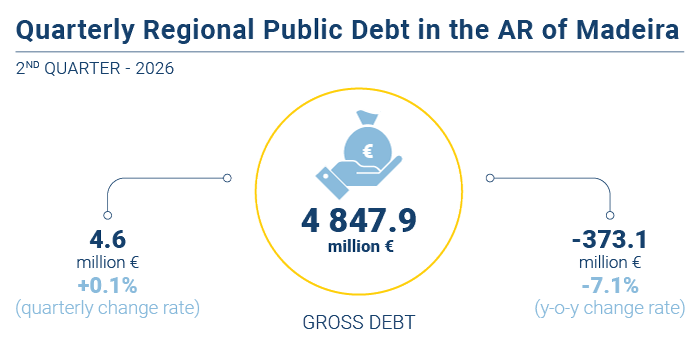
At the end of the 2nd quarter of 2026, the gross debt of the Regional Public Administration (RPA) stood at 4 847.9 million euros, increasing by around 4.6 million euros (+0.1%) compared with the end of the previous quarter and dropping by 373.1 million euros (-7.1%) year-on-year.
The year-on-year decrease is due to the fact that the RPA's debt refinancing operations planned for 2026 are lower than those of the previous year.
Looking at the evolution of the composition of gross debt by financial instrument, it can be observed that, in the 2nd quarter of 2026, loans accounted for 35.0% (36.0% in the year-earlier quarter) and debt securities for 65.0% (64.0% in the 2nd quarter of 2025).
The breakdown of debt by issuing sector shows that the Regional Government is responsible for 97.9% (97.5% in the year-earlier quarter) of total debt, and Public Enterprises classified within the RPA perimeter for 2.1% (2.5% in the 2nd quarter of 2025).
Debt net of deposits stood at around 4 544.8 million euros
At the end of the 2nd quarter of 2026, debt net of deposits stood at around 4 544.8 million euros, increasing by around 17.9 million euros (+0.4%) compared with the end of the previous quarter, and declining by 103.2 million euros (-2.2%) year-on-year.
Notes:
Public debt (Maastricht definition/optics)
Public debt under the Maastricht definition/perspective corresponds to the definition of General Government debt that is relevant in the context of European fiscal surveillance. This is a concept of consolidated gross debt valued in nominal terms. This concept differs from the total stock of liabilities defined under the ESA, both in terms of the instruments accounted for and in terms of the valuation criterion. It is a narrower concept, which does not include, among other financial instruments, shares and other equity, financial derivatives, or other payables/receivables, in particular trade debts. This debt concept adopts nominal value as its valuation rule, i.e., the value that General Government (the issuer/debtor) must repay at the end of the contract. The limit set out in the Protocol annexed to the Treaty on the Functioning of the European Union is 60% of GDP.
Net Debt excluding Deposits
Net debt excluding deposits corresponds to Gross debt (Maastricht debt) minus deposits in resident banks.
For further informations, please access: