In the first quarter of 2026
Number of debtors in Non-Financial Companies and Households increased year-on-year
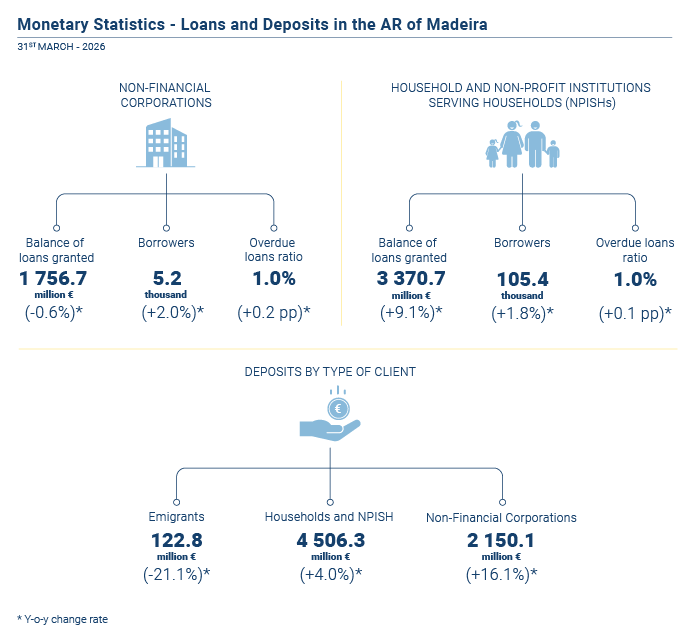
According to data released by the Bank of Portugal, at the end of the first quarter of 2026, the loan balance for non-financial companies (NFCs) amounted to 1 756.7 million euros, down by 5.9 million euros (-0.3%) compared with the end of December 2025 and by 11.3 million euros (-0.6%) vis-à-vis March 2025. In the reference quarter, the number of NFCs with a loan balance stood at 5.2 thousand, slightly above the 5.1 thousand recorded one year earlier.
The non-performing loan ratio of the institutional sector remained unchanged compared with the end of December 2025, standing at 1.0% at the end of March 2026. However, in year-on-year terms, it increased by 0.2 percentage points (pp). At the national level, this indicator stood at 1.9% in the same period, unchanged both from the previous quarter and from the corresponding quarter of the previous year.
The amount of non-performing loans of NFCs headquartered in the Region totalled 17.7 million euros in the reference period, corresponding to a decrease of 0.2 million euros compared with December 2025 and an increase of 2.9 million euros vis-à-vis March of the previous year.
The proportion of debtors in the NFC sector with non-performing loans (NPL) stood at 13.7% at the end of March 2026, a value below the national average (14.4% in the same period). In year-on-year terms, this indicator increased by 0.3 pp in the Region, in line with the change observed in the Country.
In the sector of Households and Non-Profit Institutions Serving Households (NPISHs), there was a year-on-year increase of 281.3 million euros (+9.1%) in the loan balance granted, which reached 3 370.7 million euros at the end of the first quarter of 2026. Compared with the previous quarter, the balance increased by around 86.8 million euros (+2.6%). A more detailed analysis shows that 73.7% of this total corresponded to housing loans, while the remaining 26.3% concerned consumption and other purposes.
In the reference quarter, the non-performing loan ratio in this institutional sector stood at 1.0% (0.7% in the Country), reflecting an increase of 0.1 pp year-on-year and of 0.2 pp compared with the end of December 2025. In the housing segment, the ratio remained unchanged from December 2025 (0.1%), below the national figure (0.2%). In the consumption and other purposes segment, this indicator rose to 3.2%, exceeding the figure recorded at the national level (2.5%) by 0.7 pp.
As regards overdue loans, these totalled 32.0 million euros, of which 3.4 million euros related to the housing segment and 28.6 million euros to consumption and other purposes. Overall, an increase of 20.3% was recorded both year-on-year and compared with the previous quarter.
The number of debtors in the institutional sector of Households and NPISHs increased compared with the corresponding quarter, reaching 105.4 thousand (+1.9 thousand; +1.8%), of which 43.1 thousand corresponded to debtors with housing loans (+0.3 thousand; +0.7%) and 90.0 thousand to debtors with loans for consumption and other purposes (+1.7 thousand; +1.9%).
The percentage of debtors (Households and NPISHs) with overdue loans in the ARM stood at 6.5% at the end of the first quarter of 2026, compared with 7.6% in Portugal. Compared with the same quarter of the previous year, the ratio increased by 0.4 pp in the ARM and by 0.2 pp in the Country.
Deposits increased in Non-Financial Companies and Households, but continued to decline among emigrants
At the end of the first quarter of 2026, deposits held by households and NPISHs reached 4 506.3 million euros, corresponding to a year-on-year increase of 4.0% and a quarterly rise of 0.9%.
In the NFC sector, deposits amounted to 2 150.1 million euros, representing a year-on-year change of +16.1% and an increase of 2.6% compared with the end of the previous quarter.
In turn, the outstanding stock of emigrants’ deposits maintained its downward trend, standing at 122.8 million euros at the end of March 2026, reflecting a year-on-year reduction of 21.1% and a quarterly decrease of 2.1%.