In October 2025
Regional economy maintained its growth trajectory, albeit at a more moderate pace
The Regional Indicator of Economic Activity (RIEA) shows that, in October 2025, economic activity in the Autonomous Region of Madeira (ARM) continued on a growth trajectory, although with a slowdown compared with the previous month.
It should also be noted that the RIEA is subject to revision whenever the final information from the Regional Accounts becomes available. Accordingly, in this release the indicator was recalculated, which led to a revision of previously published figures.
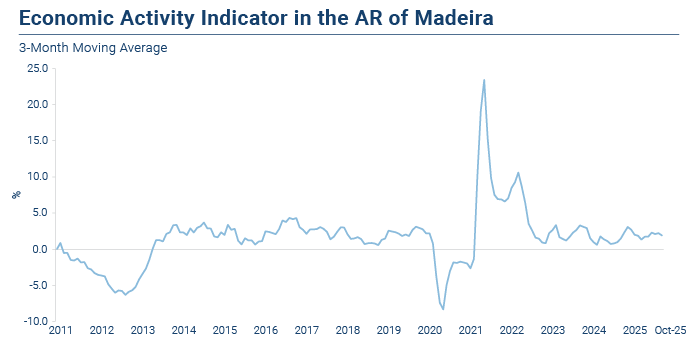
As stated by DREM in the first release of the RIEA, in October 2017, its purpose is to “signal the behaviour of economic activity, namely with regard to its direction and the magnitude of fluctuations: whether it is in positive or negative territory, accelerations, decelerations and the identification of turning points”. Its quantitative value, therefore, assumes secondary importance and should not be regarded as a substitute for the real growth rate of Gross Domestic Product, which is calculated using a broader and more comprehensive set of statistical information, although a strong correlation exists between the two variables.
Economic Activity
As previously mentioned, the regional economic activity remained in growth in October 2025, albeit with a slight deceleration compared with the previous month.
The number of overnight stays in tourist accommodation establishments increased by 4.3%, slightly below the 4.4% recorded in September. Total revenues rose by 16.5%, also below the 17.5% observed in the previous month, while RevPAR slowed to 16.2%, after the 16.7% registered in September.
Electricity distribution strengthened its growth dynamics, recording a positive year-on-year change of 2.3%, higher than the 1.1% observed in the preceding month. In the opposite direction, diesel released for consumption declined again (-0.2%), although less sharply than in September (-0.4%).
Meanwhile, the ratio of newly incorporated to dissolved companies increased to 3.4 new companies per dissolution, exceeding the ratio of 3.2 recorded in the previous month.
Qualitative Indicators
In October 2025, confidence indicators showed mixed developments across the analysed sectors. An improvement was observed in Construction and Public Works, while Manufacturing Industry, Trade and Services recorded deteriorations in their respective confidence levels compared with the previous month.
Private Consumption
In October 2025, gasoline released for consumption continued to grow, registering a year-on-year increase of 9.9%, although lower than that observed in September (10.8%), thus signalling a slight deceleration.
The outstanding balance of loans for consumption and other purposes granted to households and non-profit institutions serving households increased by 8.7%, maintaining the positive trend observed in the previous month (8.6%).
Withdrawals and purchases through automatic payment terminals (POS) using national cards grew by 7.4%, decelerating from the 8.2% recorded in September, but nevertheless remaining clearly in positive territory.
In turn, purchases of new light passenger cars once again recorded a very sharp decline (–34.8%), deepening the decrease observed in the previous month (-33.9%).
Investment
In October 2025, investment indicators displayed divergent behaviours.
Sales of light commercial vehicles recorded strong growth (+14.3%), higher than that observed in September (+7.2%).
Conversely, the outstanding balance of loans granted to non-financial corporations decreased by 1.2%, after having recorded a zero change in the previous month.
Cement sales returned to negative territory, with a year-on-year change of -4.5%, after having increased by 1.1% in September.
In contrast, median value of bank appraisals for housing maintained a positive trend, rising by 17.1%, in line with the high levels recorded in recent months.
With regard to the number of building permits, an increase of 7.5% was observed, reflecting a considerable slowdown compared with the more pronounced increases recorded in previous months.
External Demand
In October 2025, regional exports of goods increased by 43.6%, remaining at high levels, although below the sharp changes recorded in previous months.
By contrast, imports of goods decreased by 2.3%, following the growth of 1.0% observed in September.
The movement of goods in ports recorded a significant growth of 6.8%, after the marginal change of 0.1% registered in the previous month.
Passenger traffic at regional airports maintained a robust growth trajectory, increasing by 15.2% (+15.7% in September 2025).
Meanwhile, withdrawals and purchases through POS using international cards increased by 7.7%, accelerating slightly compared with the 7.4% observed in September.
Labour Market
In October 2025, the number of registered unemployed persons decreased by 12.2% (-12.3% in September).
Job applications also declined (-11.6%), confirming the continuation of the downward trend.
In contrast, job offers deepened their decline, recording a year-on-year change of -7.5%, following the 1.0% decrease observed in September.
Prices
In October 2025, the year-on-year rate of change in the Consumer Price Index (CPI) accelerated to 3.9%, after the 3.0% recorded in the previous month.
Goods inflation stood at 2.3%, while services inflation recorded a more marked acceleration, reaching 6.0%.
Finally, the underlying inflation indicator, which excludes unprocessed food and energy products, increased to 3.8% in October 2025, above the 2.4% observed in the previous month.
For more information, visit: