[NOTE: With regard to the monthly release for the 2026 reference year, DREM maintains the model used in the previous year, publishing an aggregate that comprises hotels, rural tourism accommodation and all local accommodation, regardless of the number of beds. In turn, Statistics Portugal (INE), in its release, excludes local accommodation with fewer than 10 beds, which is why this news release, the In Focus publication and the tables published by DREM show a higher overall total than that of INE, with respect to guests and overnight stays. For the variables occupancy rates, rooms, revenues and staff costs, the values coincide with those of INE given that their calculation excludes local accommodation with fewer than 10 beds.]
In January 2026
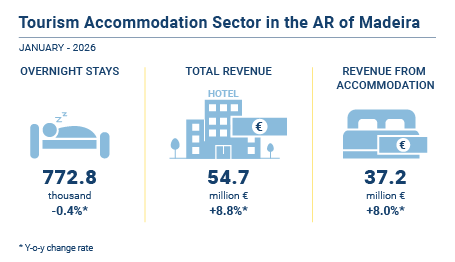
Overnight stays in tourist accommodation in the Region fell 0.4% year-on-year, but total revenue increased by 8.8%
In the Autonomous Region of Madeira (ARM), the tourist accommodation recorded, in January 2026, the arrival of 137.4 thousand guests, generating 772.8 thousand overnight stays, reflecting opposite year-on-year changes: +3.1% in guest arrivals and -0.4% in overnight stays. The hotel segment accounted for 69.9% of overnight stays (540.2 thousand), decreasing by 3.2% year-on-year. Local accommodation (28.0% of the total) increased by 7.4%, whilst rural tourism accommodation (2.1% of the total) decreased by 0.2%. It should be noted that, should this trend be confirmed in future revisions of the January 2026 data, it will constitute the first decline in the number of overnight stays in the Region since April 2021, when the COVID-19 pandemic was severely affecting tourist activity worldwide.
For comparability purposes with the data released by Statistics Portugal (INE), local accommodation with fewer than 10 beds must be excluded; under this method of calculation, overnight stays in tourist accommodation recorded a year-on-year decrease of 3.0%, a change opposite to that observed nationally (+2.0%).
In January, the largest increases in overnight stays were recorded in the Norte region (+8.2%) and the Centro region (+5.6%). In the opposite direction, the Autonomous Region of Azores and Algarve recorded the sharpest decreases (-5.8% and -4.7%, respectively). Grande Lisboa (30.2%) and the Norte region (19.5%) concentrated the largest proportion of overnight stays.
The net bed occupancy rate of tourist accommodation in the Region in the reference month was 49.6%, -3.8 percentage points (pp) compared to the same month of the previous year (53.4%). In turn, the room occupancy rate reached 57.5% (62.5% in January 2025).
In January 2026, the average length of stay across total tourist accommodation stood at 4.72 nights (4.93 in January 2025). The highest values continue to be observed in hotels (4.77 nights) and local accommodation (4.70 nights), followed by rural tourism accommodation, which presents the lowest average length of stay, at 3.66 nights.
It should be highlighted that the top 10 source markets accounted for 82.2% of total overnight stays recorded in January 2026. The United Kingdom (20.1% of the total; -5.2% compared to January 2025), Germany (19.0%; -4.3%) and Portugal (17.8%; +19.2%) stood out with the highest shares. In fourth position, in terms of relative share of total overnight stays, was the Polish market (9.5%; -9.3%), followed by the Dutch market (3.5%; +0.8%).
In January 2026, total revenue and revenue from accommodation recorded year-on-year growth of 8.8% and 8.0%, respectively, standing at 54.7 million euros and 37.2 million euros, respectively. Nationally, in the same month, total revenue and revenue from accommodation also recorded year-on-year growth, albeit of lesser magnitude, both standing at +5.6%.
In January 2026, the average revenue per available room (RevPAR) stood at around 64.91euros across total tourist accommodation (excluding local accommodation with fewer than 10 beds), +2.8% compared to the same month of the preceding year. In turn, the average daily rate (ADR) in tourist accommodation increased from 101.09 euros in January 2025 to 112.83 euros in January 2026 (a year-on-year change of +11.6%).
For further information, please visit: