In the academic year 2024/2025
Higher education in the Autonomous Region of Madeira awarded 856 diplomas, with the proportion of male graduates constituting the second highest in the available time series
The Directorate for Statistics of Madeira (DREM) is updating the "Time Series of Education Statistics", incorporating data on Higher Education graduates in the Autonomous Region of Madeira (ARM) relating to the academic year 2024/2025. Following the revision of the Annual Estimates of the Resident Population, the population-based indicators for graduates relating to the period 2021/2022 to 2023/2024 were recalculated.
In the academic year 2024/2025, the number of graduates from higher education institutions in the ARM decreased slightly compared with the previous academic year (-0.7%), with a total of 856 diplomas awarded (6 fewer than in the previous academic year). Of these, 514 diplomas (60.0%) were issued by universities and 342 (40.0%) by polytechnic institutions.
The number of female graduates remained higher than that of male graduates, representing 53.7% of the total number of graduates (460 women, compared with 396 men). However, compared with the academic year 2023/2024, a change was observed in the trend previously recorded: the number of female graduates decreased from 490 to 460 (-6.1%), while the number of male graduates increased from 372 to 396 (+6.5%). Consequently, the proportion of male graduates increased from 43.2% to 46.3%, confirming the overall growth trend observed throughout the series, albeit in a non-linear manner. This value corresponds to the second highest proportion of male graduates recorded, only surpassed by that observed in 2022/2023 (46.9%).
The age structure of graduates continued to exhibit a marked concentration in the 20–24 age group, which accounted for 63.4% of all graduates in the academic year under review (down from 64.6% in 2023/2024). This was followed by the 25–29 age group, representing 19.6% (up from 18.2% in 2023/2024), and the 40 and over age group, with 8.9% (up from 8.4% in 2023/2024). In 2024/2025, there were 28.0 graduates per 1 000 inhabitants aged 20 to 29, a figure lower than that recorded in the previous academic year (28.8 per thousand).
In 2024/2025, the number of graduates from public higher education institutions in the Region reached the third highest value in the time series, totalling 741 graduates (86.6% of the total), with the remaining 13.4% graduating from private institutions. Although the number of graduates from public education was lower than that recorded in 2023/2024 (778 graduates), it remains among the highest in the statistical series that began in the academic year 2000/2001. On the other hand, at private higher education institutions, the number of graduates increased from 84 in 2023/2024 to 115 in 2024/2025, representing an increase of 36.9%, the highest figure in the last four academic years.
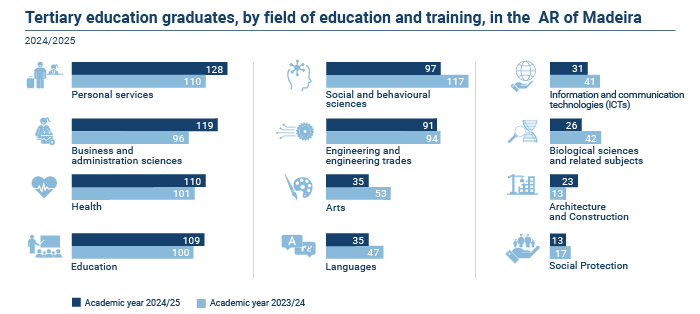
Regarding the distribution of graduates by education and training fields in higher education, in 2024/2025, four fields recorded graduate numbers in the hundreds. "Personal Services" accounted for the highest number (128; 15.0% of the total), followed by "Social and Behavioural Sciences" (119; 13.9%), "Health" (110; 12.9%) and "Education" (109; 12.7%). Together, these four fields represented 54.4% of all higher education graduates in the academic year 2024/2025.
The distribution of graduates by level of study reveals that 59.0% completed Bachelor's degrees, 22.4% completed Master's degrees, and 1.4% obtained Doctorates. Graduates from "Higher Professional Technical Courses" represented 17.2% of the total.
For more information, please click on: