In the 2025/2026 school year
Number of students enrolled in non-higher education decreased at all levels/cycles of study, except for the 2nd cycle
The Regional Directorate of Statistics of Madeira (DREM) is today releasing the preliminary data on non-higher education statistics for the Autonomous Region of Madeira (ARM) for the 2025/2026 school year. This information was provided by the Education Observatory of the Autonomous Region of Madeira (OERAM), a core unit of the Regional Directorate for School Administration (DRAE), part of the Regional Secretariat for Education, Science and Technology.
Madeira had 135 non-higher education establishments in the 2025/2026 school year
In the 2025/2026 school year, taking into account the typology of establishments, the ARM had 135 educational establishments, one fewer than in the previous school year. This decrease was due to the merger, in public education, of a 1st cycle primary school with a primary and secondary school, as part of the reorganisation of the regional school network.
Of the total number of establishments, 75 were public and 60 were private, ranging from nursery schools to vocational schools.
Non-higher education with 817 fewer students in the last school year
The ARM recorded a total of 36 286 students enrolled in pre-primary, primary and secondary education in the 2025/2026 school year, a decrease of 817 students (-2.2%) compared with the previous school year. In terms of institutional nature, public education accounted for 76.9% of enrolments and private education for 23.1%, proportions similar to those observed in the 2024/2025 school year. It should be noted that the total number of students was the lowest since the start of the series, which dates back to the 1999/2000 school year.
Regarding sex, the distribution is practically even, with 18 324 male students and 17 962 female students.
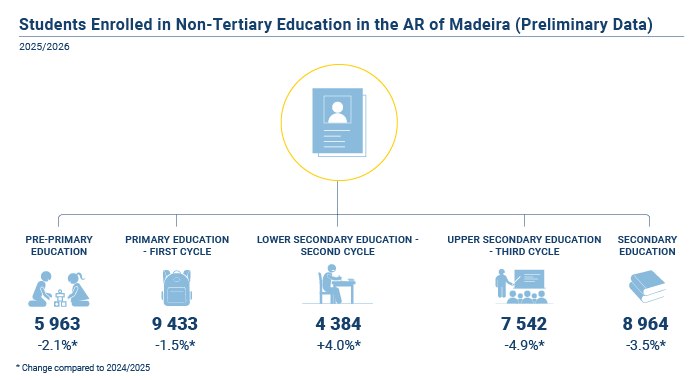
In pre-primary education, the number of children enrolled decreased by 2.1% compared with the previous school year (131 fewer enrolments), covering a total of 5 963 children. This decrease continues the decline recorded in the previous school year, which interrupted the cycle of continuous growth observed from the 2018/2019 school year to the 2023/2024 school year, and is below the figure recorded in 2020/2021, when 6 003 enrolments were counted.
In the 2025/2026 school year, 21 359 students were enrolled in primary education, representing a decrease of 1.7% (361 fewer students) compared with the previous school year. In the 1st cycle, contrary to the increase observed in the three previous school years, there was a decrease of 1.5% in the number of students enrolled (-146 students). By contrast, in the 2nd cycle, there was an increase of 4.0% (+170 students) compared with the 2024/2025 school year. In the 3rd cycle, there was a decrease of 4.9% (-385 students) in the number of students enrolled.
In secondary education, the number of students enrolled also decreased compared with the preceding school year, with 325 fewer students, totalling 8 964 students in 2025/2026.
As regards education and training offers aimed at adults, 1 440 students were enrolled in the 2025/2026 school year, reflecting a decrease of 5.0% compared with the previous school year. Of these, 686 students were enrolled in primary education offers and 754 students in secondary education offers.
Slight reduction in the number of teachers in the ARM
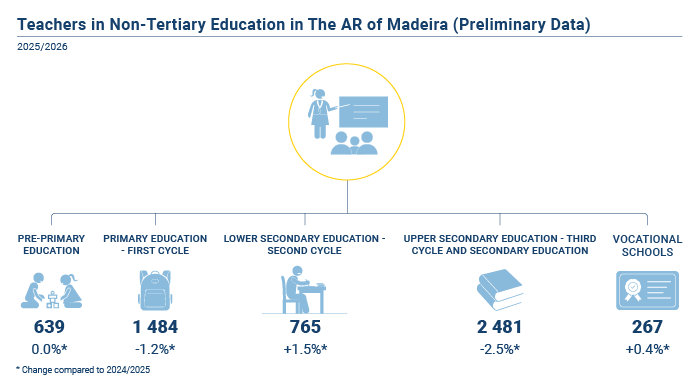
The ARM had 5 636 teachers in service in the 2025/2026 school year, 70 fewer (-1.2%) than in 2024/2025, distributed across the different levels/cycles of education, from pre-primary education to secondary education and vocational schools. This decrease resulted mainly from the reduction in teaching staff in the 3rd cycle of primary education and in secondary education (-64 teachers), despite the slight increase in the number of teachers in the 2nd cycle of primary education (+11 teachers) and in vocational schools (+1 teacher). In the other levels/cycles of education, there was a slight decrease in the 1st cycle (-18 teachers), while in pre-primary education the number remained unchanged (639 teachers).
The data reveal a predominance of teachers in public educational establishments, accounting for 89.0% of the total (5 018), while private establishments had 618 professionals.
Regarding the distribution by sex, women continued to make up the majority of the teaching staff, with 4 195 female teachers (74.4%), while men totalled 1 441 teachers (25.6%).
Among the teachers, 479 had specialist qualifications and were in service in special education, distributed across the various teaching cycles, 7 of whom belonged to the Portuguese Sign Language recruitment group.
Non-teaching staff increased by 1.6%
The number of non-teaching staff in pre-primary, primary and secondary education increased by 1.6%, from 3 868 persons in 2024/2025 to 3 931 in 2025/2026. Of this total, 3 063 were assigned to the public education network, representing 77.9% of the total.
For more information, please click on: