In the 2nd quarter of 2026
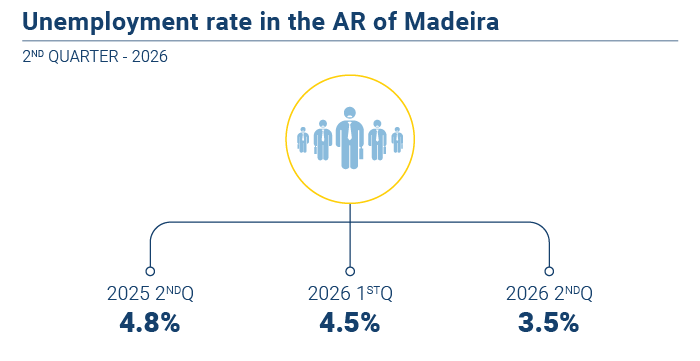
Unemployment rate fell to 3.5%, remaining the lowest in the Country
The results of the Labour Force Survey for the 2nd quarter of 2026 indicate an unemployment rate in the Autonomous Region of Madeira (ARM) estimated at 3.5%, a value 1.3 percentage points (pp) lower than in the year-on-year quarter and 1.0 pp lower than in the previous quarter. The unemployment rate for men was higher, standing at 3.8%, while that for women stood at 3.2%.
The labour force totalled 142.8 thousand persons, increasing by 4.8% (+6.5 thousand persons) year-on-year and by 0.4% (+0.5 thousand persons) quarter-on-quarter. The labour force thus reached a historical maximum in the current series.
The employed population stood at 137.8 thousand persons, having increased by 6.2% year-on-year (+8.0 thousand persons) and by 1.4% quarter-on-quarter (+1.9 thousand). Of the employed population, 3.0 thousand persons were in a situation of part-time underemployment, 7.1 thousand persons held a secondary job, and 20.0 thousand worked from home (16.5% of employed women and 12.6% of employed men). Since the 2nd quarter of 2025, the employed population has been recording successive historical maximums, reaching a new maximum once again in the 2nd quarter of 2026.
With 5.0 thousand persons, the unemployed population reached the lowest value in the series that began in 2011, representing a decrease of 23.3% year-on-year and of 21.4% compared with the 1st quarter of 2026.
Labour underutilisation affected 10.1 thousand persons, having decreased by 21.0% (-2.7 thousand persons) year-on-year and by 17.2% (-2.1 thousand) compared with the previous quarter. The labour underutilisation rate was estimated at 7.0%, representing a decrease of 2.2 p.p. year-on-year and of 1.5 pp compared with the preceding quarter.
The inactive population, estimated at 120.8 thousand persons, decreased by 3.4% year-on-year (-4.2 thousand) and increased by 0.2% compared with the 1st quarter of 2026 (+0.3 thousand).
The activity rate of persons of working age (16 to 89 years), in the 2nd quarter of 2026, was estimated at 62.6%, a value 2.2 pp higher than in the year-on-year quarter and remained unchanged compared with the preceding quarter. The activity rate for women was 59.0%, 7.7 pp lower than for men (66.7%).
In the quarter under review, the unemployment rate in Portugal stood at 5.3%, a value 0.6 pp lower year-on-year and 0.8 pp lower than in the preceding quarter. The highest unemployment rates were recorded in the Peninsula de Setúbal region, at 7.4%, followed by Norte and Grande Lisboa (both at 5.7%). At the opposite end, the ARM had the lowest rate, at 3.5%, followed by Centro and Alentejo, both at 4.0%, Algarve at 4.2%, Oeste e Vale do Tejo at 4.6%, and the Autonomous Region of the Azores (ARA) at 5.0%.
The unemployment rate decreased, quarter-on-quarter, in Algarve (-2.5 pp), Grande Lisboa (-1.7 pp), Alentejo (-1.5 pp), Centro, Oeste e Vale do Tejo, and the ARM (all at -1.0 pp), RAA (-0.4 pp), and Norte (-0.3 pp). Peninsula de Setúbal was the only region to record an increase in the unemployment rate, of 0.6 pp.
Year-on-year, the ARM recorded the largest reduction in the unemployment rate among the NUTS 2 regions, with a decrease of 1.3 pp. Reductions were also observed in Peninsula de Setúbal (-1.2 pp), Centro (-1.1 pp), Alentejo (-0.9 pp), Grande Lisboa (-0.8 pp), Norte (-0.4 pp), Algarve (-0.3 pp), and Oeste e Vale do Tejo (-0.2 pp). By contrast, the ARA was the only region to record a year-on-year increase in the unemployment rate (+1.1 pp).
For further information, please refer to: