DREM shares data to mark Mother's Day 2026
To mark Mother's Day, the Regional Directorate of Statistics of Madeira (DREM) presents a sociodemographic characterisation of the mothers of children born alive in 2025 in the Autonomous Region of Madeira (ARM), as well as some indicators relating to the initial parental allowance of mothers residing in the Region, for which the most recent available information refers to 2024.
The information relating to mothers is based on data made available by Statistics Portugal (INE), resulting from the direct and exhaustive collection of birth records carried out within the framework of mandatory civil registration in the Integrated Civil Registration and Identification System (SIRIC). The information relating to the initial parental allowance originates from Social Security administrative data.
How many women became mothers in 2025?
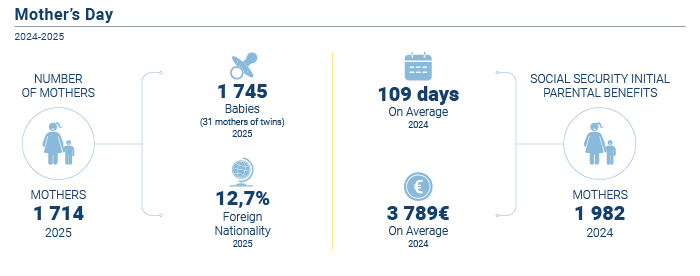
In 2025, 1 714 women residing in the ARM became mothers, with 1 745 babies born. Of these mothers, 1 683 had one child and 31 were mothers of twins.
Compared to 2024, a decrease was recorded in the number of births in the Region, from 1 793 babies to 1 745 babies in 2025. The reduction becomes even more evident when compared to the end of the last century. In 1995, 3 057 babies were born to 3 026 mothers, meaning that, over three decades, the number of births in the Region has been reduced to approximately half.
Regarding the sociodemographic profile of these mothers:
- 12.7% had foreign nationality, with Venezuelan and Brazilian nationalities being the most representative;
- 56.0% were aged between 30 and 39 years;
- The two youngest mothers were 16 years old and the two oldest were 48 years old;
- 42.0% had completed secondary education, 37.3% higher education and 17.9% primary education;
- 78.1% were employed and 6.4% were unemployed.
Motherhood currently occurs at older ages. On average, women become mothers at 30.6 years of age, compared to 25.5 years in 1995, reflecting a postponement of motherhood of approximately five years over the last three decades.
The presence of foreign mothers has increased significantly over recent decades. In 1995, only 33 mothers had foreign nationality, representing 1.1% of births, whilst in 2025 that number rose to 217 mothers, corresponding to 12.6% of births.
The family context has also changed significantly. In 1995, only 15.6% of babies were born to unmarried mothers, whilst in 2025 that proportion increased to 62.2%. This evolution reflects changes in the way families are formed, expressed in the increase in cohabitation and the postponement of marriage. On average, in 1995, women married at 25.4 years of age and, in 2025, at 37.2 years of age.
Use of parental leave by mothers
In 2024, 1 982 mothers residing in the ARM benefitted from this support, with an average of 109 days of allowance processed per mother.
Some differences were observed at municipal level. Mothers residing in Porto Moniz benefitted from the highest average number of parental allowance days (115 days), whilst mothers residing in Porto Santo and Ponta do Sol recorded the lowest average duration (102 days in both cases).
Compared to fathers, the average duration of the initial parental leave of mothers remains higher. In 2024, fathers benefitted from an average of 43 days, equivalent to approximately 37% of the average duration of mothers' leave.
Average value of the initial parental allowance
The average value of the initial parental allowance reached 3 789 euros per mother, the highest value on record. In that year, 7.5 million euros were processed for a total of 1 982 beneficiary mothers.
At the municipal level, mothers residing in Funchal benefitted from an average of 4 533 euros, the highest average value by municipality, whilst mothers residing in Santana benefitted from an average of 2 872 euros, the lowest value.