In 2025
One in ten persons aged 15 or over consumed sugary soft drinks daily
The Regional Directorate of Statistics of Madeira (DREM) releases new indicators for the Autonomous Region of Madeira (ARM) obtained from the 2025 National Health Survey (INS 2025), complementing the results previously released. The information refers to health determinants for the resident population aged 15 or over, including physical activity, food consumption and tobacco use.
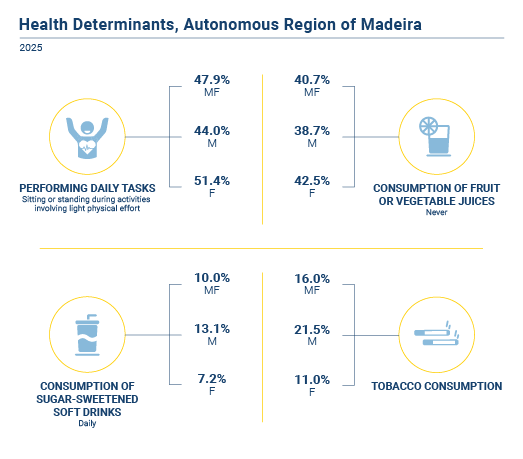
In 2025, it is estimated that, in the Region, 47.9% of the resident population aged 15 or over performed their daily tasks predominantly sitting or standing, in activities involving light physical effort, this being the most frequent way of performing them. This proportion was higher among women (51.4%) than among men (44.0%). By age group, the highest value was observed among young persons aged 15 to 24 (59.2%), followed by the population aged 65 or over (55.2%). The 55 to 64 age group stood out for having the highest proportion of persons who performed their daily tasks on the move or in tasks requiring moderate physical effort (45.2%), exceeding the proportion of those who performed them sitting or standing (41.4%). In turn, the proportion of men doing heavy or physically demanding work (11.0%) was more than double that recorded among women (5.0%). At the national level, the proportion of the population performing daily tasks sitting or standing, in activities involving light physical effort, was 52.7%, a pattern similar to that of the ARM.
Regarding the consumption of fruit or vegetable juices, 40.7% of the resident population aged 15 or over never consumed this type of beverage. Consumption less than once a week applied to 28.1% of the population, while 17.1% consumed them between one and three times a week and 6.4% once or more a day. Non-consumption was more frequent among women (42.5%) than among men (38.7%), and was also higher in the older age groups, reaching 55.8% among persons aged 75 to 84 and 55.9% among those aged 65 to 74. Among young persons aged 15 to 24, consumption less than once a week stood out (37.8%), while 25.2% never consumed fruit or vegetable juices. In Portugal, the proportion of the population that never consumed this type of beverage was higher than in the Region (49.2%). The population that consumed fruit or vegetable juices once or more a day was 4.6% in Portugal (6.4% in the ARM).
In the Region, one in ten persons aged 15 or over consumed sugary soft drinks daily (once or more a day), a proportion higher than that recorded at the national level (7.9%). By contrast, in the Region, 35.6% never consumed this type of beverage, while for 26.0% consumption was less than once a week. Consumption between one and three times a week applied to 18.5% of the population and was less frequent between four and six times a week (6.7%). Differences by sex were particularly evident in daily consumption, which applied to 13.1% of men and 7.2% of women. The analysis by age group shows a higher proportion of persons who never consumed sugary soft drinks in the older age groups: this proportion was 19.8% among those aged 15 to 24, rising to 53.0% among those aged 65 to 74 and standing at 51.5% among the population aged 85 or over.
As regards tobacco use, despite the predominance of non-smokers (82.0%), 16.0% of the resident population of the Region aged 15 or over were smokers, a proportion that reached 21.5% among men and 11.0% among women. It should be noted that 13.7% of the population smoked daily and 2.3% occasionally. At the national level, the proportion of smokers was lower than in the Region, standing at 14.6%.
Statistics Portugal makes the interactive Portuguese Food Balance Sheet application available
The Regional Directorate of Statistics of Madeira (DREM) releases the interactive Portuguese Food Balance Sheet application, made available by Statistics Portugal (INE) on its website. The interactive application allows users to explore the changes in food availability for human consumption and its energy and nutritional composition, bringing together 22 indicators organised into 9 themes, including the per capita indicators for the period 2021 to 2024, revised following the update of the Annual Resident Population Estimates. It should be noted that this information is not regionalised, being available only for the Portuguese population as a whole.
For more information, please click on: