DREM releases today on its website the publication “Demographic Statistics of the Autonomous Region of Madeira 2019” and updates the Time Series on Demography.
The annual publication contains a summary of the main results, from where the following was extracted:
Resident Population – Population increase in 2019 interrupted consecutive drops since 2011
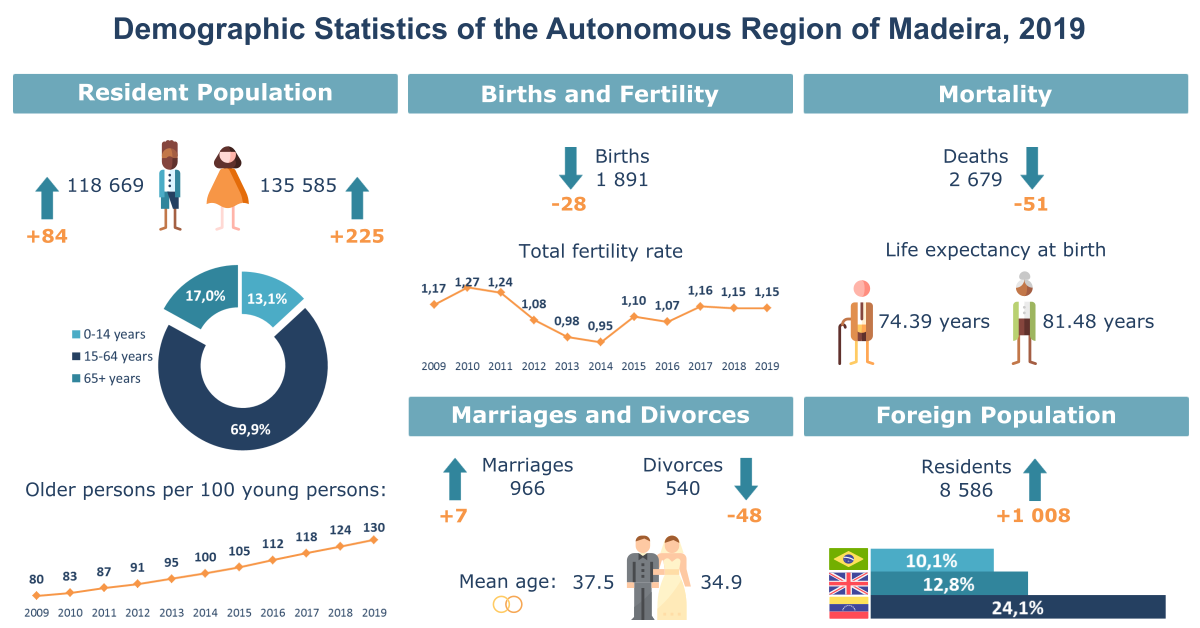
- On December 31st 2019, the resident population in the Autonomous Region of Madeira was estimated at 254,254, of which 118,669 were men and 135,585 were women. The crude rate of increase was 1.2‰ (-1.7‰ in 2018).
- The crude migratory rate was 4.3‰., while the crude rate of natural change stood at -3.1‰.
- The proportion of youth population (population under 15 years old) continued to shrink in 2019, representing 13.1% of the total population (13.5% in 2018).
- The proportion of older people (population aged 65 or over) maintained the increasing trend of the previous years, reaching 17.0% of the resident population (16.7% in 2018).
- As a result, the ageing ratio continued to rise, standing at 129.5 older persons per 100 young persons (123.6 in 2018).
Births and Fertility – Low number of live births puts the Autonomous Region of Madeira far from the generations’ replacement threshold
- In 2019, 1,891 live births were recorded, corresponding to a decrease of 1.5% compared to the previous year.
- The crude birth rate declined from 7.6 to 7.4 live births per 1,000 inhabitants between 2018 and 2019.
- The total fertility rate was 1.15 children per women in their child-bearing years (15-49 years). Still, this value remains considerably below the generations’ replacement threshold (2.1 children born per women).
- The mean age of mothers at birth of first child slightly decreased from 30.3 years in 2018 to 30.1 years in 2019. The mean age at birth of a child (regardless of birth order) decreased from 32.1 years to 32.0 years.
- Around 59% of the live births were born outside of the marriage, 32.7% with cohabiting parents and 26.5% without.
Mortality – Number of deaths in 2019 decreased from the previous year, but rose compared to 2017
- 2,679 deaths were counted in 2019, down by 51 from 2018 (-1.9%).
- The crude death rate was 10.5 deaths per 1,000 inhabitants (10.7‰ in 2018).
- The number of deaths was higher in Winter months (251 deaths, on average) and lower in the Summer (205 deaths, on average).
- In the year of reference, 5 deaths under 1 year were registered. The infant mortality rate was 2.6‰ (2.1‰ in 2018).
- In 2017-2019, life expectancy at birth for the population of the Autonomous Region of Madeira stood at 78.36 years: 74.39 years for men and 81.48 years for women.
- Life expectancy at 65 years old for the total population was 17.65 years: 15.00 years for men and 19.39 years for women.
Marriages and Divorces
Marriages – Number of marriages celebrated in 2019 was the highest in the last 9 years
- 966 marriages were celebrated in 2019, representing an increase of 0.7% over the previous year (959 marriages).
- The crude marriage rate was 3.8 marriages per 1,000 inhabitants.
- The highest number of marriages was registered in September (149) and the lowest in February (45).
- The mean age at marriage was 37.5 years for men and 34.9 years for women.
- 2% of the celebrated marriages were “first marriages” (both spouses were single).
- 5% of marriages between people of the opposite sex were civil and 32.2% were catholic.
- There were 22 same-sex marriages (19 in 2018), 9 between men and 13 between women.
Divorces – Number of divorces was the lowest in the last 18 years
- In 2019, 540 divorces were decreed - down by 48 from 2018 - corresponding to a crude divorce rate of 2.1‰.
- 4% of the total divorces in the Region were decreed “by mutual consent”.
- The mean age at divorce was 46.8 years for men and 44.3 for women.
Foreign Population – Foreigners residing in the Region hit a maximum since the beginning of the available series (2008)
- According with the Immigration and Borders Service (SEF), on December 31st 2019, the foreign population with resident status in the Autonomous Region of Madeira reached 8,586 persons, representing an increase of 13.3% from 2018. The overall foreign population can be divided in 8,579 residence permits and 7 long-stay visas.
- The Venezuelan (24.1%), British (12.8%), Brazilian (10.1%), and German (6.4%) nationalities remain the largest foreign communities residing in the Region.
- There was a growth of 29.9% in the number of foreigners residing in the Region holding a residence permit with Venezuelan nationality, representing an increase from 1,590 in 2018 to 2,066 in 2019.
For more information, please click on: