DREM releases the publication "Demographic Statistics of the Autonomous Region of Madeira 2023" and updates the time series
The Regional Directorate of Statistics of Madeira (DREM) has released the publication "Demographic Statistics of the Autonomous Region of Madeira 2023" and updated the time series, incorporating all demographic information made available throughout this year. These data can also be accessed on the Demography dashboard.
The main results are the following:
Resident Population – Population increased in 2023
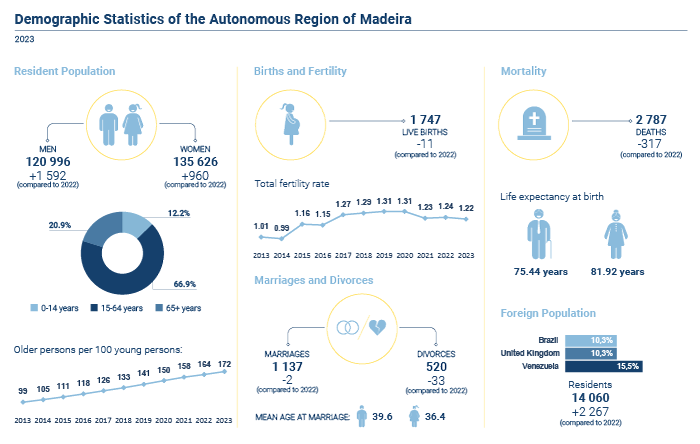
- In 2023, the resident population in the Autonomous Region of Madeira (ARM) was estimated at 256,622 persons (120,996 men and 135,626 women), representing an increase of 2,552 persons compared to 2022.
- The crude rate of increase was positive at 10.0‰ (compared to 5.4‰ in 2022), resulting from a positive crude migratory rate (14.1‰) offsetting the negative natural growth rate (-4.1‰).
- The proportion of the young population (under 15 years) continued to decrease, representing 12.2% of the total population (12.5% in 2022).
- The proportion of elderly (65 years or older) continued its upward trend in recent years, reaching 20.9% of the resident population (20.5% in 2022).
- Consequently, the ageing ratio continues to rise, reaching a peak of 172 elderly persons for every 100 young persons (164 in 2022).
Births and Fertility – Fewer live births in 2023
- In 2023, there were 1,747 live births to mothers residing in the ARM, 11 fewer than in 2022, corresponding to a crude birth rate of 6.8 live births per 1,000 inhabitants (6.9‰ in 2022).
- The total fertility rate decreased from 1.24 children per woman in their child-bearing years (15-49 years) in 2022 to 1.22 in 2023, remaining below the replacement level (2.1 children per woman).
- The average age of mothers at the birth of their first child remained at 30.5 years in 2023 while the average age of mothers at the birth of any child (regardless of birth order) increased slightly from 32.2 years to 32.3 years.
- Approximately 63% of live births were born outside of the marriage, 42.1% with cohabiting parents and 20.7% without parental cohabitation.
Mortality and Life Expectancy – Number of deaths in 2023 decreased compared to the previous year
- In 2023, there were 2,787 deaths among residents of the ARM, down by 317 (-10.2%) over 2022. The crude death rate reached 10.9‰, lower than in 2022 (12.3‰).
- The highest number of deaths occurred in the Winter months (on average, 259 monthly deaths) and lowered in the Summer months (on average, 226 monthly deaths).
- There was 1 death of an infant under 1 year, 2 fewer than in the previous year. The infant mortality rate was 0.6 deaths per thousand live births, a decrease from the rate in 2022 (1.7 deaths per thousand live births).
- Over the three-year period from 2021 to 2023, life expectancy at birth for the resident population in the Region was estimated at 79.07 years: 75.44 years for men and 81.92 years for women.
- The average life expectancy at age 65 for the entire resident population in the ARM was 18.37 years. Men at age 65 can expect to live an average of 16.00 more years, and women can expect 19.97 more years.
Marriages – Slight decrease in marriages in 2023 vis-a-vis the previous year
- In 2023, 1,137 marriages were celebrated, a decrease of 0.2% compared to the previous year (2 fewer weddings).
- The crude marriage rate stood at 4.5‰, unchanged from 2022.
- There were 61 same-sex marriages (29 in 2022), with 38 between men and 23 between women.
- The majority of marriages took place in September (163), while the fewest occurred in February (50).
- The average age at first marriage increased in 2023, reaching 35.4 years for men and 33.5 for women (34.9 and 33.4 years, respectively, in 2022).
- About 68.9% of the marriages were "first marriages", where both spouses were single.
- In 70.2% of the marriages in 2023, the spouses had previously shared a common residence.
- 76.4% of opposite-sex marriages were civil ceremonies, while 23.3% were Catholic.
Divorces – Number of divorces decreased in 2023
- In 2023, 520 divorces were decreed, 33 fewer than in 2022, resulting in a crude divorce rate of 2.0‰ (2.2‰ in 2022).
- Most divorces involved opposite-sex couples, with only 2 divorces recorded among male same-sex couples.
- The average age at divorce was 49.0 years for men and 46.6 for women (48.2 and 45.8 years in 2022, respectively).
- Of the divorces granted in 2023, 72.9% were the result of marriages lasting ten years or more, while 27.1% resulted from marriages with a duration of less than ten years.
Foreign Population – Foreign residents in the Region reach a 16-year high
- As of December 31, 2023, the foreign population residing in the Region totalled 14,060 persons, representing a 19.2% increase from 2022 (2,267 more persons).
- The foreign population was mostly composed of residents with residence permits (14,059), with only one holder of a long-term visa registered, specifically, a woman of Macedonian nationality.
- Nationals from Venezuela (15.5%), the United Kingdom (10.3%), Brazil (10.3%), Germany (10.0%) and Italy (5.2%) continue to represent the main foreign communities residing in the Region.
- The number of Brazilian nationals holding residence permits showed the greatest increase between 2022 and 2023, rising by 34.3% (from 1,080 in 2022 to 1,450 in 2023) and contributing 3.1 percentage points to the overall 19.2% increase.
- The municipalities where the foreign population has the highest proportion of total residents are Calheta (11.9%), Porto Santo (10.0%), Ponta do Sol (6.9%), and Funchal (6.9%).
For more information, please click on: