In 2024
Resident population of the Autonomous Region of Madeira once again approached 260 000, reaching the highest figure in the past eleven years
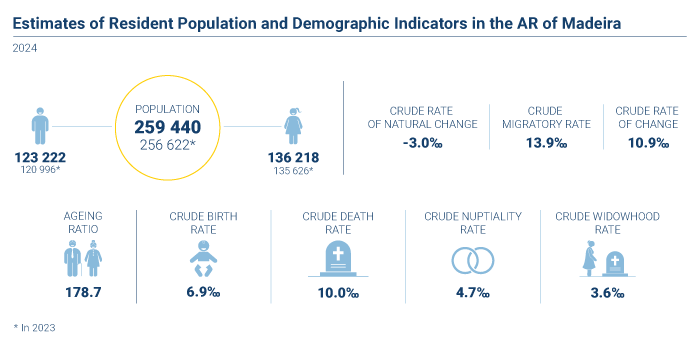
According to data provided by Statistics Portugal (INE), on December 31st, 2024, the resident population of the Autonomous Region of Madeira (ARM) was estimated at 259 440 persons (123 222 men and 136 218 women). The Region maintained, for the sixth consecutive year, the population growth trend, 2 818 more persons compared to 2023 (256 622 persons, 120 996 men and 135 626 women). It is worth noting that this total population is the highest recorded since 2014.
The net migration recorded in 2024 (+3 599), corresponding to the difference between persons who came from outside to live in the Region and those who left, ceasing to be residents, was decisive for the increase in the resident population this year, being the highest since records began by Statistics Portugal (INE) in 1981. This balance offset the unfavourable evolution of the natural balance (difference between live births and deaths), which, although negative, improved compared to 2023, going from -1 040 to -781.
The crude rate of increase (which combines the migratory effect with the natural effect) was positive at +10.9‰ (+10.0‰ in 2023). This rate was mainly driven by a positive migratory rate (13.9‰), which outweighed the negative crude rate of natural increase (-3.0‰).
The largest population increases in relative terms were observed in the municipalities of São Vicente (29.9‰), Porto Santo (27.5‰) and Porto Moniz (27.3‰). It is worth noting that all municipalities showed a positive effective growth rate.
The population density of the ARM in 2024 stood at 323,9 inhabitants per km2. Funchal had the highest value (1,418.6 pop/km2) and Porto Moniz had the lowest (31.3 pop/km2).
In the reference year, the proportion of young persons (15 years old and under) decreased to 11.9% of the total population (12.2% in 2023), while the proportion of the population aged 65 and over rose to 21.3% (20.9% in 2023). This resulted in an ageing ratio of 178.7 elderly persons per 100 young persons (171.5 in 2023). The highest values for this indicator were recorded in Porto Moniz (341.0) and Santana (308.0). The lowest values were observed in Santa Cruz (116.1) and Câmara de Lobos (117.4), with the number of elderly persons exceeding the number of young persons in all municipalities.
The median age of the resident population in the Region, which corresponds to the age that divides the population into two groups of equal size, increased from 46.9 years in 2023 to 47.2 years in 2024.
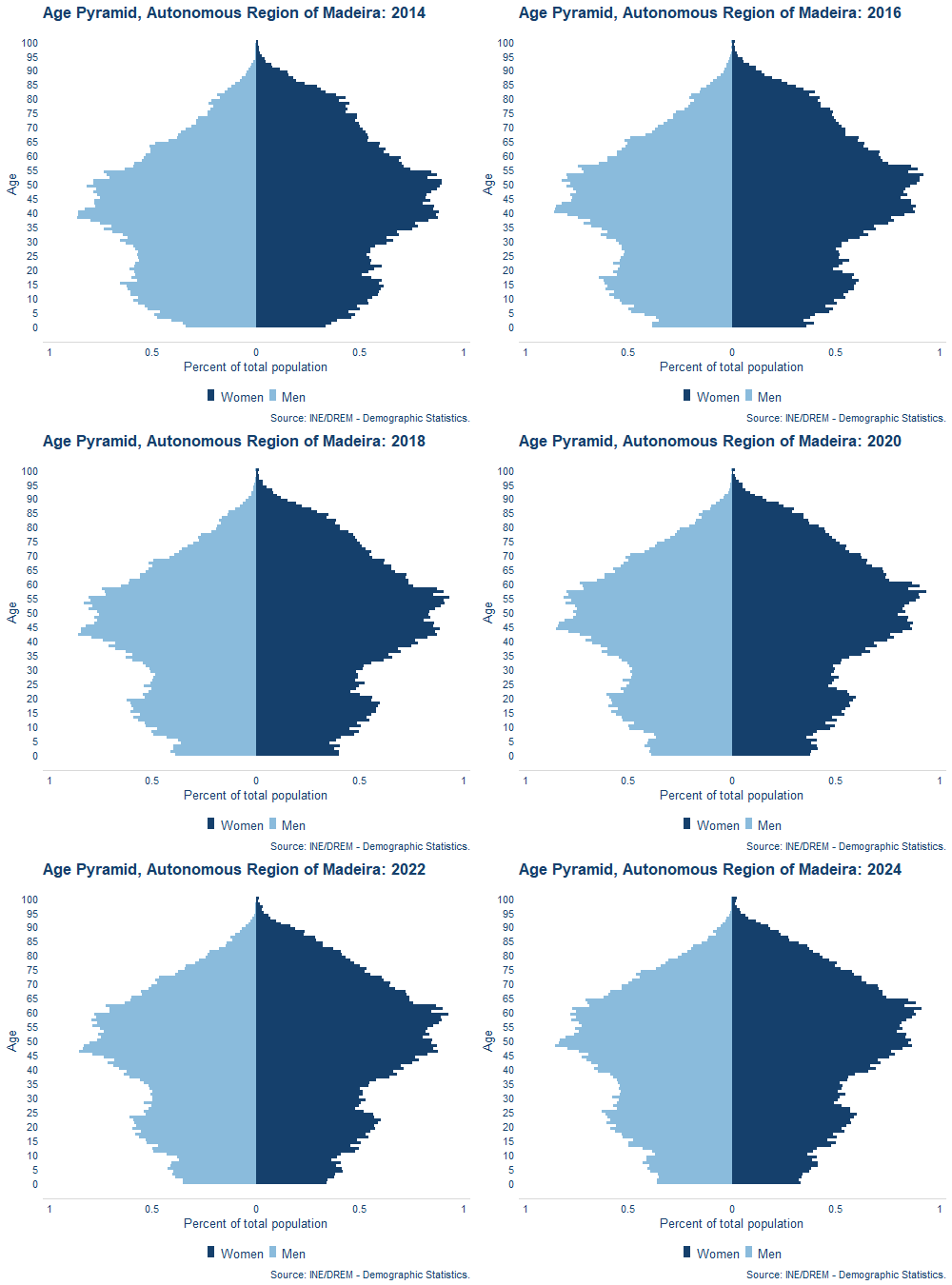
The demographic ageing trend is reflected in the changing profile of population pyramids in the Region from 2013 to 2023. The base of the pyramid has narrowed, reflecting a decline in population size due to lower birth rates, while the top has widened, indicating an increase in the number of elderly persons due to higher life expectancy.
The total fertility rate, expressed as the average number of children per woman of childbearing age (15-49 years old), increased to 1.25 children per woman (1.22 in 2023), significantly below the replacement level of 2.1 children per woman.
In 2024, there were 1 793 live births, children of mothers residing in the Region, 46 more children (+2.6%) than in 2023, corresponding to a gross birth rate of 6.9 live births per thousand inhabitants (6.8‰ in 2023).
In that year, there were 2 574 deaths of residents in the Region, 217 fewer deaths (-7.8%) than in 2023. The crude death rate reached 10.0 per thousand persons, slightly lower than that observed in 2023 (10.9‰) and, along with 2017, the lowest since 2014.
The number of marriages reached the highest value in the past 17 years (1 225 marriages), corresponding to a crude marriage rate of 4.7 marriages per thousand inhabitants in 2024 (4.5‰ in 2023).
The number of marriages dissolved due to the death of one of the spouses reached the lowest figure since records began (in 1981), with only 932 such dissolutions. As a result, the crude widowhood rate reached a historic low of 3.6 widowed persons per thousand inhabitants in 2024, down from 4.0 in 2023.
For more information, please click on: