In 2024
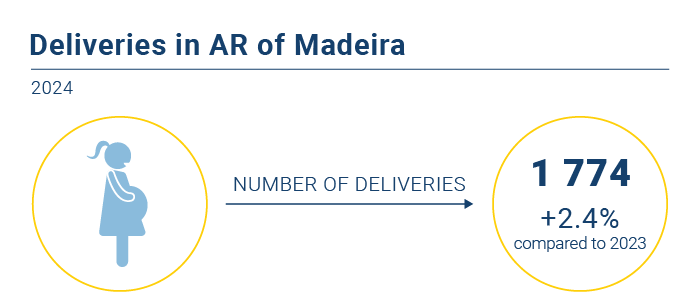
Number of births to mothers residing in the Autonomous Region of Madeira increased by 2.4%
In 2024, a total of 1 774 births were recorded among mothers residing in the Autonomous Region of Madeira (ARM), 25 of which were twin births, representing an increase of 41 births compared to 2023 (+2.4%). This trend contrasts with the national decrease of 1.3%, and among the nine NUTS 2 regions, Madeira recorded the highest relative growth, ahead of Oeste e Vale do Tejo (+1.2%), Grande Lisboa (+0.9%), and Peninsula de Setúbal (+0.1%). All other regions registered decreases, with the Autonomous Region of the Azores showing the most significant decline (-8.7%).
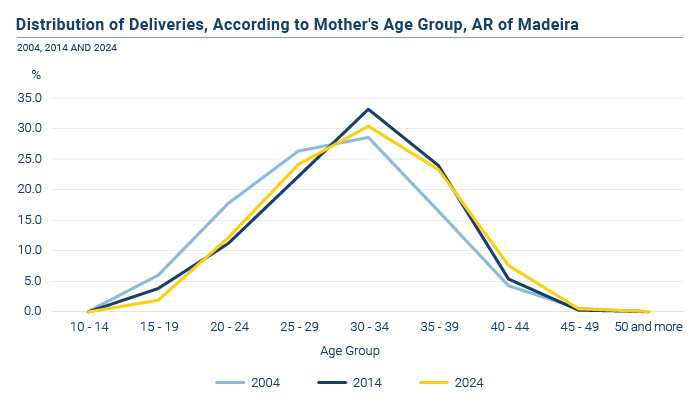
In the reference year, 77.8% of births were of mothers aged between 25 and 39 years (1 380 births), 14.0% were of mothers aged between 15 and 24 years (249 births), and 8.2% were of mothers aged 40 or older (145 births). The analysis of the available time series, which begins in 2003, clearly shows a trend over the past 21 years of a decrease in births among younger women and an increase among women aged 40 or older. Indeed, in 2004, 23.8% of births were to women aged 24 or younger, while 4.8% were to women aged 40 or older. In 2024, these proportions stood at 14.0% and 8.2%, respectively.
It is also worth noting that 95.3% of pregnancies with known duration lasted between 37 and 41 weeks, while 4.7% corresponded to gestations shorter than 37 weeks. Additionally, in four births, the pregnancy duration ranged between 22 and 27 weeks.
The municipalities with the highest proportion of births were Funchal (39.3%; 697 births), followed by Santa Cruz (17.9%; 318 births), Câmara de Lobos (16.9%; 299 births), and Machico (6.8%; 120 births).
Approximately 99% of births occurred in hospital settings (1 756 births). The remaining births took place at home (12 births) or in other locations (6 births).
The data provided are part of the "2024 Health Statistics of the Autonomous Region of Madeira" publication, the complete edition of which will be released in the first quarter of 2026.
For more information, please access: