In 2025
Number of inoculations administered in the Region increased by 2.5%
The Regional Directorate of Statistics of Madeira (DREM) releases today, on its website, data on the number of inoculations, by type of vaccine, administered in the Region in 2025. The data were provided by the Regional Directorate of Health (DRS).
The DRS adapted the standards of the Directorate-General for Health (DGS) to the Region, having replaced, in the Regional Immunisation Plan (PRV), the MenC vaccine (vaccine against invasive disease caused by Neisseria meningitidis group C) and the Pn13 vaccine (conjugate vaccine against infections caused by 13 serotypes of Streptococcus pneumoniae) with the MenACWY vaccine (vaccine against invasive disease caused by Neisseria meningitidis groups A, C, W and Y) and the Pn20 vaccine (conjugate vaccine against infections caused by 20 serotypes of Streptococcus pneumoniae), respectively.
Additionally, the HAV vaccine (vaccine against hepatitis A) and the Rotavirus vaccine began to be administered to risk groups, as was already the case with the BCG vaccine (vaccine against tuberculosis (Bacille Calmette-Guérin)).
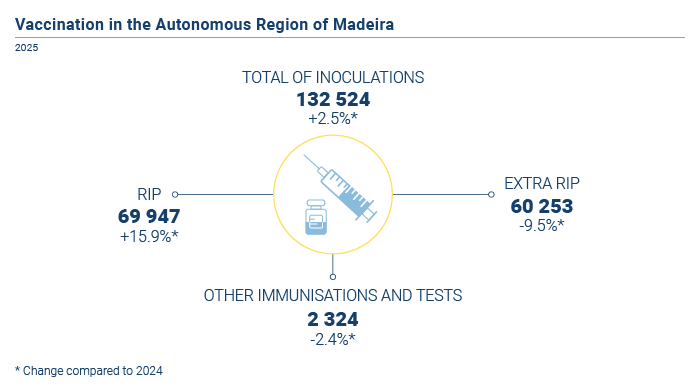
In 2025, a total of 132 524 inoculations were administered in the Region, 3 231 more than in 2024 (129 293), corresponding to an increase of 2.5%.
Under the Regional Immunisation Programme (RIP), 69 947 inoculations were administered, representing a 15,9% rise compared with 2024 (60 353). Noteworthy are:
- The Td vaccine (vaccine against tetanus and diphtheria), with 18 403 inoculations, up 2.1% from 2024 (18 017), accounting for 26.3% of RIP inoculations;
- The Pn20 vaccine, with 10,569 doses, corresponding to 15.1% of RIP inoculations;
- The HPV9 vaccine (vaccine against infections caused by 9 genotypes of Human Papillomavirus), with 6 393 doses, representing an increase of 7.7% compared with 2024 (5 935).
Extra-RIP inoculations totalled 60 253 doses, representing a decrease of 9.5% compared with the previous year (66 560). The Trivalent Influenza Vaccine (standard dose) accounted for 51.4% of Extra-RIP vaccines (30 972), while the Trivalent Influenza Vaccine (high dose) accounted for 23.5% (14 186). Also noteworthy is vaccination against COVID-19, which maintained its downward trend, recording a decrease of 14.4% compared with 2024 and accounting for 17.3% of total Extra-RIP vaccines.
As for other immunisations and tests, there was a 2.4% decrease, rising from 2,380 in 2024 to 2,324 in 2025. This increase was mainly driven by a reduction in the number of tuberculin skin tests performed, which fell from 69 in 2024 to 32 in 2025.
For more information, please access: