For the year 2022
DREM releases the Regional Environmental Statistics
In 2022, data collected by the Regional Directorate of Statistics of Madeira (DREM) indicates that in the Autonomous Region of Madeira (ARM), 53.7 million cubic meters of water were abstracted by the public water supply management entities (58.5 million cubic meters in 2021).
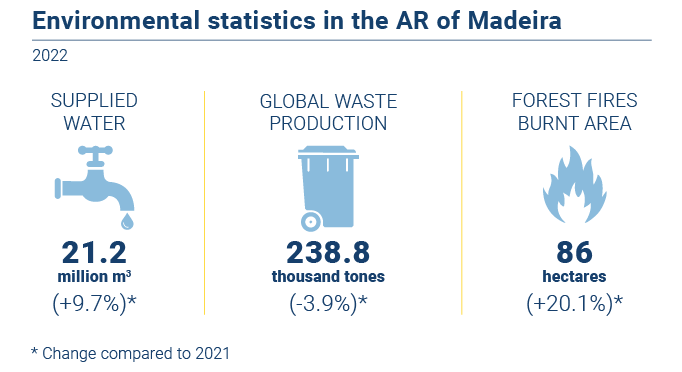
During 2022, the water distributed through the public network in the region amounted to around 21.2 million cubic meters, marking a 9.7% increase compared to 2021. Of the water distributed, 63.4% was allocated to domestic use, a percentage lower than that of 2021 (70.4%). Funchal accounted for the largest volume of water distribution, approximately 47.5% of the total for the region (10.1 million cubic meters), justified by its population density and economic activity concentration.
In 2022, 16 beaches in the ARM were awarded with the Blue Flag, the same number as in 2021. Regarding the quality of bathing waters, out of the 59 beaches analysed, 50 were classified as excellent, 4 as good, and 1 as bad, with 4 beaches remaining unclassified. In the municipalities of Calheta, Ponta do Sol, Porto Moniz, Santana, and São Vicente, all monitored bathing waters were classified as excellent.
The overall waste production in 2022 in the ARM decreased to 238.8 thousand tonnes, 9.8 thousand tonnes lower than the previous year. This 3.9% decrease is mainly attributed to the reduction in the deposition of aggregates on the island of Madeira, which decreased from 79.4 to 59.9 thousand tonnes between 2021 and 2022, indicating a 24.5% decline. A substantial part of the overall waste production is related to waste directed to the Meia Serra Waste Treatment Station. At that station, incineration, the dominant waste treatment process (91.7% of the total), increased by 5.8% compared to the previous year, with sanitary landfills also increasing by 16.3%. Regarding recyclable waste that is recycled, or waste sent out of the region for recycling purposes, it amounted to 35.9 thousand tonnes in 2022, a 14.5% increase from 2021. Additionally, in 2022, the number of recycling bins in the region totalled 1,756, a 2.5% increase from the previous year.
In 2022, the consolidated expenditure of the Regional Administration of the ARM in environmental management and protection amounted to 10.9 million euros. Of this total, 74.2% was allocated to the "Biodiversity and Landscapes" domain (compared to 79.5% in 2021).
In the same year, the 10 existing fire brigades in the region had 723 personnel, providing approximately 51.3 thousand services (a 10.4% increase compared to 2021), with the majority (66.6%) related to health/pre-hospital care. In 2022, the expenditure of the fire brigades amounted to 13.7 million euros, a 3.5% increase from 2021, with 83.8% of that total attributed to personnel expenses (compared to 82.1% in 2021).
The firefighter in the Autonomous Region of Madeira is characterized by being mostly male (86.7%), aged between 26 and 50 years old (64.2%), with secondary education (52.7%) and operating in a professional regime (56.0%).
Regarding meteorology in 2022, precipitation levels were lower than the previous year, both in Funchal (551.2 mm in 2022 compared to 861.8 mm in 2021) and Porto Santo (464.5 mm in 2022 compared to 519.9 mm in 2021). As for temperatures, in Funchal, the average maximum temperature in 2022 was 23.5°C, the same value as in 2021, while the average minimum temperature was 17.8°C (compared to 17.6°C in 2021). Detailed information on this topic can be obtained on the DREM website under the Statistical Territory area.
For the reference year, data on air quality show that the proportion of measurements for the Funchal agglomeration recording a "Very Good" or "Good" result rose to 48.2% (compared to 38.1% in 2021). Meanwhile, measurements classified as "Average" quality decreased to 44.1% (compared to 60.0% in 2021). 7.7% of measurements presented a negative qualitative assessment of "Weak" or "Bad" (compared to 1.9% in 2021).
It is noteworthy that in 2022, there were 49 forest fires (+5 compared to the previous year), consuming an area of 86 hectares (72 hectares in 2021), of which 55 hectares were forestry areas (64.0% of the total). It is important to highlight that the burnt area in 2022 was the second lowest since the beginning of the series available at DREM (since 2006), second only to 2021. The fires this year occurred in 9 of the 11 municipalities in the region, with the municipalities of Ribeira Brava (15 fires), Calheta (9), and Machico (7) experiencing the most incidents of this nature. Funchal and Porto Santo did not register any occurrences. In terms of burnt area, Calheta was the most affected municipality in RAM, with 37 hectares affected (43.2% of the total).
DREM also provides the "Time Series on Environmental Statistics" for the period 1989-2022
This time series contains data on water supply, water treatment and drainage, solid waste, expenditures of the regional and local scope entities in environmental management and protection by economic aggregate and domains. It also includes meteorological data and information on forestry fires, firemen, blue flag beaches, bathing water quality, drinking water quality, air quality, elements of nature and environment protection service, forest fire protection actions, and nature and environment protection activities.