For the year 2024
DREM releases Regional Environmental Statistics
The Regional Directorate of Statistics of Madeira (DREM) releases today the update of the Environmental Statistics for the year 2024.
More water abstracted and distributed
Data collected by the Regional Directorate of Statistics of Madeira (DREM) for 2024 indicate that 55.9 million cubic metres of water were abstracted in the Autonomous Region of Madeira (ARM) by public water supply service providers (55.3 million m3 in 2023).
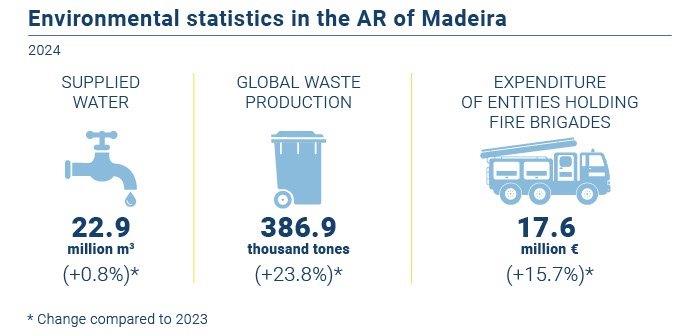
In 2024, the volume of water distributed through the public network in the Region amounted to around 22.9 million m3, an increase of 0.8% compared with 2023. Of the total water distributed, 63.8% was intended for the domestic sector, a slightly higher proportion than in 2023 (62.6%). At the municipal level, Funchal accounted for the largest volume of water distributed, around 47.1% of the regional total (10.8 million m3), reflecting the population share and the concentration of economic activity in this municipality.
The percentage of safe water in the reference year stood at 98.7% (99.0% in 2023).
Autonomous Region of Madeira increased the number of Blue Flag beaches
In 2024, Blue Flag status was awarded to 17 beaches in the Autonomous Region of Madeira, one more than in 2023.
Regarding bathing water quality, of the 61 waters analysed, 51 were classified as excellent, 5 as good, 2 as acceptable and 2 as poor, with one beach remaining unclassified. In the municipalities of Calheta, Ponta do Sol, Porto Moniz, Santana and São Vicente, all monitored bathing waters were classified as excellent.
Increase in inert waste led to growth in total waste production
According to an estimate prepared by the Regional Directorate for the Environment and the Sea (DRAM), the total waste production in the Autonomous Region of Madeira amounted to around 386.9 thousand tonnes in 2024, representing an increase of 74.3 thousand tonnes (+23.8%) compared with the previous year. This rise was mainly explained by the increase in the deposition of inert waste (+37.7% compared with 2023), which is primarily associated with construction and demolition activities. Excluding this component, total waste production would amount to 202.9 thousand tonnes, 13.4% above the 2023 level.
A considerable share of total waste production is associated with waste sent to the Meia Serra Solid Waste Treatment Station (ETRS), which totalled around 144.8 thousand tonnes in 2024, an increase of 3.8% compared with the previous year. This rise was driven by a 5.2% increase in energy recovery (waste incineration), which offset the 14.8% reduction observed in landfill disposal.
Waste sent for recycling or recovery outside the Autonomous Region of Madeira amounted to 37.3 thousand tonnes, an increase of 4.1% compared with 2023. Significant increases were recorded for tyres (+73.6%), used oils (+56.6%), end-of-life vehicle waste after dismantling (+24.6%) and cardboard (+10.3%). Conversely, reductions were observed in paper (-21.5%) and scrap/metal waste (-8.7%).
Taking into account composting carried out at the Meia Serra Station, waste recovery within the Autonomous Region of Madeira totalled 27.6 thousand tonnes in 2024, representing an increase of 168.5% compared with 2023. Construction and demolition waste accounted for 69.8% of this total.
It should also be noted that, in 2024, the number of recycling points (ecopoints) in the Region totalled 1 612.
Expenditure of fire brigades increased by 15.7% compared with 2023
In the reference year, the 10 fire brigades operating in the Region comprised 755 personnel, who provided around 49.1 thousand services, the vast majority (74.0%) related to health and pre-hospital care. Expenditure by fire brigades amounted to approximately 17.6 million euros, an increase of 15.7% compared with 2023, with 86.5% of total expenditure corresponding to staff costs (85.5% in 2023).
In the Autonomous Region of Madeira in 2024, fire brigade personnel were predominantly male (86.1%), with 61.7% aged between 26 and 50 years. Regarding educational attainment, most personnel held upper secondary education (61.7%), and 60.1% were employed under a professional regime.
2024 was cooler and wetter
In meteorological terms, in 2024, total precipitation was slightly higher than in the previous year, both in Funchal (550.8 mm in 2024; 527.9 mm in 2023) and in Porto Santo (349.8 mm in 2024; 334.5 mm in 2023). With regard to temperatures, in Funchal the average maximum temperature in 2024 was 24.4°C, 0.2°C lower than in 2023, while the average minimum temperature was 18.6°C, the same as in the previous year. More detailed information on this topic is available on the DREM website, under the statistical area Territory.
Air quality improved
Data on air quality in 2024 indicate that, in the Funchal agglomeration, the proportion of observations classified as “Very Good” or “Good” increased to 59.5%, compared with 58.9% in 2023. At the same time, the share of observations with “Moderate” air quality decreased to 36.4% (37.0% in 2023).
Negative qualitative assessments, corresponding to the “Poor” or “Bad” categories, accounted for 4.1% of observations, a value identical to that recorded in the previous year.
Fewer wildfires, but larger burnt area
In 2024, 38 forest fires were recorded in the Region (one fewer than in the previous year), affecting a total area of 5 190 hectares (5 154 hectares in 2023). Of this area, 3 495 hectares corresponded to scrubland (67.3% of the total). Fires occurred in 9 of the 11 municipalities of the Region, with Ribeira Brava (19 fires), Machico (4) and Ponta do Sol (4) recording the highest number of incidents. No forest fires were recorded in Funchal or Santana.
In terms of burnt area, Ribeira Brava was the most affected municipality in the Autonomous Region of Madeira, with 2 509 hectares affected, corresponding to 48.3% of the total burnt area.
DREM also releases the “Time Series of Environmental Statistics” for the period 1989–2024
DREM also makes available today, on its website, the updated Time Series of Environmental Statistics for the period 1989–2024, incorporating data for 2024.
This series includes information on water supply, wastewater treatment, solid waste, expenditure by the regional administration and local entities on environmental management and protection by economic aggregates and domains. It also provides meteorological data and information on forest fires, fire brigades, Blue Flag beaches, bathing water quality, drinking water quality, air quality, nature and environmental protection services, forest fire prevention actions, and nature and environmental protection activities.
For more information, please click on: