In 2018
Number of volunteer workers in the Autonomous Region of Madeira topped 14,000
The Regional Directorate of Statistics of Madeira (DREM) releases for the first time data from Survey on Volunteer Work 2018 (SVW 2018) carried out throughout the country during the 3rd quarter of 2018. The SVW 2018 was a module of the Labour Force Survey, a quarterly statistical operation of Statistics Portugal (INE), which is coordinated in the Autonomous Region of Madeira by DREM.
It should be mentioned that the results of the 2012 and 2018 surveys are not fully comparable, mainly due to changes in the international reference methodological framework.
According to the results of SVW 2018, recently released by INE, in that year, the volunteer rate (percentage of the resident population aged 15 and over who participated in at least one formal and/or informal volunteer work activity) in the Autonomous Region of Madeira (ARM) was 6.4%, corresponding to 14,038 volunteers. Of this total, 78.2% concerned formal volunteering (10,972 volunteers), i.e. 5.0% of the population living in the ARM aged 15 and over. It should be noted that formal volunteer work (concept not affected by the methodological changes mentioned above) almost doubled when compared to 2012 (5,901 volunteers), with a consequent effect on the volunteer rate, which in that same year was only 2.9%.
In 2018, the women’s volunteer rate (6.7%) exceeded the male rate (6.1%) by 0.6 percentage points.
The volunteer rate is higher among younger people, decreasing progressively as we move into the older age groups. Thus, people aged 15-24 had the highest volunteer rate (8.2%), followed by the 25-44 age group (7.7%) and the 45-64 age group (6.0%). The lowest value is found in the group of 65 and over (3.8%).
Volunteering is more common in the population with a higher level of education, since the highest rate was observed in those with tertiary education (15.3%), followed by those with upper secondary and post-secondary education (7.4%). The lowest value is registered among those with a lower degree, i.e. lower secondary or less (3.9%).
Considering the labour force status, the data show that the volunteer rate was higher among the unemployed (9.9%), when compared to the employed (6.9%) and inactive (5.1%).
Of the 10,972 formal volunteers, 38.4% were concentrated in “Social Services”, followed by “Culture, Communication and Recreational activities organisations”, “Human health services” and “Religious congregations and associations”, with shares ranging from 10% to 15%.
The sociodemographic profile of the volunteers living in the ARM is similar to that of the country. In general, they are people who are more involved in the activities of formal volunteer work, mostly women, young people, unemployed and with a higher education level.
At NUTS II level, it should be noted that the volunteer rate found for the ARM (6.4%) was below the national average (7.8%) and all regions of the mainland (Norte 7.2%; Centro 8.9%; Área Metropolitana de Lisboa 8.3%; Alentejo 7.7% and Algarve 6.9%). The Autonomous Region of the Azores (5.5%) had the lowest rate.
Finally it should be noted that Portugal (6.4%) and the ARM (5.0%) are quite distant from the EU-28 average (19.8%), as regards the formal volunteer rate, the only rate that, for methodological reasons, can be compared between the member states of the European Union.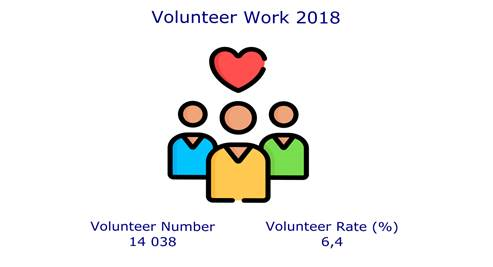
For more information, lease click on: