In the second quarter of 2023
Unemployment rate in the Autonomous Region of Madeira stood at 6.4%
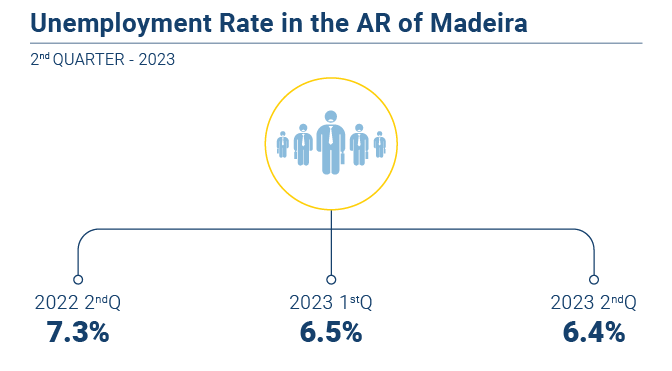
The results of the Labour Force Survey for the second quarter of 2023 indicate an estimated unemployment rate of 6.4% in the Autonomous Region of Madeira (ARM), which is a decrease of 0.1 percentage points (pp) compared to the previous quarter and a decrease of 0.9 pp compared to the same quarter last year.
The estimated unemployed population, totalling 8,700 persons, decreased by 8.7% compared to the same quarter last year (approximately 900 persons) and increased by 0.5% compared to the previous quarter (around 45 persons).
The employed population reached a new high of approximately 127,400 persons, marking a 4.0% increase year-on-year (4,900 persons) and a 2.1% increase compared to the preceding quarter (2,700 persons). Among the employed population, 17,200 persons worked from home (16.6% of employed women and 10.5% of employed men).
The labour force participation rate for persons aged 16 to 89 in the second quarter of 2023 was estimated at 61.9%, which is a 1.2 pp increase compared to the same quarter last year, and the same increase when compared to the previous quarter. The labour force participation rate for women was 57.0%, lower than that of men (67.6%) by 10.6 pp.
The inactive population, estimated at 118,600 persons, decreased by 1.9% compared to the same quarter last year and by 2.1% compared to the previous quarter.
In Portugal, the unemployment rate for the analysed quarter decreased to 6.1%, which is 1.1 pp lower than the previous quarter and 0.4 pp higher than the same quarter last year.
During the referenced quarter, Área Metropolitana de Lisboa (7.0%) and the Autonomous Region of the Azores (6.7%) had the highest unemployment rates, while the lowest rates were observed in Centro (4.9%), Algarve (5.0%), and Alentejo (5.3%). Norte and the ARM occupied an intermediate position with unemployment rates of 6.4% in both regions.
The unemployment rate decreased on a quarterly basis in all regions of the country except for the Autonomous Region of the Azores, where it increased by 0.5 pp.
In year-on-year terms, the unemployment rate decreased in the Autonomous Region of Madeira (-0.9 pp) and in Centro and Algarve regions (both with -0.3 pp). In the remaining NUTS2 regions, the trend was the opposite, with Norte and Alentejo experiencing the largest increase (+0.9 pp), followed by the Autonomous Region of the Azores (+0.8 pp) and Área Metropolitana de Lisboa (+0.2 pp).
For more information, please click on: