In the year 2020
Pandemic has pushed back electricity production and consumption to the lowest level in 16 years
According to information published by the Directorate General for Energy and Geology (DGEG) last November 30th, the Regional Directorate of Statistics of Madeira (DREM) provides information on the gross production, consumption and number of consumers of electricity in the Autonomous Region of Madeira (RAM) with reference to 2020.
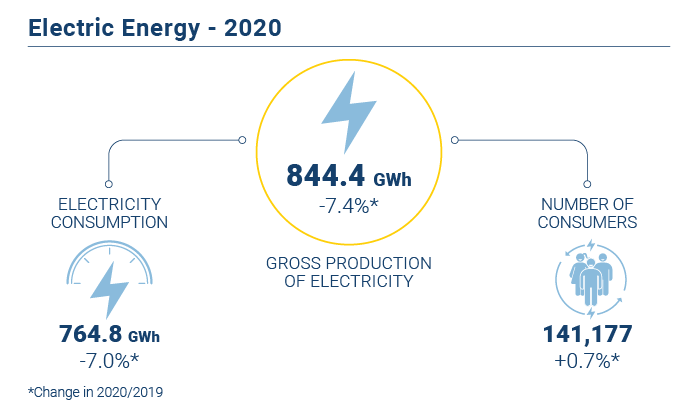
The gross production of electricity in the Autonomous Region of Madeira, in 2020, stood at 844.4 GWh, representing a decrease of 7.4%, compared to 2019. In fact, it was the lowest value of this indicator in the last 16 years. In 2020, 78.6% of energy production was of thermal origin, 10.1% of wind origin, 7.7% of hydro origin and 3.5% of photovoltaic origin.
Final electricity consumption stood at 764.8 GWh, which represented a decrease of 7.0% compared to 2019. Domestic consumption (which represented 35.4% of total consumption) increased by 6.0% between 2019 and 2020, an inverse trend to that seen in non-household consumption, namely in consumption by the various economic activities. Thus, "accommodation, food services activities and similar" (-29.6%) was the sector with the largest drop in energy consumption, followed by "Arts, entertainment, sports and recreation activities" and "Transport, storage and supporting activities for transportation; Postal and courier activities", both with -18.5%. On the contrary, "Electricity, gas, steam, hot and cold water and cold air " and "Human health and social work activities" registered increases of 10.4% and 2.7%, respectively.
By municipality, only Funchal (-10.6%) and Porto Santo (-7.1%) registered falls above regional average. Ribeira Brava was the only municipality in which there was no decrease in energy consumption (+0.8%).
Regarding the number of electricity consumers, there was an increase of 1,016 (+0.7%) compared to 2019, setting its total at 141,177. By municipality, Ponta do Sol (+1.2%), Calheta and Ribeira Brava (+1.1%, both) led the increases, which was shared by all municipalities.