DREM releases Regional Accounts data for 2019 and 2020
Statistics Portugal (INE) released today the results for the Regional Accounts for the years of 2019 and 2020, final in the first case and provisory in the second.
Final data for 2019 show that Madeira’s economy grew by 1.8% compared to the previous year
The final information for 2019 reveals that the Regional Gross Domestic Product (GDP) reached 5.126,4 million euros, rising by 1.8% in real terms (excluding the price effect), compared to the previous year. Despite the upwards revision concerning GDP provisional information made last year, the growth rate for the Region remained below the country’s average (+2.7%).
The growth in 2019 was hampered by the low performance of "Wholesale and retail trade, transport, accommodation and food service activities”, the main industry of the regional economy, in which the Gross Value Added (GVA) stagnated in real terms.
It should be noted that the Gross Fixed Capital Formation (GFCF, the most important parcel of investment) stood at 838.4 million euros in 2019, rising by 11.8%, above the country’s change rate (+8.0%). GFCF in 2019 was the highest since 2012.
As for the Gross Disposable Income (GDI) of households in the Autonomous Region of Madeira, it grew by 2.9% in 2019, standing at 13,362 euros per capita, representing a disparity index from the national average of 95.8, i.e., it stands by 4.2% below that average. The GDI of households recorded a 4.5% increase in the country.
Pandemic caused a 14.3% decline in GDP in real terms in 2020
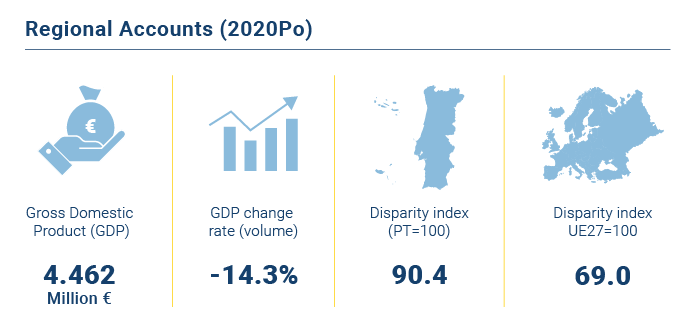
Statistics Portugal, in its first estimate for 2020, points to a GDP growth rate in the Region of -14.3% in real terms, below the country, in which this indicator reached -8.4%. Naturally, the specialisation of the regional economy in activities related to and dependent on tourism explains the worst performance of the Autonomous Region of Madeira, which was also, as in 2019, affected by the performance of the IBCM companies, whose GDP decreased quite sharply.
By branch of activity, in 2020, the GVA of "Wholesale and retail trade, transport, accommodation and food service activities" stood out with the largest decline in real terms (-32.4%), followed by "Professional, scientific, technical and similar activities; administrative and support service activities" (-26.3%), these strongly affected by the IBC component. With decreases greater than 10%, came "Arts, entertainment and recreation; repair of household goods and other services" (-14.8%) and "Mining and quarrying; manufacturing; electricity, gas, steam and air conditioning supply; water supply" (-10.6%).
Contrary to the general trend, "Financial and insurance activities" (+1.8%) and "Construction" (+1.7%) stood out. Also of note was "Public administration and defence; compulsory social security; education, human health and social work activities", whose GVA, which has a strong contribution from the general government institutional sector, grew by 0.2% in real terms, contributing decisively to cushion the fall of the private sector economy, heavily affected by the COVID-19 pandemic.
GDP per capita in 2020 amounted to 17,560 euros in the Region, while in the country this ratio stood at 19,431 euros. It should be noted, however, that the only two regions above the Autonomous Region of Madeira are also above the national average (A.M Lisboa and Algarve).
The GDP per capita disparity indexes relative to the national average (PT = 100) and the European Union average (EU28 = 100) were 90.4 and 69.0, respectively.
Apparent labour productivity, which corresponds to the ratio between GVA and Employment, was 34,609 euros, below the national value (35,858 euros).
Finally, it should be noted that Statistics Portugal is expected to present the final data for 2020 one year from now, and due to the small size of the Autonomous Region of Madeira’s economy, revisions may be of significance.
For more information, please click on: