DREM releases Regional Accounts data for 2020 and 2021
Statistics Portugal (INE) released today the results for the Regional Accounts for the years 2020 and 2021, of a final and provisional nature, respectively.
Regional Gross Domestic Product largely recovered in 2021, but without reaching the record of 2019
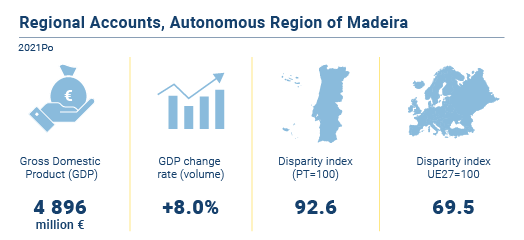
Statistics Portugal, in its first estimate for the year 2021, points to a GDP growth rate in the Autonomous Region of Madeira of +8.0% in real terms (excluding the effect of price change), which is the highest among the NUTS II regions of the country and is substantially above the national average (+5.5%). The Region's performance is due to the strong recovery in business services, tourism and related activities.
Breaking down by industry, in 2021, the real growth of Gross Value Added (GVA) of "Consultancy, scientific and technical activities; administrative and support service activities" (+19.9%) stood out, followed by " Wholesale and retail trade, transport, accommodation and food service activities" (+14.8%). “Construction” was also noteworthy, with a 7.2% increase in GVA. The analysis of the remaining seven industries shows that all grew in real terms, except for "Arts, entertainment and recreation”, and “Repair of household goods and other services", which fell by 1.7%. It should be noted that the branch of "Public administration and defence; compulsory social security; education, human health and social work activities", whose GVA has a strong contribution from the general government institutional sector, rose by 4.4% in real terms.
GDP per capita in 2021 was 19,300 euros in the Region, below the national average of 20,847 euros. Área Metropolitana de Lisboa (26,665 euros) and Algarve (21,173 euros) were above the national average, followed by Alentejo (19,575 euros) and the Autonomous Region of Madeira. Norte (18 166 euros) has the lowest GDP per capita, behind the Autonomous Region of Azores Azores (18 263 euros) and Centro (18 372 euros).
For the Region, the disparity indexes of the GDP per capita vis-à-vis the national average (PT=100) and the European Union average (EU27=100) were 92.6 and 69.5, respectively.
Apparent labour productivity, which corresponds to the ratio between GVA and Employment, stood at 34 107 euros, slightly below the national value (37 455 euros).
It should be noted that Statistics Portugal is expected to present the final data for 2021 within a year, and due to the small size of the Autonomous Region of Madeira´s economy, there can be relevant revisions.
Final data for 2020 show that the Autonomous Region of Madeira´s economy dropped by 15.4% compared to the previous year, in real terms
The final data for 2020 reveal that the regional Gross Domestic Product (GDP) did not exceed 4,449.6 million euros in that year, reflecting a drop of 15.4% in real terms compared to the previous year. Thus, the performance of the economy of the Autonomous Region of Madeira was revised downwards (the reduction in GDP in the preliminary version was 14.3%) and the change was substantially lower than the average for the country (-8.3%). The specialisation of the ARM economy in activities related to Tourism, strongly affected by the pandemic contributed to this result, as well as to the performance of the most affected region, Algarve (-18.3%). On the opposite side, Centro (-5.7%) was the region with the smallest real reduction in GDP.
The real growth in 2020 was conditioned by the significant falls in the Gross Value Added (GVA) in the "Professional, scientific, technical and similar activities; administrative and support service activities" (-35.6%) and "Wholesale and retail trade, transport, accommodation and food service activities" (-34.1%), which represent the main branch of activity of the regional economy. The breakdown of the 10 branches shows that only "Information and Communication" (+36.3%), "Construction" (+0.2%) and "Agriculture, Forestry and Fishing" (+0.1%) escaped the general downward trend.
In 2020, the disparity indexes related to the national average and to the European Union (EU27) average were 89.9 and 68.6, respectively.
It should be noted that the Gross Fixed Capital Formation (GFCF, the most important component of investment) in the Autonomous Region of Madeira, in 2020, stood at 795.0 million euros, which represented a decline from the previous year, of 5.2%, more pronounced than the one recorded in the country (-0.8%).
In turn, the gross disposable income (GDI) of households in the Autonomous Region of Madeira decreased by 3.5% in 2020, settling in per capita terms at 12,893 euros, representing a disparity index from the national average of 93.8, i.e., it stands 6.2% below the average. It should be noted that the GDI of households also fell at a national level, although to a lower extent (-1.3%).
For more information, please click on: