At the end of the 1st quarter of 2023
Gross debt of the Regional Public Administration amounted to 5,073.0 million euros
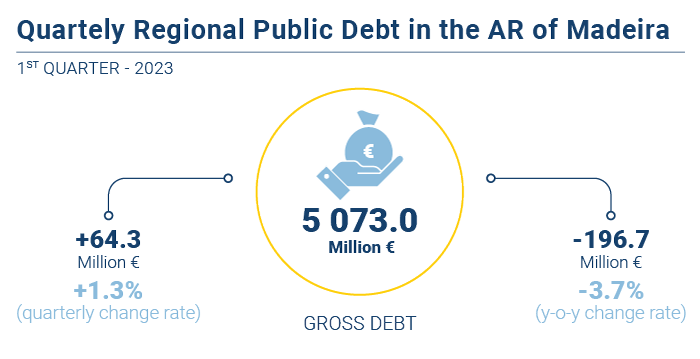
At the end of the 1st quarter of 2023, the gross debt of the Regional Public Administration stood at 5,073.0 million euros. This represents an increase of approximately 64.3 million euros (+1.3%) compared to the end of the previous quarter and a decrease of 196.7 million euros (-3.7%) compared to the same period last year.
The year-on-year change is attributed to the fact that the debt refinancing operation in 2023 occurred only in the 2nd quarter of this year, whereas in 2022 it took place in the 1st quarter.
Analysing the composition of the gross debt by financial instrument, it can be observed that loans accounted for 45.1% and debt securities for 54.9% in the 1st quarter of 2023, which is the same as the percentages recorded in the same quarter of the previous year.
Examining the breakdown of the debt by issuing sector, it is evident that the Regional Government is responsible for 94.4% (compared to 91.8% in the same quarter last year) of the total debt, while Public Companies classified within the scope of the Regional Public Administration account for 5.6% (compared to 8.2% in the 1st quarter of 2022).
Net debt excluding deposits amounted to around 4,884.8 million euros
At the end of the 1st quarter of 2023, net debt excluding deposits reached approximately 4,884.8 million euros. This reflects a rise of about 67.2 million euros (+1.4%) compared to the end of the previous quarter and an increase of 208.3 million euros (+4.5%) compared to the same period last year.
Notes:
Public debt (Maastricht definition/perspective):
Public debt in the Maastricht definition/perspective corresponds to the relevant definition of debt of the Public Administrations in the context of European budgetary supervision. It is a concept of gross consolidated debt valued in nominal terms. This concept differs from the total stock of liabilities defined in the SEC, both in terms of the accounted instruments and the valuation criteria. It is a less comprehensive concept that does not include, among other financial instruments, shares and other equity interests, financial derivatives, or other debts/credits, particularly commercial debts. This concept of debt adopts the nominal value as the valuation rule, meaning the amount that the public administration (issuer/debtor) should repay at the end of the contract. The limit established in the protocol attached to the Treaty on the Functioning of the European Union is 60% of GDP.
Net debt excluding deposits:
Net debt excluding deposits corresponds to gross debt (Maastricht debt) subtracted from deposits with resident banks.
For more information, please click on: