At the end of the 4th quarter of 2023
Gross debt of the Regional Public Administration stood at 5,002.3 million euros
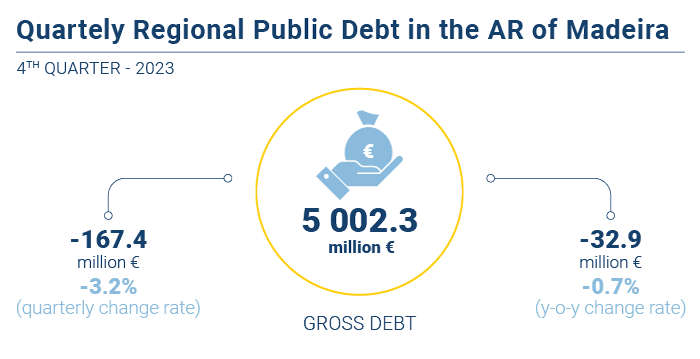
At the end of the 4th quarter of 2023, the gross debt of the Regional Public Administration stood at 5,002.3 million euros. This represented a decrease of approximately 167.4 million euros (-3.2%) compared to the end of the previous quarter and a decline of 32.9 million euros (-0.7%) vis-a-vis the same period last year. The decline over the prior quarter is explained by the mismatch between the dates of the debt refinancing and the amortisation that occurred during the year 2023.
Analysing the evolution of the composition of gross debt by financial instrument, it can be observed that in the 4th quarter of 2023 compared to the same quarter last year, the proportion of loans decreased from 44.4% to 40.3%, while the opposite occurred with the percentage of securities, which increased from 55.6% to 59.7% during the same period.
The breakdown of the debt by issuing sector shows that the Regional Government is responsible for 96.6% (91.9% in the same quarter last year) of the total debt, with Public Enterprises classified within the scope of the Regional Public Administration accounting for 3.4% (8.1% in the 4th quarter of 2022).
Net debt excluding deposits amounted to around 4,805.4 million euros
At the end of the 4th quarter of 2023, net debt excluding deposits reached approximately 4,805.4 million euros showing a decrease of about 11.9 million euros (-0.2%) compared to the end of the previous quarter and a drop of 38.8 million euros (-0.8%) vis-a-vis the same period last year.
Notes:
Public Debt (Maastricht definition/optics)
Public debt in the Maastricht definition/perspective corresponds to the relevant definition of debt of Public Administrations in the context of European budgetary supervision. It is a concept of gross consolidated debt valued in nominal terms. This concept differs from the total stock of liabilities defined in the SEC, both in terms of the accounted instruments and in terms of valuation criteria. It is a less comprehensive concept that does not include, among other financial instruments, shares and other equity, financial derivatives, or other debts/credits, especially commercial debts. This debt concept adopts nominal value as the valuation rule, that is, the value that the public administration (issuer/debtor) should amortize at the end of the contract. The limit established in the protocol annexed to the Treaty on the Functioning of the European Union is 60% of GDP.
Net Debt excluding Deposits
Net debt excluding deposits corresponds to Gross Debt (Maastricht debt) subtracted by deposits in resident banks.
Fore more informations, please click on: