DREM releases the 2019 edition of the study on the municipal purchasing power conducted by Statistics Portugal
Statistics Portugal released today the 2019 edition of the study on the municipal purchasing power.
This study presents an analysis of the Portuguese municipalities regarding their purchasing power in a broad sense of material well-being, based on a set of variables and the use of a principal components factor analysis model, providing synthesis indicators that give information of the purchasing power. The set of variables includes data on operations of the Multibanco network, housing credit granted, taxes, population, monthly earnings of employees, companies, sales of new cars and buildings, etc…
The EPCC includes three indicators: the per capita Indicator (IpC) of Purchasing Power, the Proportion of Purchasing Power (PPC) and the Relative Dynamism Factor (FDR).
The IpC refers to the purchasing power manifested daily, in per capita terms, in the various municipalities or regions, with the national value as a reference. Note that this indicator does not mean the IpC of the residents in the municipality, but that which was manifested in the municipality.
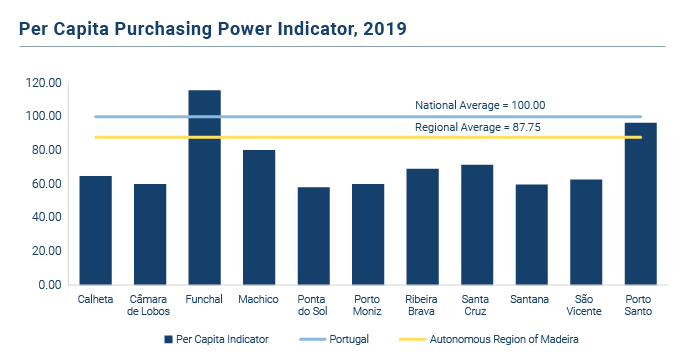
In this indicator, the Autonomous Region of Madeira scores 87.75, standing together with the Autonomous Region of the Azores at the bottom of the list of the 7 NUTS2 regions. The only municipality in the Autonomous Region of Madeira with an IpC higher than the national average is Funchal (115.71), emerging as the 13th municipality in the country with the highest value for this indicator, maintaining the position of the ranking of the last study. Besides Funchal, only Porto Santo (96.35) has a value above the regional average (87.75). Ponta do Sol is the municipality with the lowest CPI (58.00), followed by Santana (59.58), Porto Moniz (59.83) and Câmara de Lobos (59.93). These four municipalities of the Autonomous Region of Madeira make up the group of 12 municipalities in which the CPI is lower than 60.
Regarding the Proportion of Purchasing Power (PPC), the Autonomous Region of Madeira concentrated 2.167% of the national purchasing power, while Funchal belonged to a short list of 23 municipalities that individually concentrated more than 1% of the national purchasing power. This municipality accounted for 53.9% of the purchasing power of the Autonomous Region of Madeira, followed by Santa Cruz (14.5%) and Câmara de Lobos (9.0%).
This study also allows tracing the importance of the tourism activity for the municipalities using the Dynamism Relative Factor (FDR). Except for Machico and Câmara de Lobos, all municipalities of the Region have a coefficient higher than the national average (-0.088). Porto Moniz (1.261), Calheta (0.716) and Porto Santo and Vicente (both with 0.535) are the municipalities with the highest FDR. The Autonomous Region of Madeira had the second highest value among the seven NUTS2 regions (0.091), behind the Algarve (3.149).
For more information, please click on: