In 2024
Crime rate in the Autonomous Region of Madeira declined compared with the preceding year
In this release, the Regional Directorate of Statistics of Madeira (DREM) presents a time series on justice for the Autonomous Region of Madeira (ARM), updated with the 2024 data provided by the Directorate-General for Justice Policy (DGPJ), which acts under delegation from Statistics Portugal (INE) in this domain.
Courts - Number of pending cases fell again
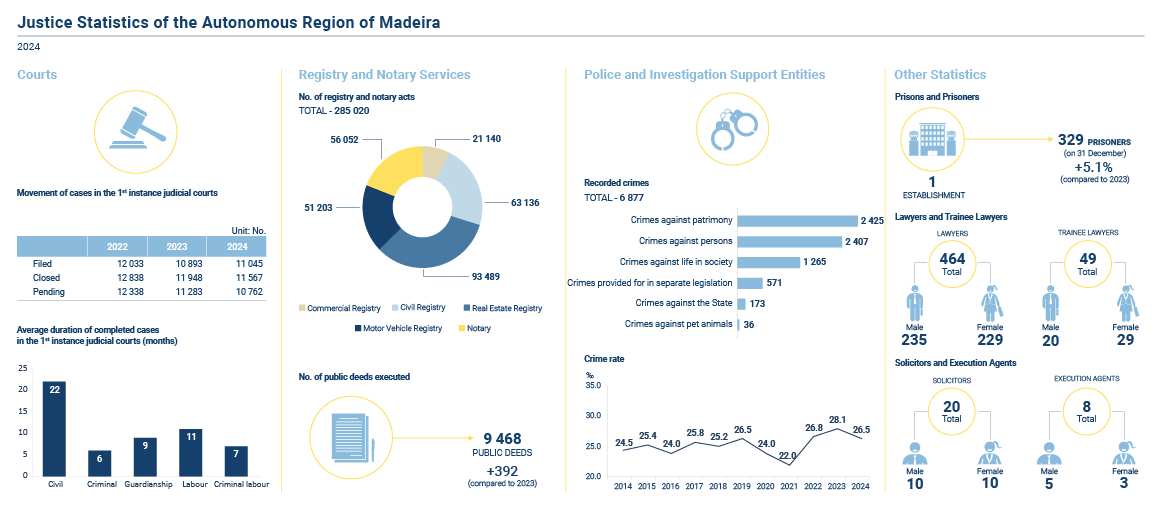
Data concerning the flow of cases in first-instance judicial courts (excluding courts of enforcement of sentences) in the district of Madeira indicate that in 2024, the number of pending cases decreased by 4.6 % compared with 2023. As of December 31, 2024, the number of pending cases in these courts stood at 10.8 thousand (11.3 thousand in 2023).
In 2024, the number of closed cases (11.6 thousand) remained higher than the number of incoming cases (11.0 thousand). The favourable balance of approximately 522 cases underpins the aforementioned reduction in pending cases (–4.6 % compared with 2023), noting that over the period 2015-2024, this category of cases has undergone successive declines.
In 2024, civil court proceedings continued to predominate in the first-instance judicial courts (cases relating to debt, tenancy, divorce, inventory, insolvency, corporate recovery, road traffic accidents), thereby distinguishing them from criminal, labour and juvenile justice cases. The significance of these civil cases is underlined by their movements in 2024: they represented 63.7 % of incoming cases (7.0 thousand), 63.6 % of closed cases (7.4 thousand) and 81.7 % of pending cases (8.8 thousand). The evolution of this case type shows an increase in incoming cases (+7.0 % compared with 2023), whereas closed cases (–6.1 %) and pending cases (–3.5 %) both declined. As a result of the greater number of completed than incoming cases, the balance in 2024 amounted to –322 cases.
The clearance rate (the ratio of the number of closed cases to the number of incoming cases), which measures a system’s capacity in a given year to cope with demand in that same period, was 104.7 % in 2024, a decrease of 5.0 percentage points compared with the previous year (109.7 %). The clearance rate for the civil cases (113.5 %) exceeded that of other types of cases, whereas the labour case resolution rate recorded the lowest rate (77.3 %).
With regard to the average duration of closed cases in first-instance judicial courts, the civil lawsuit remains the longest-running in the system, with an average duration of 22 months, identical to the previous year. The same applies to labour cases, which remained at 11 months, and criminal cases, at 6 months. In the remaining categories (juvenile and labour-criminal cases) reductions of 1 and 2 months, respectively, were observed relative to the previous year.
Registries and Notary – Number of registrations and notary acts increased
In the ARM in 2024, 285.0 thousand registry and notary acts were carried out (+3.4 % compared with 2023), of which 32.8 % pertained to real estate registration and 22.2 % to civil registration. With a smaller share, commercial registration (7.4 %), motor-vehicle registration (18.0 %) and notarial acts (19.7 %) followed.
With regard to public deeds, in 2024 there was a 4.3 % increase compared with the previous year, rising from 9.1 thousand deeds in 2023 to 9.5 thousand in 2024. The large majority were executed in the municipality of Funchal (4.0 thousand deeds; 42.6 % of the total).
Crimes – Crime rate declined
In 2024, the Police Authorities registered 6.9 thousand crimes in the Region, representing a decline of 4.6 % compared with the previous year (7.2 thousand).
The most significant crime categories compared to the total – “crimes against persons” and “crimes against patrimony” – both 2.4 thousand crimes were recorded in 2024, together accounting for 70.3 % of the total (70.1 % in 2023). Compared with 2023, crimes against persons rose by 3.1 % and crimes against patrimony decreased by 11.0 %.
By municipality, the results indicate that more than half of the crimes registered in the ARM in 2024 occurred in Funchal (3.6 thousand crimes; 51.6 % of the total), followed by Câmara de Lobos (963 crimes; 14.0 %), Santa Cruz (774 crimes; 11.3 %) and Machico (475 crimes; 6.9 %).
In 2024, the crime rate – defined as the ratio of the number of crimes to the resident population (per thousand) – stood at 26.5 ‰, below that recorded in 2023 (28.1 ‰). It is noteworthy that this rate remained substantially below the national average (33.0 ‰) and that of the Autonomous Region of the Azores (39.7 ‰). Within the Region, the highest rates were observed for “crimes against patrimony” (9.3 ‰) and “crimes of assault” (6.3 ‰).
By municipality, the lowest crime rate was observed in Ponta do Sol (12.8 ‰) and the highest in Porto Santo (41.8 ‰). Aside from the latter, the municipalities of Funchal (32.8 ‰), Porto Moniz (27.7 ‰) and Câmara de Lobos (29.0 ‰) exhibited rates above the regional average.
In 2024, the police authorities identified and registered 1 000 injured/offended persons of domestic violence crimes against the spouse (or equivalent) in the Region, 115 fewer than in the preceding year (1 115 persons). The year 2015 recorded the highest value in the series (1 240 persons). Of the identified injured/offended persons, 73.2 % were women, while 26.8 % were men. In the municipality of Funchal 653 (65.3 %) injured/offended persons were identified, 80 (8.0 %) in Santa Cruz and 74 (7.4 %) in Câmara de Lobos.
Lawyers – Number of lawyers declined
In 2024, in the ARM, the number of lawyers registered with the respective bar association was 513, 12 fewer than in 2023. Of this total, 49 were trainee lawyers (9.6 % of the total), the majority being female (59.2 % of the trainee lawyers). Among the remaining 464 registered lawyers (90.4 % of the total), male lawyers (50.6 %) outnumbered female lawyers (49.4 %).
Prison Establishments and Inmates – Inmate population numbered approximately 329 at the end of 2024
According to information provided by the DGPJ, the Funchal Prison Establishment held a prisoner population of 329 persons as of 31 December 2024, 16 more than on the same date in 2023. Although this number was below the capacity indicated (349 persons), the series available for the prisoner population (2005-2024) shows that this indicator reached its highest value in 2024.
For more information, please click on: