DREM releases results of the 2021 Survey on Income and Living Conditions
The Regional Directorate of Statistics of Madeira (DREM) carries out annually in the Autonomous Region of Madeira (ARM) the Survey on Income and Living Conditions (EU-SILC), a statistical operation that has a national scope, and for which Statistics Portugal (INE) is responsible.
This is a harmonised statistical operation regulated by the EU and, in brief, its goals are to produce statistics on income distribution, living conditions, and social exclusion, enabling the analysis of:
- the composition and distribution of the income of households and persons;
- living conditions (housing and comfort conditions, financial capacity, etc.);
- the impact of social transfers on the level of poverty and social exclusion;
- the link between poverty and social exclusion and economic activity, employment, socio-family typology, education, health, and housing.
In this context, DREM releases today on its website, the results of the survey conducted between May and September 2021 on a sample of 2,708 households. As a consequence of the public health measures related to the pandemic COVID-19, namely confinement and social distancing, the survey was conducted exclusively through telephone interviews. Indicators on poverty and economic inequality were calculated on the basis of 2020 annual net equivalised monetary income, excluding other sources of income, namely wages in kind, self-consumption, self-supply and self-housing. The data on material and social deprivation are related to 2021. The data reflect the new economic growth strategy of the European Union defined for the next decade (Europe 2030 Strategy), with a new indicator for monitoring the population at-risk-of-poverty or social exclusion, combining the conditions of relative poverty, severe material and social deprivation and a new indicator on very low work intensity per capita.
Median equivalised disposable income in the Autonomous Region of Madeira was 9,806 euros
In 2020, the median equivalised disposable income per equivalent adult was 9,806 euros (up by 761 euros over the previous year). The income per equivalent adult is the result obtained by dividing the income of each household by its size in terms of "equivalent adults", using the OECD's modified equivalence scale, in which a weight of 1 is attributed to the first adult in a household, 0.5 to the other adults and 0.3 to each child in the household. Median equivalised disposable income corresponds to the income obtained by households through each of its members, from work (employee and self-employed), property and capital, pensions (national or from abroad), other social transfers (family support, housing, unemployment, sickness, and disability, education and training, social inclusion), and other private transfers less taxes due and contributions to social protection regimes.
The national median for this change was 11 089 euros.
At-risk-of-poverty rate in the Autonomous Region of Madeira, in 2020, decreased to 24.2%
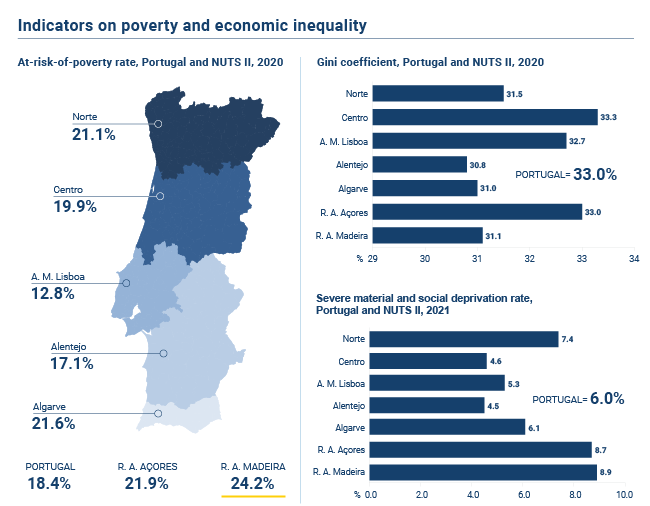
The at-risk-of-poverty rate (which corresponds to the proportion of the population whose equivalent income is below the poverty line, i.e. 6,653 euros per year, which corresponds to 60% of the median equivalised disposable income per equivalent adult for Portugal) calculated with the national poverty line was 18.4% in the country (up to 2.2 pp from 2019), and in the Autonomous Region of Madeira it reached 24.2% (-2.1 pp than in 2019). By NUTS2 regions, the lowest value was recorded in Área Metropolitana de Lisboa (12.8%) and the highest in the Autonomous Region of Madeira (24.2%).
The at-risk-of-poverty rate calculated based on the regional poverty lines (i.e. 5,883 euros in the case of ARM, which corresponds to 60% of the median equivalised disposable income per equivalent adult for ARM) stood at 18.2%, higher by 0.9 pp compared to 2019. In this indicator, Alentejo recorded the lowest value (16.6%), while Norte and the Área Metropolitana de Lisboa (19.1%) emerge as the regions with the highest percentage. It should be noted that the regional poverty lines have the advantage of reflecting different socio-economic conditions, namely different cost-of-living levels.
In reading these data, it should be borne in mind that given the survey methodology, concerning sources of income, wages in kind, self-consumption, self-supply, and self-help (non-monetary income) are excluded. These components, as shown by the latest Household Budget Survey (IDEF), have particularly significant importance in the Autonomous Region of Madeira, having contributed to decreasing the poverty rate by 6.2 pp in the year 2014 (the latest edition of IDEF).
Severe material and social deprivation rate in the Autonomous Region of Madeira decreases to 8.9%
In the framework of the Europe 2030 strategy, the concept of material and social deprivation was defined for monitoring poverty and social exclusion. The material and social deprivation indicators are based on a set of thirteen items related to the social and economic needs and durable goods of households.
Contrary to the previous material deprivation indicators, focused on the household and on economic and financial difficulties, the new material and social deprivation indicators add the aspects related to each persons’ well-being (new clothes, shoes, and pocket money) and to leisure and social interaction. Of the thirteen items of material and social deprivation, seven related to the family as a whole and six to the individual level.
The material and social deprivation rate is given by the proportion of the population in which there are at least five of the following thirteen difficulties:
- Difficulties collected at household level
1) No capacity to face unexpected financial expenses close to the monthly value of the poverty line (without asking for financial help);
2) Unable to pay for one week’s holiday away from home per year, paying travel and accommodation costs for all household members;
3) Delay, motivated by economic difficulties, in any of the regular payments for mortgage or rent payments, utility bills, hire purchase installments or other loan payments, or other expenses not related to the main residence;
4) Unable to afford a meal with meat or fish (or vegetarian equivalent) at least every second day;
5) Unable to afford to keep their home adequately warm;
6) Without the availability of car (light vehicle or SUV) due to economic difficulties;
7) Impossibility of replacing worn-out furniture;
- Difficulties collected at the level of individuals aged 16 years old or over
8) Impossibility of substituting worn-out clothes by some new ones (excluding second-hand clothes);
9) Impossibility to have two pairs of properly fitting shoes ((including a pair of all-weather shoes);
10) Impossibility to spend a small amount of money each week on him/herself;
11) Impossibility to have regular leisure activities;
12) Impossibility of getting together with friends/family for a drink/meal at least once a month;
13) Impossibility to have access to the internet for personal use at home.
In the case of the items of material and social deprivation, and of the global indicators of deprivation, the household situation is replicated for all its members, regardless of age. In the case of deprivation items collected at an individual level, children under 16 years of age are considered deprived if at least half of the household members aged 16 or over reported being in deprivation.
In the ARM, in 2021, the rate of severe material and social deprivation was 8.9%, which is 2.9 pp higher than in the country (6.0%). Compared to 2020, there is a decrease of 2.4 pp in the ARM (11.3% in 2020). The A.R. Azores was the second region with the highest value for this indicator (8.7%) and Alentejo had the lowest value (4.5%).
Risk of poverty or social exclusion rate in the Autonomous Region of Madeira in 2021 is 28.9%.
The Europe 2030 strategy defines, among other goals, the reduction of the number of people at-risk-of-poverty or social exclusion in the European Union by at least 15 million people in 2030, including at least 5 million children.
The same strategy defines a new indicator for monitoring the population at-risk-of-poverty or social exclusion, combining the conditions of relative poverty, severe material and social deprivation, and very low work intensity per capita. By EU convention, the indicator takes as a reference the year to which the severe material and social situation is referred, despite the relative at-risk-of-poverty being the determining element in its trajectory.
In 2021, in the Autonomous Region of Madeira, the at-risk-of-poverty or social exclusion rate (income from 2020) was 28.9%, a figure below 30% for the first time ever. This rate decreased in the ARM by 3.9 pp vis-à-vis 2020. The ARM was the region of the country with the highest value, followed by the A.R. Azores (27.7%), while Área Metropolitana de Lisboa had the lowest rate (16.9%). The national average was 22.4%, up by 2.4 pp compared to the previous year.
Inequality increased in 2020 but remained below the national average
The Gini coefficient and the S80/S20 ratio, allow the assessment of the asymmetry in the distribution of income in the Autonomous Region of Madeira and in the country, reflecting the differences in income among all population groups.
The Gini coefficient synthesizes in a single value the asymmetry of the income distribution, assuming values between 0 (when all individuals have the same income) and 100 (when the total income is concentrated in a single individual). In the Autonomous Region of Madeira, in 2020, this indicator stood at 31.1%, below the national value (33.0%). Compared to 2019, the increase in the ARM was 0.3 pp and at a national level of 1.8 pp. Centro is the region of the country with the highest inequality (33.3%) and Alentejo is the region where the lowest asymmetry is observed (30.8%).
The S80/S20 ratio, defined as the ratio between the proportion of total income received by the 20% of the population with the highest income and the share of income received by the 20% with the lowest income, reached the value of 5.1 in 2020 (5.0 in 2019). At a national level, an increase was also recorded, rising from 5.0 in 2019 to 5.7 in 2020.
Very low work intensity per capita in the Autonomous Region of Madeira maintained the downward trend in 2020
Very low work intensity per capita (per person) is considered to be all persons under 65 years of age who, in the income reference period, lived in households in which the adult population aged 18 to 64 years reported having worked, on average, fewer than 20% of the possible working time (excluding students aged 18 to 24 years; retired persons and/or old age or disability pensioners; and inactive persons aged 60-64 years and living in households whose main source of income is pensions).
In 2021, in the Autonomous Region of Madeira, the share of the population aged under 65 years living in households with very low per capita work intensity was 6.6%, recording a 2.1 pp decline from the previous year. The highest value was recorded by the Autonomous Region of Madeira and the lowest in Alentejo (4.1%). The national average was 5.2%, having registered an increase of 0.2 pp over 2020.
For more information, please click on: