Note: Release amended on 5 May 2025. The definition of the relative median at-risk-of-poverty gap rate was completed, as the original version was incomplete.
In 2022
Relative median at-risk poverty gap in the Autonomous Region of Madeira was higher than retired population, but lower for the employed, unemployed, and other inactive population
The Regional Directorate of Statistics of Madeira (DREM) releases today on its website the results of the Survey on Living Conditions and Income (ICVR), regarding the poverty risk among the population aged 18 and older, specifically categorised by employment status, duration of unemployment, and level of completed education. The indicators were constructed based on the annual net equivalised monetary income of 2022, excluding other sources of income such as in-kind salary, self-consumption, self-supply, and self-rental.
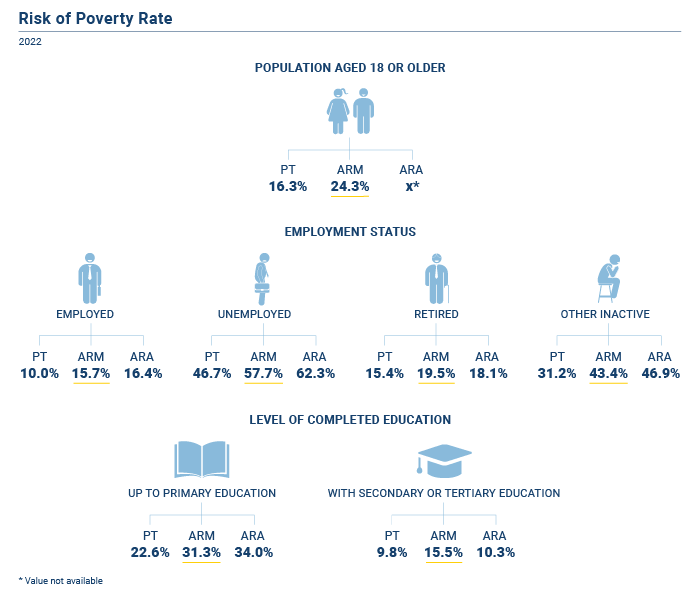
The results of the Survey on Living Conditions and Income, conducted between April and July 2023, indicate that in the Autonomous Region of Madeira (ARM), considering the group of persons aged 18 and over and the national poverty line (7,095 euros), the at-risk poverty rate after social transfers in 2022 reached 24.3% (16.3% nationally).
The at-risk poverty rate for the unemployed population in the ARM was 57.7%, which was 11.0 percentage points higher than the national rate and 4.6 percentage points lower than that of the Autonomous Region of the Azores (ARA), where it reached 62.3%.
For the retired population, the at-risk poverty rate in the ARM was 19.5%. This was the only population group where the at-risk poverty rate in the ARM was higher than the national and the ARA rates. The national at-risk poverty rate was 15.4%, and in the ARA, it was 18.1%.
The at-risk poverty rate in the ARM for the employed population was 15.7%, which was 5.7 percentage points higher than the national rate (10.0%) and 0.7 percentage points lower than the ARA rate (16.4%).
The relative median at-risk-of-poverty gap rate, which assesses how far the median disposable monetary income of persons at risk of poverty (i.e., persons living in households with annual net monetary income per adult equivalent below the poverty threshold) is from the poverty line, was, in 2022, lower in the ARM when compared with the national rate (except in the group of pensioners) and with that of the ARA.
According to the duration of unemployment, the rates in the ARM are consistently higher than the national rates, with a notable difference of 11.1 percentage points in the "12 months" group, where the poverty risk rate in the ARM was 61.6% compared to 50.5% nationally. Compared to the ARA, the rates in the ARM were lower in the "0 months" group, reaching 22.8% in the ARA and 21.0% in the ARM, and in the "12 months" group, where the rate was 64.9% in the ARA and 61.6% in the ARM.
A lower at-risk poverty rate was observed in the ARM among persons with "Secondary or tertiary education," being less than half the poverty risk rate of persons in the "Up to primary education" group, respectively 15.5% and 31.3%, a difference of 15.8 percentage points.
Nationally, the at-risk poverty rate for these two groups was lower, at 22.6% for the "Up to primary education" group and 9.8% for the "With secondary or tertiary education" group. In the ARA, rates of 34.0% and 10.3%, respectively, were observed.
For more information, please click on: