In 2023
Percentage of the population of the Autonomous Region of Madeira living in overcrowded conditions increased while overburden housing cost rate decreased
The Regional Directorate of Statistics of Madeira (DREM) is releasing today, on its website, a set of indicators regarding housing deprivation of the population living in the Autonomous Region of Madeira (ARM). These data were gathered from the Survey on Living Conditions and Income (SILC) along two complementary modules collected in 2023: "Intergenerational transmission of social advantages and disadvantages and housing difficulties" and the ad hoc module on "Energy efficiency of buildings and housing".
The overcrowding rate corresponds to the proportion of households where the number of rooms (≥ 4m2 ) is not sufficient for the household's dimension and demographic composition.
It is considered that an individual lives in overcrowded housing conditions if it does not have a minimum number of rooms, which allows:
- one room for the household as a whole;
- one room for each couple;
- one division for each single person aged 18 or over;
- one room for two persons aged 12 to 17 of the same sex;
- one room for two persons aged 12 to 17 of the different sex;
- one room for two persons under 12 years old.
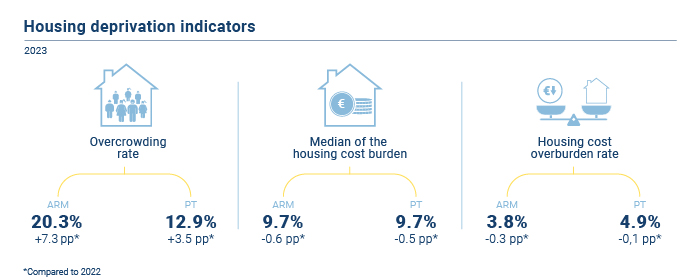
According to the Survey on Living Conditions and Income, in 2023, the housing overcrowding rate in the Autonomous Region of Madeira stood at 20.3% marking a 7.3 percentage point (pp) increase compared to the previous year and surpassing the national average of 12.9%. This increase in overcrowding was observed across all NUTS1 regions. On the Mainland, this indicator was 12.5% (9.2% in 2022) and in the Autonomous Region of the Azores (ARA) it was 21.4% (13.5% in 2022).
In 2023, the resumption of data collection on the physical and sanitary conditions of housing, which had been interrupted in 2021 and 2022, enabled the calculation of the annual severe housing deprivation rate. This indicator corresponds to the proportion of the population living in an overcrowded household and with, at least, one of the following housing problems: a) lack of a bath or shower in the dwelling and lack of an indoor flushing toilet for sole use of the household; b) leaking roof, damp walls/floors/foundation, or rot in window frames or floor; c) insufficient natural light (too dark) in a sunny day. In the ARM, in 2023, 13.4% of residents reported living in severe housing deprivation, above the national average of 6.0%. In the ARA, this indicator was 13.6%.
Two indicators regarding housing cost burden are also available, namely the median housing expenditure burden and the overburden housing cost rate.
The median housing expenditure burden corresponds to the median of the ratio between the housing costs and the disposable household income (net of housing allowances). Housing costs include those related to housing facilities such as water, electricity, gas and other fuels, as well as condominium, insurances, sewage, minor repairs, rents and interest related to the main residence mortgage. In 2023, the median housing expenditure burden in the ARM was 9.7%, 0.6 pp lower than that observed in 2022 (10.3%) and the same as in the Country and on the Mainland. In the ARA, this indicator stood at 9.5%.
The overburden housing cost rate, i.e. the proportion of people living in households where the housing costs represent more than 40% of the disposable household income (net of housing allowances), stood at 3.8% in 2023. This rate was 0.3 p.p. lower than that recorded in 2022 (4.1%). The national average was 4.9%, being higher on the Mainland (5.0%) and lower in the ARA (2.8%).
Regarding the thermal comfort of housing, data collected in the ad hoc module on Energy Efficiency of Buildings and Housing, indicate that 86.0% of the Region's population lived in housing where no type of heating was used at home, above the national average (26.6%). The proportion was lower on the Mainland (24.0%) and in the ARA (72.6%). It is essential to consider the climatic characteristics of the Region, where temperatures in the coldest months are much milder than in the rest of the national territory, when interpreting this indicator's data.
For more information, please click on: