In April 2023
Economic activity in the Autonomous Region of Madeira experienced a slower pace of growth
The Regional Indicator of Economic Activity (RIEA) reveals that in the month of April 2023, the regional economic activity continued to grow, although at a slower rate compared to the previous month.
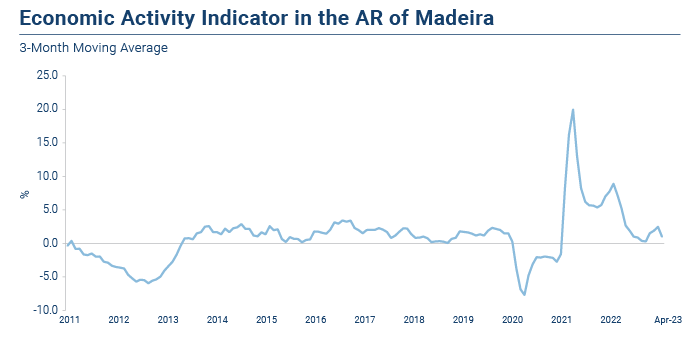
As stated in the initial release of the Regional Indicator of Economic Activity (RIEA) in October 2017, its primary purpose is to provide a signal about the behaviour of economic activity in the Autonomous Region of Madeira (ARM). It aims to indicate the direction and magnitude of fluctuations in economic activity, identifying whether it is in positive or negative territory, and highlighting accelerations, decelerations, and potential turning points.
It's essential to note that the quantitative value of the RIEA assumes a secondary importance compared to other economic indicators, such as the volume change of the Gross Domestic Product (GDP). The GDP is determined using a more diverse and comprehensive set of statistical information. The RIEA serves as a complementary tool to provide early insights into the economic activity's trends, but it is not meant to replace the more comprehensive and accurate measurement of the GDP.
Despite its secondary role, there is a strong correlation between the RIEA and GDP, indicating that the indicator can still provide valuable information about the overall economic performance of the region. It helps analysts and policymakers understand the direction and potential shifts in economic activity, contributing to informed decision-making. However, for a complete and comprehensive assessment of the regional economy, it is crucial to consider a broader range of statistical data, including the volume change of GDP.
Monthly Economic Survey - The economic situation of the Autonomous Region of Madeira in April 2023 from 6 topics
DREM presents a brief analysis of the main short-term indicators, broken down by themes.
Economic activity
In April 2023, the regional economic activity in the Autonomous Region of Madeira (ARM) continued to show positive growth, although at a slower pace compared to the previous month. One of the significant contributors to this economic growth was the tourism sector, which experienced an increase in overnight stays (excluding local accommodation below 10 beds) of 24.1% during that month. However, it is worth noting that this growth rate was lower than the 46.8% recorded in the previous month, March 2023.
The performance of electricity distribution, which is often associated with economic activity, also showed growth in April 2023, but at a slower rate than the previous month. Specifically, electricity distribution grew by 0.6% during that month, whereas it had grown by 1.5% in the previous month.
On the other hand, diesel released for consumption experienced a decrease of 3.1% in April 2023, which was in contrast to the growth of 1.2% observed in the previous month.
Analysing the ratio of incorporated and dissolved companies in the ARM, it was observed that in April 2023, there were 2.4 new companies incorporated for each company dissolved in the region. This indicates a higher proportion of newly established companies compared to the previous month, where the ratio was 2.2.
Overall, the economic indicators suggest that economic activity in the ARM maintained a positive trajectory in April 2023, although there were some signs of moderation compared to the exceptionally high growth rates seen in the previous month.
Private consumption
Despite the need to take in account the impact of national tourism, one of the key indicators reflecting the evolution of private consumption is related to the operations carried out through the SIBS network with cards issued by national banks. Observing the total amount withdrawn from ATMs and purchases made through automatic payment terminals with national cards, there was a growth of 13.0% in April 2023. However, this growth interrupted the trend of acceleration that had been occurring since last October.
Similarly, gasoline released consumption also experienced a slowdown, with the year-on-year change fixed at +14.2% in April 2023, compared to +17.9% in the previous March.
Investment
Investment indicators in April 2023 showed an uneven evolution. Loans granted to households for housing increased by +0.7% (compared to +1.1% in March), and housing bank appraisals grew by +16.3% (compared to +15.9% in the previous month). However, all other investment indicators experienced a decline. The balance of loans granted to non-financial corporations decreased by -4.7% (compared to -5.1% in the previous month), cement sales dropped by -3.9% (compared to +1.3% in March), and building permits went down by -9.4% (compared to +1.6% in the previous month).
External Demand
Although foreign trade represents only a small portion of the region's overall trade (with most trade being with the mainland), it is worth noting that both exports (+6.0%) and imports of goods (+36.1%) have grown. The movement of goods in ports, which is a broader indicator of trade dynamics with foreign countries, has also increased by +6.7% (compared to +5.9% in the previous month). In other indicators, there is a slowdown in passenger traffic at airports, which increased by +39.3% (compared to +67.6% in March), consistent with the evolution of the aggregate amount withdrawn from ATMs and purchases made through automatic payment terminals with international cards, which rose by +32.0% (compared to +46.3% in the previous month).
Labor Market
Data from employment authorities at both the national and regional levels indicate a decrease in job vacancies by -34.4% in April 2023. Additionally, there was a slight increase in job applications by +1.8% and an increase in the number of registered unemployed by +1.4% throughout the month.
Prices
In April 2023, the year-on-year inflation rate of +6.6% slowed down compared to the previous month. It was higher for goods, recording a rate of +6.7%, than for services, which had a rate of +6.2%. The underlying inflation rate, which excludes unprocessed food and energy products, was +7.1%.
For more information, please refer to: