In the school year 2021/2022
Number of enrolled students, considering preschool education through secondary education, was below 40,000
The Regional Directorate of Statistics of Madeira (DREM) has released today the "Time Series of Education in the Autonomous Region of Madeira" which has been updated with information for the school year 2021/2022. These data were provided by the Education Observatory of the Autonomous Region of Madeira (OERAM), a unit within the Regional Directorate of School Administration (DRAE) under the Regional Secretariat for Education, Science, and Technology.
In the school year 2021/2022, there were a total of 119 establishments providing pre-school education in the Autonomous Region of Madeira (ARM) , which is an increase of two establishments compared to the previous school year. The number of kindergarten teachers in the Region was 661, slightly lower than the previous year's count of 666. The number of enrolled students in pre-school education experienced a 3.4% increase compared to the previous year, with approximately 6,200 children enrolled. This marks the fourth consecutive year of growth in the number of children enrolled in preschool education. It is important to note that the time series for these data began in the school year 1999/2000. Looking back at the series, the lowest number of enrolled students was recorded in the school year 2017/2018, with 5,600 students, while the highest number occurred in the school year 2006/2007, with 8,100 students. Over the last decade, there has been an 18.5% decrease in the number of children enrolled in preschool education.
For primary education, there were a total of 23,099 students enrolled in the school year 2021/2022, indicating a decrease of 1.8% (-413 students) compared to the previous year. Within primary education, there was a 1.5% reduction in the 1st cycle, a 0.6% increase in the 2nd cycle and a 3.3% decrease in lower secondary education. The total number of students enrolled in primary education in 2021/2022 is the lowest observed since the beginning of the time series in 1999/2000, when the highest enrollment of approximately 38,200 students was recorded. This represents a significant decrease of around 15,100 students between the highest and lowest points in the time series. Looking at the past ten years, there has been a substantial decline in the number of students enrolled in primary education, with decreases of 32.0%, 32.1%, and 24.5% in the 1st cycle, 2nd cycle, and lower secondary education, respectively.
In secondary education, there were approximately 10,400 students enrolled in the school year 2021/2022, which represents a drop of 3.4% (-360 students) compared to the previous year. This decline continues the decreasing trend that began in the school year 2019/2020. It's worth noting that the highest enrollment in secondary education was recorded in the 2005/2006 school year with 11,900 students, while the lowest enrollment occurred in the 2000/2001 school year with 8,200 students. Compared to the 2011/2012 school year, there has been a 7.0% decline in the number of students enrolled in secondary education.
In terms of overall enrollment, including preschool education through secondary education, the school year 2021/2022 saw a total of 39,700 students enrolled in the ARM. This represents a decrease of 1.4% (-571 students) compared to the previous year. The number of students enrolled in the 1st cycle has been decreasing since the 2007/2008 school year, while lower secondary education has seen a decline since the 2013/2014 school year, and secondary education has been decreasing since the 2015/2016 school year (except for a 3.2% increase in the 2018/2019 school year). The number of students in the 2nd cycle showed a slight increase (+32 students) in the previous school year, breaking the decreasing trend observed since 2011/2012. It's important to note that the total number of students enrolled is the lowest since the beginning of the time series. In terms of institutional nature, public education accounted for 78.5% of enrollments, while private education accounted for 21.5%.
Regarding the teaching staff in preschool, primary, and secondary education (including vocational education), there were a total of 5,900 teachers in service, which is an increase of 32 teachers (+0.5%) compared to the 2020/2021 school year. This rise can be attributed to the growth observed in the teaching staff of the 1st cycle (+17 teachers), the 2nd cycle (+12 teachers), and vocational schools (+23 teachers). However, there was a decrease in the teaching staff in other levels of education, totalling 20 teachers (-5 in preschool education and -15 in primary, lower secondary, and secondary education).
The non-teaching staff in preschool, primary, and secondary education experienced a decrease of 2.9% from 3,947 persons in the 2020/2021 school year to 3,831 persons in the 2021/2022 school year.
In the 2021/2022 school year, approximately 74.6% of the non-teaching staff in non-higher education worked in publicly funded educational institutions, with 89.4% of them being women. In terms of age groups, 2.6% were under 30 years old, while 21.7% were 60 years old or older.
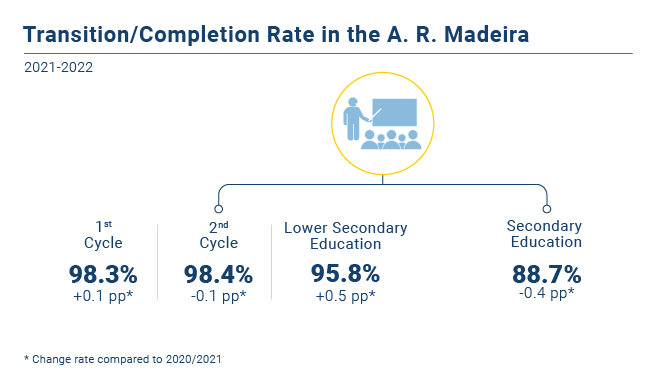
The transition/completion rate in primary education increased by 0.2 percentage points, reaching 97.4% in the school year 2021/2022, reversing the reduction observed in the previous school year. This reversal in trend reflects an improvement compared to the previous school year when a reduction was observed. However, in secondary education, the transition/completion rate decreased compared to the 2020/2021 school year, reaching 88.7% with a drop of 0.4 percentage points.
For more information, please click on: