76% of the enterprises state that the current international environment has a negative or very negative impact on the turnover evolution in 2022
The Regional Directorate of Statistics of Madeira (DREM) releases today the results of the Fast and Exceptional Enterprise Survey (IREE), the selective data collected on the week of 9 to 22 May 2022, a statistical operation created by Statistics Portugal (INE) and the Bank of Portugal (BdP), in April 2020, with the aim of identifying some of the main effects of the COVID-19 pandemic, based on a quick response questionnaire.
Subsequently, over the pandemic's peak periods and given the evolution of the constraints resulting from the COVID-19 pandemic, several editions of the survey were carried out to assess the impact on the economic activity of enterprises.
At the present time, taking into account that the pandemic has not yet been overcome and that the effects of the armed conflict in Ukraine have accentuated the problems in the supply channels and the increase in prices of energy and other essential products to the production chains, BdP and INE decided to conduct a new edition of the survey.
For the Autonomous Region of Madeira - a region where information is collected by DREM - the overall response rate for the week in question was 96%, representing 97% of the staff employed (NPS) and around 100% of the turnover (NRV) of the sampled enterprises. As in previous editions, these percentages were substantially higher than for the country as a whole (74% overall response rate, representing 76% of the NPS and 80% of the sample turnover).
It should be noted that the survey was intended to gather data for the country and was not designed to gather data at the regional level. The information presented for the Autonomous Region of Madeira corresponds exclusively to data from the responses obtained, without any extrapolation. For this reason, the set of information disclosed is reduced, especially when compared to the information made available by INE for the Country.
DREM is grateful for the collaboration of the enterprises, which continues to be crucial to make it possible to provide timely and quality information.
The main results for the week of 9 to 22 May are as follows:
Current state of business activity and prospects for 2022
- 59% of the enterprises report that they had already reached or exceeded the pre-pandemic level of activity (in the country the proportion was 56%);
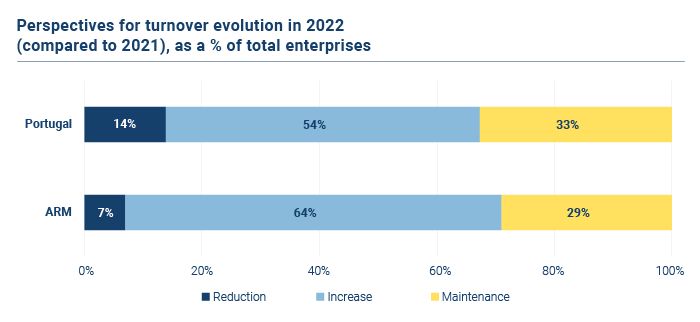
- 64% of the enterprises foresee an increase in turnover in 2022 compared to the previous year and only 7% foresee a reduction (in the country, the percentages are 54% and 14%, respectively);
- 20% of the enterprises estimate an increase in turnover in 2022 between 5 and 9%; 13% increases between 10% and 19% and the same percentage foresees growth between 20% and 39%;
- 76% of the enterprises state that the current international situation (in particular the conflict in Ukraine), has a negative or very negative impact on the evolution of turnover in 2022 (83% in the country). Approximately 52% of enterprises consider that both the increase in energy costs and the increase in transport costs are very relevant factors with a potential negative impact on their activity. A significant percentage (47%) of enterprises also highlight the increase in the price of other raw materials and intermediate goods, while 35% highlight supply problems. The scenario of uncertainty with an impact on enterprise investment decisions is highlighted by 33%;
- 72% of the enterprises - for which the increase in transport costs, the increase in the prices of other raw materials and intermediate goods and the problems in the supply of raw materials or intermediate goods have a potential negative impact on their activity - have already implemented or plan to implement measures in order to mitigate the effects of shortages of raw materials and intermediate goods and other disruptions in the supply chain, where 53% refer the change/diversification of suppliers and 27% the replacement of some raw materials and intermediate goods used;
- 60% of the enterprises - for which the increase in energy costs is a factor with a potential negative impact on their activity - have already implemented or plan to implement measures to mitigate the effects of these increases or interruptions in the supply of energy products, with 39% highlighting the renegotiation of supply contracts as a measure taken or to be taken and 21% the substitution by cheaper/renewable energy sources;
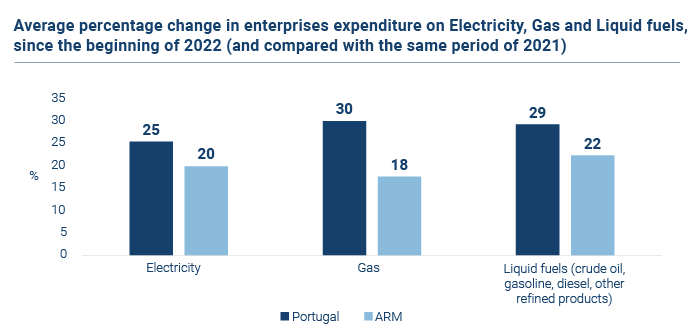
- In terms of the year-on-year rate of change, average spending grew by 20% for electricity, 18% for liquid fuels and 22% for gas. In the country, the changes are 25%, 29% and 30%, in the same order.
Perspectives for price evolution in 2022
- 61% of the enterprises expect to increase sales prices in 2022, with 43% of enterprises anticipating increases of at least 5%. Of the enterprises that expect to raise prices in 2022, 56% point to increased costs with raw materials/intermediate goods (non-energy). The increase in energy costs is also considered very relevant for the price increase by 48% of the enterprises;
- 68% of the enterprises (among those that indicated as relevant/very relevant the increase in wages, energy costs, raw materials/intermediate goods costs and other costs for the increase in selling prices), report a moderate impact of the cost increase on sales prices (up to 50% of the cost increase). For 25% of the enterprises, the impact of the cost increase on sales prices will be significant (more than 50% of the cost increase). In the country, these percentages are 60% and 28%, respectively.
Prospects for wage evolution in 2022
- 77% of the enterprises estimate an increase in wages per person employed in 2022 compared to 2021 (82% in the country). Regional enterprises point to average annual growth of wages of 5.2% in 2021 and foresee an increase of 5.5% for 2022 (4.2% and 5.2% in the country, respectively). Amongst the reasons highlighted as very relevant for wage increases in 2022 are the increase in the minimum wage and the need to retain workers (30% and 28%, respectively);
- 28% of the average (corresponding to 37% of total employment) estimate an increase in the number of employees in 2022 compared to 2021.
Current situation of teleworking and perspectives for 2022
As for the use of teleworking, 13% of the average refer having, in May 2022, a higher proportion of employees in this situation when compared with the pre-pandemic period (24% in the country).
Public support measures for enterprises
- The flexibilization of tax payments and the deferral of social security contributions is the public support measure mentioned by 49% of the enterprises as relevant or very relevant (37% in the country). 42% highlight the tax offset from increases in VAT revenue on fuel and 41% the tax changes (in the ISP and IUC);
- In the absence of additional policy measures, 86% of the enterprises report being able to remain in business without restrictions in 2022 (in the Country, the figure is 82%).
Impact of the main risks on the activity of enterprises in 2022
- The evolution of inflation and the war in Ukraine are the factors most mentioned by enterprises with a negative or very negative impact on their activity in 2022 (76% and 74% of enterprises). In contrast, 56% of enterprises expect a positive or very positive impact from the evolution of demand directed towards the enterprises.