DREM releases Public Expenditure Statistics for the period 2010-2023
The Regional Directorate of Statistics of Madeira (DREM) releases today a set of information regarding public expenditure by the Regional Administration of Madeira for the period 2010 to 2023, with reference to the 2016 base of the Portuguese National Accounts. It should be noted that for some of the information, the last available year is 2022.
The conceptual framework of public expenditure statistics and the terminology used are based on the European System of Accounts (ESA 2010) and the Manual on Government Finance Statistics (GFSM) for the classification of public expenditure by functions (COFOG). It is important to note that the institutional subsector of the Regional Administration of Madeira (ARM) includes the Regional Government, Autonomous Services, and Funds, which encompass, for example, Public Institutes and Reclassified Companies within the scope of Public Administrations.
Aggregate Public Expenditure - Regional Public Expenditure increased in 2022 but weighed less on GDP
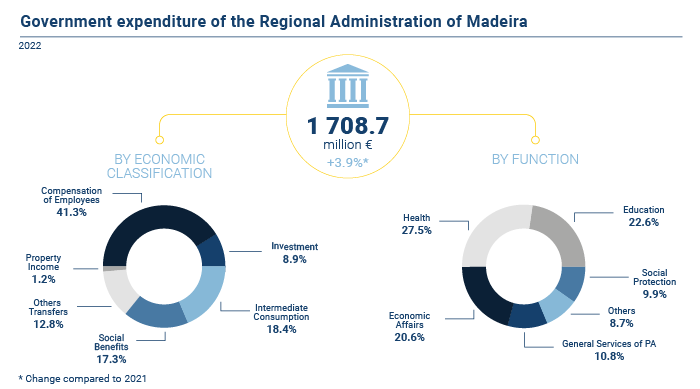
In 2022, the nominal value of public expenditure of the ARM reached 1,708.7 million euros, increasing by 3.9% compared to the previous year. However, given the strong recovery of the Gross Domestic Product (GDP) in 2022, the share of regional public expenditure in GDP decreased to 28.4%, down by 4.3 percentage points (pp) over 2021. Nationally, this ratio was 44.1% in 2022, dropping by 3.4 pp from the previous year. In 2023, for which there is no available regional GDP value, the nominal value of the ARM expenditure was around 1,820.2 million euros, reflecting a growth of 6.5% compared to 2022.
Economic Classification of Expenditure - In 2023, wages grew by 11.7%, while intermediate consumption fell by 4.9%
From the perspective of the economic classification of public expenditure, the three largest components are wages, intermediate consumption, and social benefits, which represented 11.7%, 5.2%, and 4.9% of GDP, respectively, in 2022. In the same order, the share of these items in total expenditure was 41.3%, 18.4%, and 17.3%. In 2023, wages accounted for 43.3% (+2.0 p.p. compared to 2022) and social benefits 17.5% (+0.2 p.p.), surpassing intermediate consumption, which represented 16.4% of total expenditure, or -2.0 p.p. compared to 2022.
In 2022, expenditure on wages reached a total of 705.3 million euros (+3.1% compared to 2021), while in 2023, this item rose to 788.0 million euros (+11.7% compared to 2022).
As for intermediate consumption, it reached 314.8 million euros in 2022, registering an increase of 4.2% compared to the previous year. In 2023, this item fell to 299.4 million euros, -4.9% compared to the previous year.
Meanwhile, social benefits in 2022 grew by 5.1%, reaching 296.4 million euros. In 2023, this item increased to 318.6 million euros, or +7.5% compared to the previous year.
It is also noteworthy that in 2023, property income (mainly corresponding to interest paid) returned to pre-pandemic levels, amounting to 106.1 million euros.
The ARM investment remained relatively stable between 2021 and 2023, going from 157.5 million euros in 2021 to 152.6 million euros in 2022 (-3.1%), then growing again in 2023 to 159.9 million euros (+4.8%).
Other transfers (subsidies, other current transfers, and capital transfers) grew by 22.1% compared to 2021, reaching 219.0 million euros. In 2023, this item decreased by 32.3% to 148.3 million euros, approaching the values recorded in 2019 and 2020.
Classification of Expenditure by Functions - Health and Education represented over 50% of total expenditure in 2022
In addition to the economic classification, public expenditure can also be classified by functions (COFOG). The functional classification adopted here follows ESA 2010 guidelines. This classification complements the economic classification, providing information on the purposes of expenditure, thereby broadening the analytical framework for assessing the quality of public expenditure.
In public expenditure, the functions with the largest share of GDP in 2022 were Health (7.8%) and Education (6.4%). Following these were the functions of Economic Affairs; General Public Services (including interest paid), and Social Protection, with shares of GDP of 5.8%, 3.1%, and 2.8%, respectively. In total expenditure, the shares in Health and Education were 27.5% and 22.6%, respectively. Economic Affairs, General Public Services, and Social Protection represented 20.6%, 10.8%, and 9.9% of total expenditure, respectively.
Analysing the expenditure evolution by main functions, between 2021 and 2022, there were increases in Sports, Recreation, Culture, and Religion (+16.2%), Public Order and Safety (+12.8%), Economic Affairs (+7.5%), Environmental Protection (+6.7%), Social Protection (+4.7%), Education (+3.3%), and Health (+3.2%). On the other hand, there were decreases in expenditure for Housing and Community Amenities (-3.6%) and General Public Services (-1.2%).
For more information, please refer to: