DREM releases an Em Foco edition dedicated to the Demographic Statistics of the Autonomous Region of Madeira for the year 2024
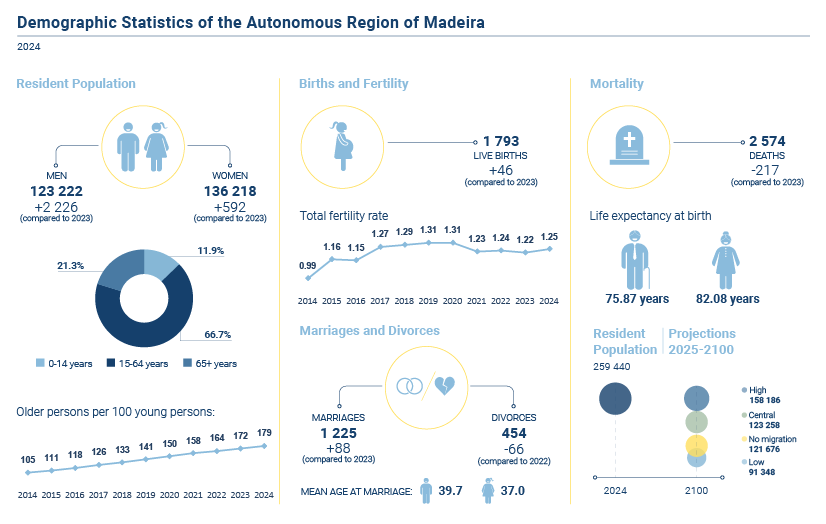
The Regional Directorate of Statistics of Madeira (DREM) is releasing today on its website an Em Foco edition dedicated to Demographic Statistics for the Autonomous Region of Madeira, providing an analysis of the Region’s demographic situation in 2024 and its evolution since 2014. This publication summarises the main results released throughout the year across the different dimensions of demography – resident population, birth rates and fertility, mortality and life expectancy, as well as marriages and divorces.
This edition of the Demographic Em Foco also includes a summary of the most relevant results from the Resident Population Projections exercise 2025-2100. Additionally, the Demographic dashboard has been expanded to include these projections, allowing for interactive consultation of the various indicators, not only for years already observed, but also for future years resulting from the demographic projections exercise.
The main results are the following:
Resident Population – Population increased in 2024
- In 2024, the resident population in the Autonomous Region of Madeira (ARM) was estimated at 259 440 persons (123 222 men and 136 218 women), representing an increase of 2 818 persons compared to 2023.
- The crude rate of increase was positive at 10.9‰ (10.0‰ in 2023), resulting from a positive crude migratory rate (13.0‰) offsetting the negative natural growth rate (-3.0‰).
- The proportion of the young population (under 15 years) continued to decrease, representing 11.9% of the total population (12.2% in 2023).
- The proportion of older persons (65 years or older) maintained the upward trend in recent years, reaching 21.3% of the resident population (20.9% in 2023).
- Consequently, the ageing ratio continued to rise, reaching a maximum of 179 older persons per 100 young persons (172 in 2023).
Births and Fertility –More live births in 2024
- In 2024, there were 1 793 live births to mothers residing in the ARM, 46 more than in 2023, resulting in a crude birth rate of 6.9 live births per 1 000 inhabitants (6.8‰ in 2023).
- The total fertility rate increased from 1.22 children per woman in their child-bearing years (15-49 years) in 2023 to 1.25 in 2024, remaining below the replacement level (2.1 children per woman).
- The average age of a mother at the birth of a child, regardless of birth order, decreased from 32.3 years in 2023 to 31.8 years in 2024. The average age at the birth of the first child decreased slightly, from 30.5 years in 2023 to 30.0 years in 2024.
Mortality and Life Expectancy – Number of deaths in 2024 decreased from the previous year
- In 2024, there were 2 574 deaths among residents of the ARM, 217 fewer than in 2023 (-7.8%). The crude death rate reached 10.0‰, slightly lower than in 2023 (10.9‰).
- There were 6 deaths of an infant under 1 year, 5 more deaths than in the previous year. The infant mortality rate was 3.3 deaths per thousand live births, an increase compared to the value recorded in 2023 (0.6‰).
- Over the three-year period from 2022 to 2024, life expectancy at birth for the resident population in the Region was estimated at 79.26 years: 75.87 years for men and 82.08 years for women.
- The average life expectancy at age 65 for the entire resident population in the ARM was 18.56 years. Men at age 65 can expect to live an average of 16.19 more years, and women can expect 20.14 more years.
Marriages – Number of marriages celebrated in 2024 increased compared to the prior year
- In 2024, 1 225 marriages were celebrated, 88 more marriages compared to the previous year (+7.7%).
- The crude marriage rate stood at 4.7 marriages per thousand inhabitants (4.5% in 2023).
- There were 53 same-sex marriages (61 in 2023), with 34 between men and 19 between women.
- The average age at first marriage increased in 2024, with men at 35.9 years and women at 33.7 years (compared to 35.4 and 33.5 years, respectively, in 2023).
- In 72.4% of the marriages in 2024, the spouses had previously shared a common residence.
- The proportion of marriages in which the couple’s future residence was abroad decreased to 22.1% (25.0% in 2023).
Divorces – Number of divorces decreased in 2023
- In 2024, 454 divorces were decreed, 66 fewer than in 2023 (-12.7%), resulting in a crude divorce rate of 1.8‰ (2.0‰ in 2023).
- Most divorces involved opposite-sex couples, with only 8 divorces being between same-sex couples (4 male couples and 4 female couples).
- The average age at divorce was 48.9 years for men and 46.2 years for women (49.0 and 46.6 years in 2023, respectively).
- Of the divorces granted in 2024, 67.8% were the result of marriages lasting ten years or longer, while 32.2% resulted from marriages shorter than 10 years.
Resident Population Projections, 2025–2100 – According to the central projection scenario, by 2100, the population is expected to decrease by 52.5%
- In the central projection scenario, the resident population in the Region is expected to decrease by 52.5% over the next 75 years, representing a loss of around 136.2 thousand persons (from 259.4 thousand in 2024 to 123.3 thousand in 2100).
- Under a low scenario (lower fertility and very low net migration), the resident population in the Region could fall to 91.3 thousand persons by 2100.
- In a more optimistic scenario, which assumes an increase in both fertility rates and net migration (high scenario), the resident population is still projected to decline, reaching 158 thousand people by 2100.
- In the no-migration scenario, which assumes the unlikely possibility of no migratory flows and uses the same fertility and mortality assumptions as the central scenario, the resident population would be expected to reach around 121.7 thousand persons by 2100.
- In the central scenario, a positive aspect is the projected increase in the total fertility rate, from 1.25 in 2024 to 1.36 in 2100.
- With negative impacts on the Region’s population structure, and assuming a sharper decline in the young population than in the elderly population, the ageing index is projected to worsen. In the central scenario, it will rise from 179 older persons per 100 young persons in 2024 to 442 in 2100, more than doubling.
For more information, please click on: