










Newsletters
Subscribe to our newsletter and get statistical data as soon as it is available!...
In July 2026
Regional economic growth slowed for the third consecutive month
The Regional Indicator of Economic Activity Indicator (RIEA) shows that economic activity in the Region continued to grow, albeit at a slower pace than in the previous month, marking the third consecutive month of deceleration.
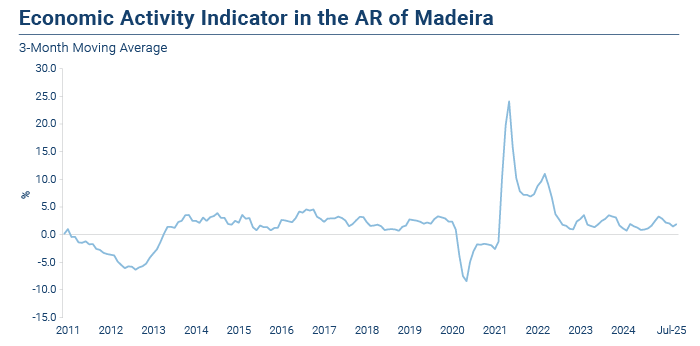
As DREM noted in the first release of the RIEA , in October 2017, the aim of the indicator is to “signal the behaviour of economic activity, particularly in terms of the direction and magnitude of fluctuations: whether activity is in positive or negative territory, accelerations, decelerations and the identification of turning points”. Its quantitative value is therefore of secondary importance and is not intended to replace the real change in Gross Domestic Product (GDP), which is calculated using a wider and more comprehensive range of statistical information, although the two variables are strongly correlated.
Economic Overview – The economic situation of the Autonomous Region of Madeira in July 2026
Economic Activity
As mentioned above, regional economic activity continued to grow in July 2026, albeit at a slower pace than in the previous month, marking the third consecutive month of deceleration.
In the tourism sector, the number of overnight stays in tourist accommodation establishments, excluding local accommodation establishments with a capacity of fewer than 10 beds, decreased by 1.5%, easing the decline recorded in June (-1.8%). Total revenue increased by 6.2%, maintaining a positive trend, although at a slower pace than in the previous month (6.5%). Revenue per available room (RevPAR) continued to decelerate, growing by 2.8%, following the 3.2% increase recorded in June.
In turn, the net bed occupancy rate increased to 72.2%, compared with 67.2% in the previous month.
In the energy sector, electricity distribution increased by 3.5%, slightly below the 3.7% growth recorded in the previous month. Meanwhile, diesel released for consumption decreased by 2.3%, easing the decline recorded in June (-7.0%).
Regarding business dynamics, the ratio of newly incorporated to dissolved companies remained at 2.4 new companies per dissolution, unchanged from the previous month.
Qualitative Indicators
In July 2026, confidence indicators improved in Manufacturing, Trade and Services. By contrast, the confidence indicator for Construction and Public Works decreased.
Private Consumption
In the month under review, gasoline released for consumption increased by 2.8% year-on-year, accelerating from the 1.0% growth recorded in June.
The outstanding balance of loans granted to households and non-profit institutions serving households (NPISHs) for consumption and other purposes increased by 7.6%, slightly below the 7.7% recorded in the previous month. Meanwhile, cash withdrawals and purchases made using national cards at automated payment terminals (POS terminals) grew by 5.2%, maintaining the growth rate observed in June.
Purchases of new light passenger cars decreased by 14.7% year-on-year, a steeper decline than the 7.9% recorded in the previous month.
Investment
In July 2026, investment indicators showed mixed developments.
Sales of light commercial vehicles decreased by 16.9%, deepening the 9.6% decline recorded in June. Meanwhile, the outstanding balance of loans granted to non-financial corporations increased by 2.6%, reversing the downward trend recorded in previous months (-1.4% in June).
Cement sales decreased by 4.0%, deepening the 2.7% decline recorded in June. Conversely, the outstanding balance of housing loans granted to households and NPISHs increased by 9.5%, maintaining the same growth rate as in the previous month. The bank appraisals on housing rose by 18.8%, slightly below the 19.1% increase recorded in the previous month.
The number of buildings permits increased by 1.4% year-on-year, significantly below the 25.2% growth recorded in the previous month.
External Demand
In July 2026, regional exports of goods decreased by 14.4%, deepening the contraction recorded in the previous month (-9.9%). In turn, imports of goods increased by 24.6%, accelerating from the 8.9% growth recorded in June.
The movement of goods in the Region's ports continued to perform positively, growing by 3.6%, although at a slower pace than in the previous month (4.2%).
Air passenger traffic at regional airports increased by 2.6%, slightly above the 2.4% recorded in June.
Cash withdrawals and purchases made using international cards at automated payment terminals (APT terminals) increased by 2.6%, below the 3.7% growth recorded in the previous month.
Labour Market
In July 2026, the number of registered unemployed persons decreased by 12.8%, extending the decline recorded in the previous month (-11.0%).
Job applications decreased by 12.6%, also representing a more pronounced decline than that recorded in June (-10.5%).
Meanwhile, job offers decreased by 18.7%, deepening the 15.7% decline observed in the previous month.
Prices
In July 2026, the year-on-year rate of change in the Consumer Price Index (CPI) stood at 4.7%, down from 5.0% in the previous month, reflecting a slowdown in goods inflation to 2.7% and a decrease in services inflation to 7.0%.
The underlying inflation indicator, which excludes unprocessed food and energy products, edged up to 4.5%, following the 4.4% recorded in June.
For further information, please access:
- Dashboard (Portuguese only)
- RIEA - In Focus (Portuguese only)
- Time series
- Monthly Summary of Economic Indicators
International Statistical Cooperation
 |
International Statistical Cooperation
|
Statistical Literacy
 |
Statistical Literacy
|
|
|
|
|
 |
 |
|



 |
|
|
 |

Copyright © 2026 Direção Regional de Estatística da Madeira. All rights reserved.
Address: Calçada de Santa Clara 38, 9004-545 Funchal, Madeira Island
Phone: +351 291 145 110 (National landline call)