









Newsletters
Subscribe to our newsletter and get statistical data as soon as it is available!...
DREM releases income statistics for 2020 based on the Personal Income Tax (IRS) return
The Regional Directorate of Statistics of Madeira (DREM) proceeds with the dissemination, on an annual basis, of a set of regional information based on anonymised fiscal data from the Portuguese Tax and Customs Authority (AT). These data are related to the settlement note of Personal Income Tax (IRS - Modelo 3), obtained under an agreement between Statistics Portugal (INE) and AT. The information refers to the year 2020 and is broken down by municipality.
In this study, several indicators related to the gross reported income (per se or excluding the tax paid) are released, by tax household or taxable person and also some changes that allow assessing income inequality (S80/S20 ratio and Gini coefficient).
Median value of gross reported income less income tax paid by a taxable person in the Region and in the country with a gap of 55 euros
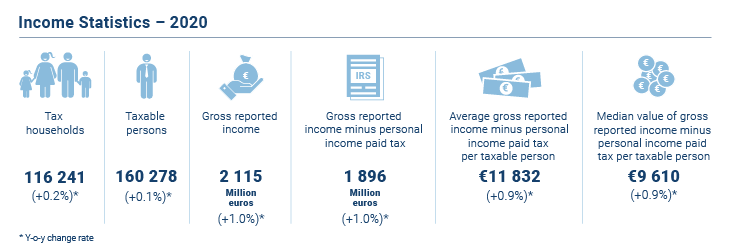
In 2020, 116,241 tax households and 160,278 taxable persons were recorded in the Region. Both indicators grew by 0.2% and 0.1%, respectively, compared to 2019. In the country, the changes were 1.1% and 0.6%, respectively.
In the same year, the total gross income declared by tax households less income tax paid amounted to 2,115 million euros (+1.0% than in 2019, which represents an average value per tax household of 18,194 euros), meaning a median value of 12,011 euros.
In 2020, the average gross reported income less income tax paid by the taxable person was 11,832 euros (+0.9% than in 2019), while the median was 9,610 euros (+0.9%). At the national level, the average was 11,998 euros (+0.8% compared to the previous year), while the median was 9,665 euros (+1.3%), only 55 euros higher than the regional average.
In the context of the 7 NUTS2 regions, the Autonomous Region of Madeira (ARM) is only behind Área Metropolitana de Lisboa, the region with the highest median (11,321 euros), which stands significantly above the other regions and the Azores, while Norte has the lowest median (9,099 euros), behind the Algarve (9 261 euros). The medians of the Autonomous Region of Madeira (3rd region, with 9,610 euros) and Alentejo (5th region, with 9,492 euros) are relatively close.
Main income inequality indicators in the region deteriorated in the pandemic year
The S80/S20 ratio, which corresponds to the quotient between the total income of the 20% with the highest income and the income earned by the 20% with the lowest income, reached in the Autonomous Region of Madeira, stood at 3.1, in 2020, meaning the income of the richest 20% is 3 times higher than that of the poorest 20%. The national average is 2.8, and by region, the Autonomous Region of Madeira has the highest ratio (3.1), followed by Área Metropolitana de Lisboa and Azores, with 3.0 in both cases. The region with the lowest inequality according to this indicator is Alentejo (2.5).
The Gini coefficient is also an indicator of inequality in income distribution, which aims to summarize the asymmetry of this distribution in a single value. It assumes values between 0% (when all taxable persons have the same income) and 100% (when all income is concentrated in a single taxable person).
In 2020, the regional Gini coefficient of gross reported income less income tax paid by the taxable person was 36.9%, having increased by 0.3 percentage points compared to 2019. The value of the Autonomous Region of Madeira is slightly higher than that presented for the country as a whole (36.4%). By region, Alentejo (32.9%) and Centro (33.8%) have the lowest Gini coefficients, while Área Metropolitana Lisboa (37.6%) and the A.R. Azores (37.5%) recorded the highest values. The Autonomous Region of Madeira remains the 3rd region with the highest Gini coefficient.
For more information, please click on:
International Statistical Cooperation
 |
International Statistical Cooperation
|
Statistical Literacy
 |
Statistical Literacy
|
|
|
|
|
 |
 |
|


 |
|
|
 |

Copyright © 2026 Direção Regional de Estatística da Madeira. All rights reserved.
Address: Calçada de Santa Clara 38, 9004-545 Funchal, Madeira Island
Phone: +351 291 145 126 (National landline call)