











Newsletters
Subscribe to our newsletter and get statistical data as soon as it is available!...
In 2025
Amount of new credit granted by financial institutions operating in the Region reached 724 million euros
The Regional Directorate of Statistics of Madeira (DREM) is today updating the time series on the sociodemographic characterisation of persons who took out credit from financial institutions operating in the Autonomous Region of Madeira (ARM), with data for 2025.
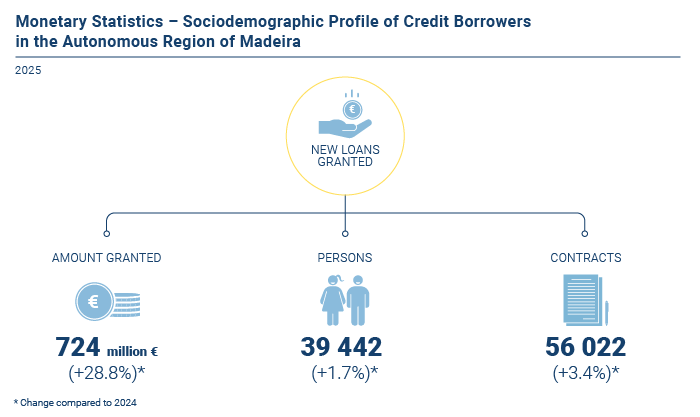
Total new credit granted - In 2025, financial institutions operating in the ARM concluded 56 022 new credit or loan agreements with 39 442 persons, for a total amount of 724 million euros
The total amount of credit granted increased by 28.8% compared with 2024, standing at 724 million euros in 2025, while the number of agreements was 56 022, involving 39 442 persons, corresponding to annual increases of 3.4% and 1.7%, respectively. The highest value in the 2021-2025 series was reached for all of these variables.
Housing loans for own permanent residence accounted for 49.7% of the total amount of credit granted, followed by personal loans (21.5%), car loans (13.7%), other housing loans (5.4%), credit cards (4.8%) and other loans (4.8%).
In 2025, the 18-to-35 age group represented 35.4% of persons but accounted for 44.2% of the amount. In the 36-to-45 age group, the shares were 22.8% and 27.4%, respectively. Conversely, persons aged 56 to 65 represented 13.6% of the total but only 7.5% of the amount, while those aged 66 and over accounted for 6.7% of persons and 2.7% of the amount.
The distribution by sex remained balanced, although men represented 51.1% of persons who took out credit, compared with 48.9% of women. When the analysis focuses on the amount contracted, the difference was slightly larger, with men accounting for 52.2% of the total and women for 47.8%.
Regarding employment status, 65.7% of persons who took out credit were employees. This group accounted for 75.4% of the amount contracted. Self-employed persons represented 4.2% of persons and 6.3% of the amount, while retired persons accounted for 6.2% of persons and 2.3% of the amount.
By level of education, persons with upper secondary education predominated (44.3%), followed by those with higher education (25.5%) and those with qualifications below upper secondary education (13.1%). In terms of the amount contracted, persons with higher education accounted for more than half of the total (50.5%), while those with upper secondary education represented 34.2%.
The share of the foreign population increased from 4.7% in 2024 to 5.3% in 2025, considering the number of persons, and from 6.3% to 7.0% when the analysis focuses on the amount contracted. Among foreign borrowers, and considering total credit by number of persons, those of Venezuelan (23.0%), Brazilian (11.9%), Nepalese (8.6%) and Bangladeshi (8.1%) nationality stood out.
Housing loans for own permanent residence - In 2025, 2 064 housing loan agreements for own permanent residence were concluded, involving 2 813 persons and an amount of 360 million euros
The amount contracted in housing loans for own permanent residence increased by 49.4% compared with 2024, reaching 360 million euros, while the number of persons who took out this type of loan was 2 813, with 2 064 agreements concluded. Compared with 2024, this corresponded to increases of 20.4% and 18.3%, respectively. Despite the recovery observed, the number of agreements remained below that recorded in 2021 (2 207).
More than half of the persons who obtained housing loans for their own permanent residence were aged between 18 and 35 (56.0%), a share 10.1 percentage points higher than that recorded in 2024. The 36-to-45 age group represented 28.1% of the total.
Women represented 51.2% of persons who used this type of loan, maintaining a slight predominance over men (48.8%). Employees accounted for 81.1% of borrowers, while persons with higher education represented 56.4% of the total.
The foreign population represented 6.7% of persons who took out housing loans for own permanent residence. Among these borrowers, those of Venezuelan (19.8%), Ukrainian (10.7%), Brazilian (7.5%) and Russian (7.0%) nationality stood out.
Personal loans - In 2025, 16 728 persons took out personal loans, for a total amount of 156 million euros, formalised through 22 100 agreements
Compared with 2024, the amount contracted in personal loans increased by 13.9%, standing at 156 million euros in 2025, while the number of agreements grew by 3.9% to 22 100 and the number of persons increased by 2.4% to 16 728.
Persons aged between 18 and 35 continued to be the most represented group (31.3%), followed by the 36-to-45 (24.3%) and 46-to-55 (23.0%) age groups.
The distribution by sex was practically balanced, with women representing 50.1% of persons and men 49.9%. However, in terms of the amount contracted, men accounted for 54.4% of the total, compared with 45.6% of women.
Employees represented 72.8% of persons who took out personal loans. As for level of education, half of borrowers had upper secondary education (50.4%), followed by those with higher education (22.9%).
The foreign population accounted for 2.6% of the total number of persons, with Venezuelan nationals the most represented, at 34.4% of all foreign borrowers.
Car loans - In 2025, 6 483 car loan agreements were concluded, involving 7 320 persons, for a total amount of 99 million euros
Compared with 2024, the amount contracted increased by 11.2%, standing at 99 million euros in 2025, while the number of agreements for this type of loan and the number of persons involved were 6 483 and 7 320, respectively. Compared with 2024, the increases were 6.8% and 4.4%, respectively.
Persons aged between 18 and 35 continued to be the most represented group (36.8%), followed by the 36-to-45 (24.2%) and 46-to-55 (22.9%) age groups.
Men represented 57.8% of persons who took out car loans, compared with 42.3% of women. In terms of the amount contracted, men accounted for 58.4% of the total, while women represented 41.6%.
Employees represented 69.3% of persons who took out car loans. As for level of education, persons with upper secondary education predominated (44.1%), followed by those with higher education (21.2%).
The foreign population accounted for 2.7% of the total number of persons, with Venezuelan nationals once again the most represented, at 45.1% of all foreign borrowers.
Credit cards – In 2025, 20 746 credit card agreements were concluded by 18 386 persons, for a total amount of 35 million euros
In 2025, the amount contracted in new credit cards was 35 million euros, unchanged compared with 2024. The number of agreements was 20 746, while the number of persons stood at 18 386. Compared with 2024, there were decreases of 2.9% and 4.3%, respectively.
Although they represented only 4.8% of the total amount of new credit granted, credit cards continued to account for high proportions of the number of persons and agreements, at 46.6% and 37.0% of the total, respectively.
Persons aged between 18 and 35 represented 40.6% of credit card users. Men accounted for 51.2% of the total, regaining a slight predominance over women (48.8%).
Employees made up 59.3% of borrowers, 2.3 percentage points fewer than in 2024. By level of education, persons with upper secondary education predominated (41.5%), followed by those with higher education (26.1%).
The foreign population represented 6.3% of persons who used credit cards, 1.0 percentage point more than in 2024. Among these borrowers, those of Venezuelan (21.7%), Brazilian (10.7%), Bangladeshi (10.6%) and Nepalese (7.8%) nationality stood out.
DREM shares Banco de Portugal dashboard on the topic
With the authorisation of Banco de Portugal, DREM is sharing the BdP dashboard on this topic, with data for the country as a whole for the period 2021 to 2025. This tool allows dynamic and detailed navigation, enabling users to interactively view the evolution of the sociodemographic characteristics of persons who took out credit from financial institutions.
For more information, please click on:
International Statistical Cooperation
 |
International Statistical Cooperation
|
Statistical Literacy
 |
Statistical Literacy
|
Statistical authorities


Supervision and support


Copyright © 2026 Direção Regional de Estatística da Madeira. All rights reserved.
Privacy policy | Cookie Notice | Contact us | Sitemap | RAMStats 2.0 app
Address: Calçada de Santa Clara 38, 9004-545 Funchal, Madeira Island
Phone: +351 291 145 110 (National landline call)