










Newsletters
Subscribe to our newsletter and get statistical data as soon as it is available!...
DREM releases the update of the online version of the geo-referenced Facilities Network and Supporting Services to the Population of the Autonomous Region of Madeira, with data for the year 2022
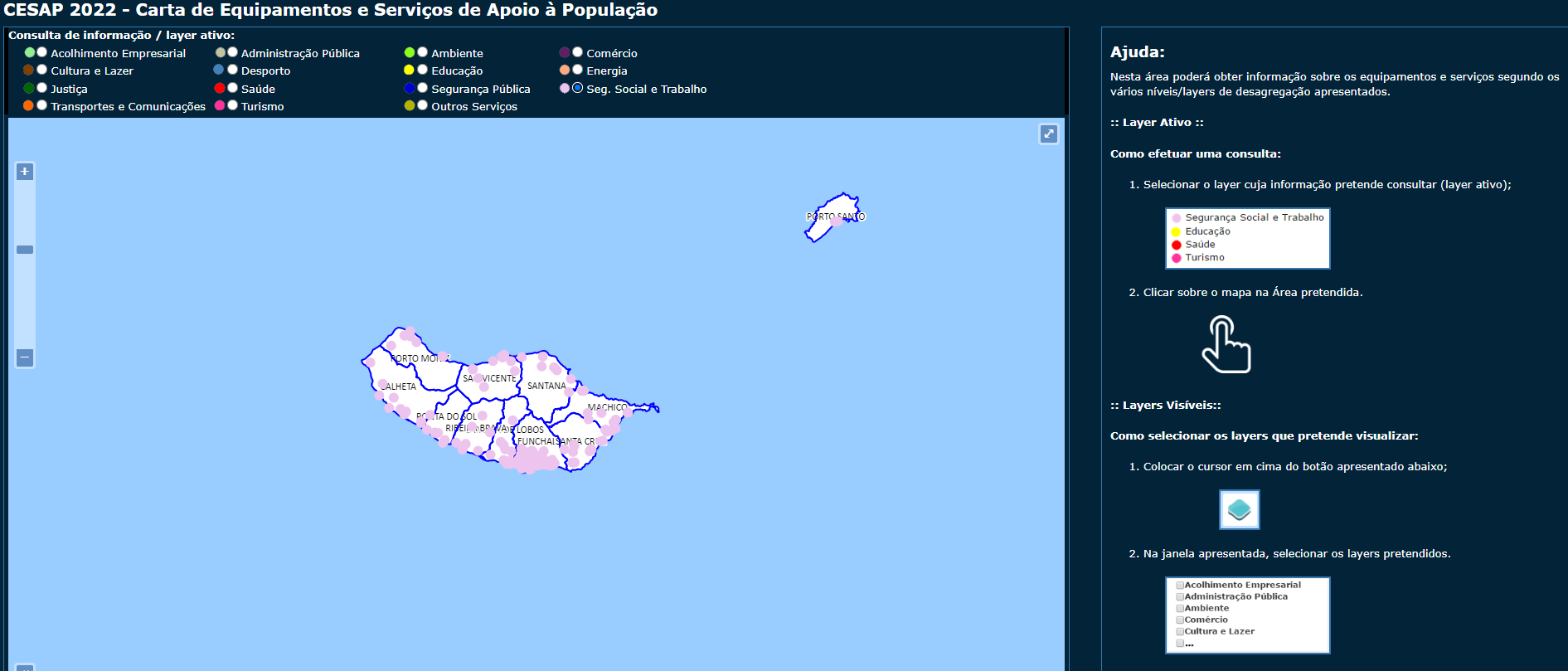
This edition of “Facilities Network and Supporting Services to the Population of the Autonomous Region of Madeira” (CESAP) results from the update of the facilities and services in operation during 2022. This update was carried out by the entities in charge, which identify and characterize the network of support facilities available in the 11 municipalities of the Autonomous Region of Madeira. The collected data has been compiled in a geographic database with approximately 2,000 records, divided into 15 thematic areas: business environment, public administration, environment, trade, culture and leisure, sport, education, energy, justice, health, public security, social security and labour, transport and communications, tourism and other facilities.
The CESAP project started out in 2002, following the Municipal Inventory carried out through an exhaustive survey addressed to the parish council of the Autonomous Region of Madeira, with the goal of identifying the collective facilities network (public and private) and support services to the population. It allowed, at the time, to characterize the civil parishes regarding these infrastructures and the residents search of facilities and services when these did not exist in the parish where they lived, which enabled the delimitation of areas of influence. In a subsequent phase, the Regional Directorate of Statistics of Madeira (DREM) proceeded with the georeferencing, by thematic areas, of some of those inventoried facilities and services, considered of particular interest for the several social and economic actors involved in the activities of the different municipalities.
The first publication of these data took place in 2003, with a paper edition, which included the characterization of these facilities and services, and statistical indicators for each municipality. Since then, there has been an annual update, since DREM is engaged in maintaining this information permanently updated, by integrating the changes occurring in the most different domains.
This information on facilities and services, and the respective geographical coordinates, is an important tool of great value for a better and more effective understanding of the territorial dynamics of the Region. It also reinforces the concept of the dissemination of geographic information and spatial data, contributing to the dissemination of large amounts of information, easy to understand, through a simple and appealing presentation. These data may be readily provided by DREM in shapefile or Excel format. DREM has made this data available through WMS service, and now also publishes in WFS format, which has been available since 2017. This guarantees the conditions that allow the user to have access to DREM's geographical data in those two formats.
It should also be noted that, as a public service, DREM reports the spatial data and respective metadata in accordance with the recommendations of the INSPIRE Directive (INfrastructure for SPatial InfoRmation in Europe). This directive, in force since 2007, was created with the aim of leading the creation of the European infrastructure for spatial information and focuses on spatial information under the responsibility of the public institutions of the Member States. The aim is to provide access to spatial data sets and services through the INSPIRE geo-portal, where the CESAP web services are available, and through the open data portal of the National System for Geographic Information, which is coordinated by the Directorate-General for the Territory.
As a dynamic and participative process, DREM is also available to receive suggestions for improvement that users may consider relevant and that can contribute to making this database more useful.
For more information, please click on:
International Statistical Cooperation
 |
International Statistical Cooperation
|
Statistical Literacy
 |
Statistical Literacy
|
|
|
|
|
 |
 |
|



 |
|
|
 |

Copyright © 2026 Direção Regional de Estatística da Madeira. All rights reserved.
Address: Calçada de Santa Clara 38, 9004-545 Funchal, Madeira Island
Phone: +351 291 145 110 (National landline call)