










Newsletters
Subscribe to our newsletter and get statistical data as soon as it is available!...
In the academic year 2020/2021
Number of graduates in tertiary education establishments in Madeira increased by 14.6%
The Regional Directorate of Statistics of Madeira (DREM) updates the "Education Time Series of the Autonomous Region of Madeira" with information on tertiary education graduates in the academic year 2020/2021, provided by the Directorate General of Education and Science Statistics.
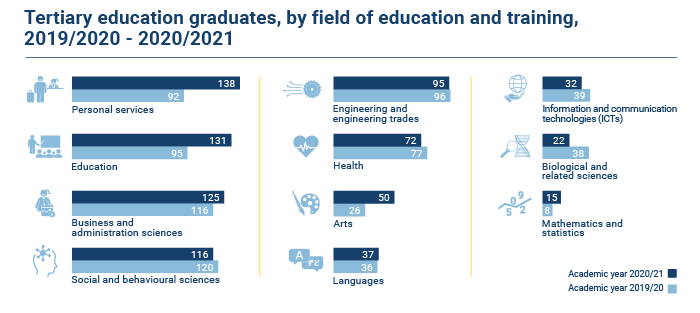
In the academic year 2020/2021, the number of graduates in tertiary education establishments in the Autonomous Region of Madeira increased by 14.6%, reaching 879 graduates, the second highest value of the series (767 in 2019/2020 and 1 004 in 2007/2008). Although the number of female graduates (54.6% of the total), continues to be higher than that of male graduates, the gap between men and women continues to narrow (56.6% in the previous academic year). The age of graduates shows a high in the 20-24 age group, reaching 62.3% in the academic year under review (60.5% in 2019/2020). It is followed by the 25-29 age group with 19.6% and the 40 and over age group with 7.2%. In this academic year, there were 27.6 graduates per 1 000 inhabitants aged 20-29, a figure that has been increasing in recent years (24.2 per 1 000 inhabitants in 2019/2020).
Regarding the distribution of the education and training areas of the tertiary education graduates, in 2020/2021, the area "Personal services" was the one that recorded the highest number of graduates (138; 15.7% of the total). This is the first time the number of graduates in this area exceeds the other areas, with an increase of about 50% compared to the previous academic year. As in previous years, the areas "Education" (131; 14.9%, "Business and Administration Sciences " (125; 14.2%) and "Social and Behavioural Sciences" (116; 13.2%) were, those with the highest number of graduates.
The distribution of degrees in tertiary education, by educational levels, shows a share of 68.4% in undergraduate degrees, 17.2% in master's degrees and 1.7% in doctoral degrees. Graduates in higher technical education represented 12.7% of the total number of graduates.
International Statistical Cooperation
 |
International Statistical Cooperation
|
Statistical Literacy
 |
Statistical Literacy
|
|
|
|
|
 |
 |
|



 |
|
|
 |

Copyright © 2026 Direção Regional de Estatística da Madeira. All rights reserved.
Privacy policy | Cookie Notice
Address: Calçada de Santa Clara 38, 9004-545 Funchal, Madeira Island
Phone: +351 291 145 110 (National landline call)