

- HomeHome
- DREMDREM
-
Statistical InformationStatistical Information
-
Economic
- Government
- Agriculture, Forestry and Fishing
- Construction and housing
- Trade
- Economic Accounts
- Enterprises
- Industry and energy
- Innovation and knowledge
- Prices
- Monetary and Financial Sector
- Short-term trends
- Transports and Communications
- Tourism
-
Social
- Culture, Sport and Recreation
- Education
- Health
- Justice
- Labour market
- Population and Social Standards
- Social protection
- Territory
- Multithemes
- Indicators System
-
Economic
- Dissemination CalendarDissemination Calendar
- MetadataMetadata
- LinksLinks
- Site MapSite Map
- Press release
- Dashboards
- Contact usContact us
- RAMStats 2.0









Notícias (GB)
In 2025, one in ten persons aged 15 or over consumed sugary soft drinks daily (Read more...)
In August 2026, the number of deaths decreased by 1.7% year-on-year, while the number of live births fell by 11.7% (Read more...)
In July 2026, the regional economic growth slowed for the third consecutive month (Read more...)
In the 3rd quarter of 2026, the volume of cement sold increased compared with the previous quarter, but decreased year-on-year (Read more...)
In September 2026, the twelve-month average rate of change of the Consumer Price Index (CPI) stood at 3.8%, with the year-on-year rate of change accelerating to 4.6% (Read more...)
DREM updates the Time Series on Social Protection with 2025 data (Read more...)
In 2025, mental well-being and life satisfaction showed positive values in the Region (Read more...)
In the 2025/2026 school year, the number of students enrolled in non-higher education decreased at all levels/cycles of study, except for the 2nd cycle (Read more...)
DREM releases Demographic Statistics of the Autonomous Region of Madeira for 2025 (Read more...)
DREM publishes a new edition of the Quarterly Statistical Bulletin covering the 2nd quarter of 2026 (Read more...)
Newsletters
Subscribe to our newsletter and get statistical data as soon as it is available!...
For 2020
DREM releases indicators of housing deprivation
The Regional Directorate of Statistics of Madeira (DREM) releases today on its website the final results of the Survey on Living and Income Conditions, carried out between March and September 2020. These data confirm the provisional results released on February 19th 2021 about poverty and inequality. Today, further data concerning housing conditions becomes available.
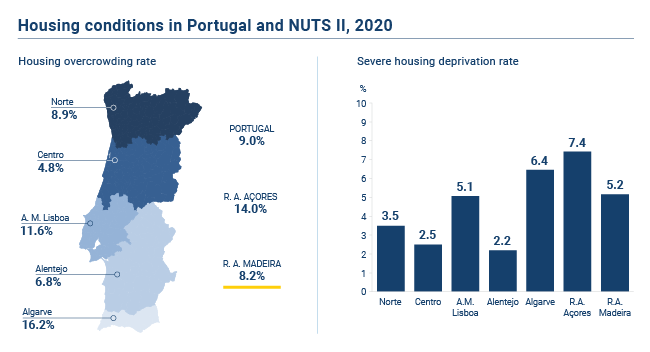
The Survey on Living and Income Conditions indicates that, in 2020, 8.2% of residents in the Autonomous Region of Madeira lived in a condition of lack of space, a smaller percentage than in 2019 (8.3%). The national average was 9.0%.
Around 5.2% of residents in the A.R. Madeira lived in a condition of severe housing deprivation, i.e., besides being overcrowded, the dwelling in which they lived also had at least one of the following problems: no indoor bath or shower or flushing toilet; leaking roof, damp walls/floors/foundation, or rot in window frames or floor; insufficient natural light in a sunny day. Besides standing above the national average (3.9%), this indicator was higher than in 2019 (4.5%).
Two indicators regarding housing cost burden are also available. The housing cost burden is the ratio between the housing costs and the disposable household income (net of housing allowances). Housing costs include those related to housing facilities such as water, electricity, gas and other fuels, as well as condominium, insurances, sewage, minor repairs, rents and interest related to the main residence mortgage.
The median housing cost burden was 10.8% in 2020, unchanged from 2019. However, contrary to what happened in 2019, in 2020 this rate was higher than in the country (10.4%).
The overburden housing cost rate, i.e. the percentage of people living in households where the share of housing expenditures to income is over 40%, stood at 4.4% in 2020, dropping by 2.1 p.p. from 2019. The national average was lower (4.1%).
International Statistical Cooperation
 |
International Statistical Cooperation
|
Statistical Literacy
 |
Statistical Literacy
|
|
|
|
|
 |
 |
|



 |
|
|
 |

Copyright © 2026 Direção Regional de Estatística da Madeira. All rights reserved.
Privacy policy | Cookie Notice
Address: Calçada de Santa Clara 38, 9004-545 Funchal, Madeira Island
Phone: +351 291 145 110 (National landline call)