











Newsletters
Subscribe to our newsletter and get statistical data as soon as it is available!...
In 2021
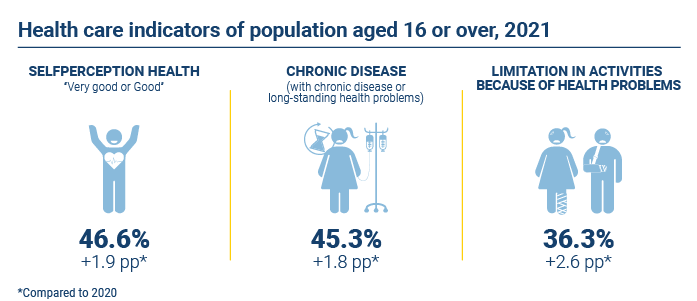
46.6% of persons aged 16 or over declared their health as "very good or good" and 45.3% suffer from chronic diseases
The Regional Directorate of Statistics of Madeira (DREM) releases today a set of indicators of the health status of the population aged 16 years or over, resident in the Autonomous Region of Madeira (ARM). These data were obtained from the Survey on Income and Living Conditions ((EU-SILC) conducted between 2018 and 2021.
Health status was assessed by persons aged 16 or over, based on their subjective assessment of their general health in physical, social and emotional terms. The presence of a chronic disease or long-term health problem (i.e. a problem that has lasted or could last for at least six months) was also assessed, as well as the presence of limitations in performing activities that are considered common for most people due to health problems (even if seasonal or intermittent).
In 2021, 46.6% of persons aged 16 or over self-assessed their state of health as "very good or good". This indicator has increased by 1.9 percentage points (pp) compared to the previous year (44.7%), which is the highest value in the period under question. It is worth noting that between 2020 and 2021, this indicator only increased in the Autonomous Region of Madeira and Alentejo. At a national level, the percentage in 2021 is 50.2%, with the highest value being recorded in Área Metropolitana de Lisboa (56.2%) and the lowest in Centro (43.8%).
In the Region, in 2021, 40.5% described their health status as "Fair" and 12.8% as "Poor or Very Poor".
The prevalence of a chronic disease or long-term health problem has recorded an increasing trend since 2019, when the proportion was at its lowest (41.1%). In 2021, 45.3% of the population (+1.8 percentage points compared to 2020) reported having a chronic disease or long-term health problem. This trend is also observed at a national level, with 43.9% of the population reporting this in 2021, up by 0.7 pp over 2020 and up by 2.7 pp over 2019. Centro and Alentejo were the only regions that recorded a decrease between 2020 and 2021. In this year, the Autonomous Region of the Azores recorded the highest percentage (47.1%) and the Algarve the lowest (42.0%).
Activity limitation increased between 2020 and 2021, affecting 36.3% of the population of Madeira aged 16 years or over, +2.6 percentage points compared to 2020. In 2021, 28.9% felt "limited but not severely" and 7.4% "severely limited" in performing activities, at least in the last 6 months prior to the survey. At a national level, the presence of limitations in 2021 was reported by 34.9% of the population surveyed, with Área Metropolitana de Lisboa having the lowest percentage (32.2%) and Centro, the highest (37.6%).
In 2021, the triennial module 'Child Health and Material Deprivation' was conducted for the first time in SILC, whose topic is not included in the regular dataset of this survey. This year, 88.5% of the children of Madeira under the age of 16 had “good or very good health”. In Mainland Portugal, this rate stood at 90.7% and in the Autonomous Region of the Azores at 85.2%.
For more information, please click on:
International Statistical Cooperation
 |
International Statistical Cooperation
|
Statistical Literacy
 |
Statistical Literacy
|
|
|
|
|
 |
 |
|


 |
|
|
 |

Copyright © 2026 Direção Regional de Estatística da Madeira. All rights reserved.
Address: Calçada de Santa Clara 38, 9004-545 Funchal, Madeira Island
Phone: +351 291 145 126 (National landline call)