











Newsletters
Subscribe to our newsletter and get statistical data as soon as it is available!...
In 2025
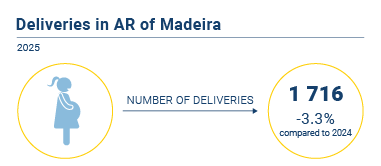
Number of births to mothers residing in the Autonomous Region of Madeira decreased by 3.3% compared to 2024
In 2025, a total of 1 716 births were recorded among mothers residing in the Autonomous Region of Madeira (ARM), representing a decrease of 58 births compared to 2024 (-3.3%). This trend contrasts with the national increase of 3.7%. It should be noted that 31 of the deliveries were twin births.
The municipalities with the highest proportion of births were Funchal (40.6%; 697 births), followed by Santa Cruz (17.3%; 297 births), Câmara de Lobos (16.8%; 289 births), and Machico (6.9%; 118 births).
Among the nine NUTS 2 regions, the ARM was the only one to record a negative change compared to the previous year, in contrast with the increases observed in all other regions. Notable increases were recorded in Norte (+5.9%) and Centro (+5.2%), as well as in Península de Setúbal and the Autonomous Region of the Azores (ARA), both with changes of +4.9%. The smallest increases were recorded in Alentejo (+0.7%), Grande Lisboa (+1.4%), Algarve (+2.0%), and Oeste e Vale do Tejo (+2.8%).
Approximately 99.0% of births occurred in hospital settings (1 699 births). The remaining births took place at home (11 births) or in other locations (6 births).
In the reference year, 78.4% of births were to mothers aged between 25 and 39 years (1 345 births), 13.5% were to mothers aged between 15 and 24 years (231 births), and 8.2% were to mothers aged 40 or older (140 births).
Analysis of the available series (starting in 2003) reveals, over the past two decades, a downward trend in the number of births to younger mothers (under 20 years of age) and, conversely, an increase in the proportion of births to mothers aged 35 or older. In 2005, births to mothers under 20 accounted for 5.5% of the total, while those to mothers aged 35 or older represented 20.3%. By 2025, these figures had shifted to 1.5% and 32.5%, respectively. It is also worth noting that the proportion of births to mothers aged 40 or older doubled over the same period, rising from 4.2% in 2005 to 8.2% in 2025.
It is also worth noting that 94.1% of pregnancies with known duration lasted between 37 and 41 weeks, while 5.8% corresponded to gestations shorter than 37 weeks. Additionally, in three births, the pregnancy duration ranged between 22 and 27 weeks.
The data provided are part of the 2025 Health Statistics of the Autonomous Region of Madeira publication, the complete edition of which will be released in the first quarter of 2027.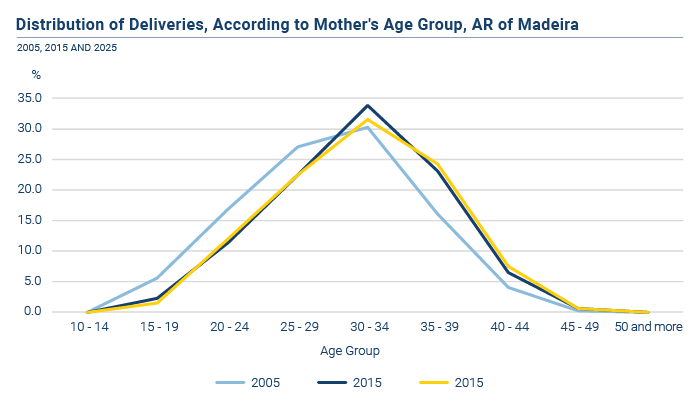
For more information, please access:
International Statistical Cooperation
 |
International Statistical Cooperation
|
Statistical Literacy
 |
Statistical Literacy
|
|
|
|
|
 |
 |
|


 |
|
|
 |

Copyright © 2026 Direção Regional de Estatística da Madeira. All rights reserved.
Address: Calçada de Santa Clara 38, 9004-545 Funchal, Madeira Island
Phone: +351 291 145 126 (National landline call)