









Newsletters
Subscribe to our newsletter and get statistical data as soon as it is available!...
For the year 2020
DREM releases Environmental Statistics
Data gathered by the Regional Directorate of Statistics of Madeira (DREM) for the year 2020 indicate that 60.4 million cubic metres of water were abstracted in the Autonomous Region of Madeira (ARM) (62.4 million m3 in 2019), by the managing entities of public water supply services.
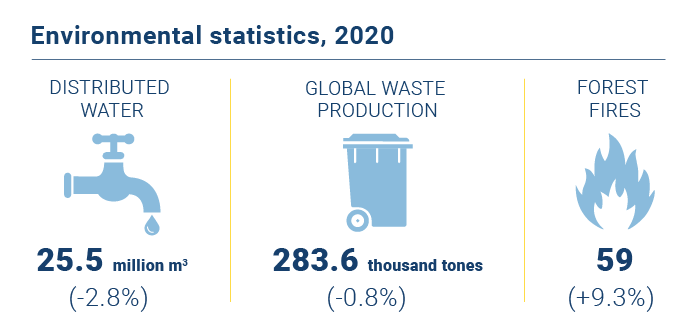
In 2020 the distributed water through the public water system stood at 25.5 million cubic metres, a 2.8% decrease from 2019. 71.6% of that total was for household consumption, a higher percentage than in 2019 (56.3%) as a result of the COVID-19 pandemic measures, which conditioned the economic activity and social life in the Region. Funchal accounted for the largest volume of water distribution, about 61.1% of the Region's total (15.6 million m3), due to the population weight and the concentration of economic activity in this municipality.
In the year of reference, 16 beaches in the ARM were awarded with blue flags, the same as in 2019. Regarding bathing water quality, 92.9% were classified as excellent or good, with only one beach with poor quality. In the municipalities of Calheta, Porto Moniz, Santana, São Vicente and Porto Santo, all monitored bathing waters were classified as excellent.
In 2020, the global production of waste in Madeira decreased to 283.6 thousand tonnes, down by 2.2 thousand tonnes over the previous year (-0.8%). This decrease is related to the deposition in the solid waste treatment plant of Meia Serra which went from 133.5 to 127.2 thousand tonnes between 2019 and 2020, reflecting a decrease of 4.7%. In this station, incineration, the dominant treatment process (94.7% of the total), decreased 3.5% compared to the previous year. Regarding the waste for recycling or sent outside the Region for this purpose, it amounted to 31.1 thousand tonnes (+4.1% than in 2019).
The consolidated expenditure of the Regional Government of Madeira on environmental management and protection was 29.7 million euros, +4.1% than in 2019. 65.0% of that amount was destined to “Soils, groundwater and surface” (69.2% in 2019).
In 2020, the 721 firemen (up by 18 over 2019; +2.6%) of the 10 fire brigades located in the Autonomous Region of Madeira, carried out 41,435 services (down by 6.1% from 2019), 65.5% of which were related to health/prehospital situations. In the reference year, the expenditure of the fire brigades stood at 11.6 million euros, having decreased 3.5% from 2019. 82.7% of that total refers to the compensation of employees (84.0% in 2019). The firefighter in the ARM is characterised by being mostly male (86.8%), aged between 26 and 50 years (66.0%), with secondary education (49.9%) and operating on a professional regime (56.4%).
Compared to the previous year, there was more rainfall in both Funchal (503.5 mm in 2020 and 224.5 mm in 2019) and Porto Santo (464.1 mm in 2020 and 339.8 mm in 2019). In Funchal, the average maximum temperature was 23.8ºC (23.6ºC in 2019), while for the minimum temperatures, the average was 17.9°C (17.7°C in 2019). Detailed information on this topic can be obtained on the DREM website, in the Territory statistical area.
Information regarding the air quality index for Funchal shows an improvement compared to the previous year with 57.9% of the observations being rated as good or very good (39.5% in 2019), while 39.6% were classified as medium quality (58.1% in 2019). Only 2.5% were negative.
Also to be noted, there was 59 forest fires registered in 2020 (up by 5 from 2018), which consumed an area of 1,392 hectares, (+1,504.6% compared to the prior year), 630 hectares of which of wooded area (45.3% of the total). These fires occurred in 9 of the Region's 11 municipalities, with Porto Santo and Porto Moniz recording no occurrences and the municipalities of Ribeira Brava (18 fires), Machico (12), Calheta and Câmara de Lobos (both with 9) recording more occurrences of this type. In what concerns the burnt areas, Calheta was the municipality with the most fires, with 1 228 hectares of affected area (88.2% of the total).
DREM also releases Time Series on Environmental Statistics for the 1989-2020 period
DREM also releases today on its website, the Time Series on Environmental Statistics, updated with the data for 2020.
In this edition, the series is presented with a redesigned layout and broadened with new information at a municipal level, such as water abstracted and distributed, bathing water and fires. It should also be noted that, within the scope of this reformulation, DREM now provides information about the profile of the Region's Fire Brigades.
The time series contains data about water supply, water treatment and drainage, solid waste, expenditures of the regional and local scope entities in environmental management and protection by economic aggregate and domains. There are also meteorological data and information on forestry fires, firemen, blue flag beaches, bathing water quality, drinking water quality, air quality, elements of the nature and environment protection service, forest fire protection actions and nature and environment protection activities.
For more information, please click on:
International Statistical Cooperation
 |
International Statistical Cooperation
|
Statistical Literacy
 |
Statistical Literacy
|
|
|
|
|
 |
 |
|


 |
|
|
 |

Copyright © 2026 Direção Regional de Estatística da Madeira. All rights reserved.
Address: Calçada de Santa Clara 38, 9004-545 Funchal, Madeira Island
Phone: +351 291 145 126 (National landline call)