









Newsletters
Subscribe to our newsletter and get statistical data as soon as it is available!...
Referring to the year 2023
DREM releases Regional Environmental Statistics
The Regional Directorate of Statistics has released today the updated Environmental Statistics for the year 2023.
Increased water extraction and distribution
Data collected by the Regional Directorate of Statistics of Madeira (DREM) for 2023 indicate that 55.3 million cubic meters of water were abstracted in the Autonomous Region of Madeira (RAM) by supply management entities (53.7 million m3 in 2022).
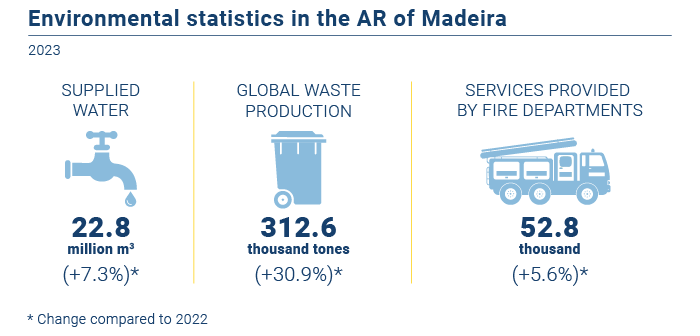
In 2023, the water distributed in the Region by the public network was around 22.8 million m3, +7.3% compared to 2022. 62.6% of the water distributed was allocated for the domestic sector, a lower percentage than in 2022 (63.4%). In municipal terms, Funchal concentrated the largest volume of distributed water, around 48.0% of the Region's total (10.9 million m3), reflecting its population density and concentration of economic activity.
ARM maintains number of Blue Flag beaches
In 2023, 16 beaches in the ARM were awarded with the Blue Flag, the same value as in 2022. In terms of bathing water quality, out of the 61 beaches that were analysed, 51 were classified as excellent, 4 as good, 2 as poor, with 4 beaches remaining unclassified. In the municipalities of Calheta, Ponta do Sol, Porto Moniz, Santana and São Vicente, all monitored bathing waters were classified as excellent.
Increase in inert waste drives overall waste production growth
Global waste production in 2023, in the ARM, grew to 312.6 thousand tonnes, a rise of 73.8 thousand tonnes compared to the previous year. This increase of 30.9% is fundamentally explained by the significant rise in the deposition of inert materials on the island of Madeira, which went from 59.9 to 131.4 thousand tonnes between 2022 and 2023, translating into an increase of 119.3%. A substantial share of the overall waste production was processed at the Meia Serra Waste Treatment Station. At the aforementioned station, incineration, the dominant treatment process (87.1% of the total), declined by 0.7% compared to the previous year, with organic recovery increased significantly (+112.1%). Regarding waste targeted for recycling or sent outside the Region for this purpose, it totalled 39.0 thousand tonnes (+8.7% compared to 2022). It should also be noted that, in 2023, the number of recycling bins in the Region totalled 1 618.
Increase in firefighting operations
In the same year, the 10 fire brigades in the Region had 746 employees, who provided around 52.8 thousand services (+5.6% compared to 2022), the vast majority (73.0%) related the health/pre-hospital care. In the year under review, fire brigades' expenses amounted to around 15.3 million euros, +11.1% compared to 2022, of which 85.5% attributed to personnel expenses (83.8% in 2022 ).
The firefighters in the ARM are characterised by being mostly male (86.2%), aged between 26 and 50 years (61.4%), having secondary education (57.0%) and operating in a professional regime (57.1%).
Rising average temperatures and declining precipitation
In the field of meteorology, in 2023, the precipitation level was slightly lower than the previous year, both in Funchal (527.9 mm in 2023 against 551.2 mm in 2022), and in Porto Santo (334.5 mm in 2023 against 464.5 mm in 2022). As for temperatures, in Funchal, the average maximum temperatures in 2023 were 24.6ºC, 1.1ºC more than in 2022, while in the minimum temperatures, the average was 18.6ºC (17. 8ºC in 2022). Detailed information on this topic can be obtained on the DREM website under the Statistical Territory area.
Fewer wildfires but greater burnt area
For the year in question, air quality data show that the proportion of measurements for the Funchal agglomeration recording a result of “Very Good” or “Good” rose to 58.9% (48.2% in 2022). In turn, observations classified as “Average” quality fell to 37.0% (44.1% in 2022). 4.1% of measurements presented a negative qualitative assessment of “Weak” or “Bad” (7.7% in 2022).
It is also worth noting that in 2023 there were 39 forest fires (-10 compared to the previous year), which consumed an area of 5 154 hectares (86 hectares in 2022), of which 2 068 hectares were forestry areas (40.1% of the total). ). It is worth noting that the area burnt in 2023 was the second largest in the last decade. The fires this year occurred in 8 of the 11 municipalities in the Region, with the municipalities of Ribeira Brava (20 fires), Calheta (7) and Ponta do Sol (5) having recorded the most incidents of this nature. Santa Cruz, Santana and Porto Santo did not register any occurrences. In terms of burnt area, Calheta was the most affected municipality in the ARM, with 3 045 hectares of affected surface (59.1% of the total).
DREM also releases “Time Series of Environmental Statistics” for the period 1989-2023
DREM has also made available today an updated version of the Time Series of Environmental Statistics, incorporating data for 2023.
In this time series, it is possible to find information on water supply, wastewater treatment, solid waste, expenditure of regional administration and local entities on management and protection of the environment by economic aggregates and domains. It also provides meteorological data and information on forestry fires, firefighters, Blue Flag beaches, bathing water quality, water quality for human consumption, air quality, elements of nature and environmental protection service, forest fire protection actions and nature and environmental protection activities.
International Statistical Cooperation
 |
International Statistical Cooperation
|
Statistical Literacy
 |
Statistical Literacy
|
|
|
|
|
 |
 |
|


 |
|
|
 |

Copyright © 2026 Direção Regional de Estatística da Madeira. All rights reserved.
Address: Calçada de Santa Clara 38, 9004-545 Funchal, Madeira Island
Phone: +351 291 145 126 (National landline call)