








Newsletters
Subscribe to our newsletter and get statistical data as soon as it is available!...
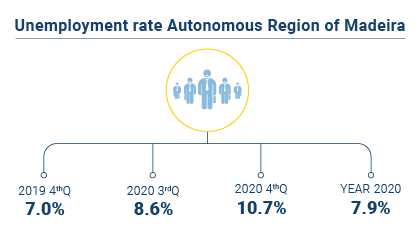
Estimated unemployment rate stood at 10.7% in the 4th quarter 2020, while the average for the year was 7.9%
The Labour Force Survey results for the fourth quarter of 2020 indicate that the Unemployment Rate for Madeira was estimated at 10.7%, 2.1 percentage points (p.p.) higher than in the previous quarter and 3.7 p.p. higher compared to the same quarter of the previous year.
The unemployment rate for 2020 (average) in the Autonomous Region of Madeira was 7.9%, increasing by 0.9 p.p. from 2019.
The estimate of the unemployed population in Madeira stood at 14.8 thousand persons, having recorded quarterly and year-on-year increases of 25.1% and 53.7%.
The employed population was estimated at 123.2 thousand persons, a year-on-year decrease of 4.9 thousand employed persons (-3.9%) and a 2.0 thousand decrease from the previous quarter (-1.7%).
The unemployment rate in Portugal, for the fourth quarter of 2020, stood at 7.1%, 0.4 p.p. higher than in the same quarter last year and 0.7 p.p. lower than in the previous quarter. In annual terms, the unemployment rate increased by 0.3 p.p. from 2019 to 6.8%.
The unemployment rate stood below the national average in Autonomous Region of the Azores (5.5%), Centro (5.8%) and Norte (7.0%). Above that average are Alentejo (7.4%), Área Metropolitana de Lisboa (7.7%), Algarve (9.9%) and the Autonomous Region of Madeira (10.7%). Compared to the previous quarter, Área Metropolitana de Lisboa (-1.8 p.p.), Autonomous Region of the Azores (-1.2 p.p.) and Norte (-0.9 p.p.) had a decrease in the rate. In Centro the unemployment rate remained unchanged from the previous quarter while it increased in Alentejo (1.2 p.p.), Algarve (1.4 p.p.) and in the Autonomous Region of Madeira (2.1 p.p.). Year-on-year, the unemployment rate declined only in the Autonomous Region of the Azores (-2.1 p.p.) and in Norte (-0.1 p.p.). The highest growth was recorded by the Autonomous Region of Madeira (3.7 p.p.) and Algarve (3.1 p.p.), regions which are highly dependent of the tourism industry, which has been highly affected by the restrictions related to the COVID-19 pandemic.
For more information, please click on:
International Statistical Cooperation
 |
International Statistical Cooperation
|
Statistical Literacy
 |
Statistical Literacy
|
|
|
|
|
 |
 |
|


 |
|
|
 |

Copyright © 2026 Direção Regional de Estatística da Madeira. All rights reserved.
Address: Calçada de Santa Clara 38, 9004-545 Funchal, Madeira Island
Phone: +351 291 145 126 (National landline call)