










Newsletters
Subscribe to our newsletter and get statistical data as soon as it is available!...
In 2024
Regional poverty risk rate was below the national figure for the unemployed, above it for retirees, and close to it for workers
The Regional Directorate of Statistics of Madeira (DREM) publishes today, on its website, further results from the Survey on Living Conditions and Income (SILC) for the years 2023 and 2024, focusing on the characterisation of poverty risk among the population aged 18 and over, broken down by activity status, duration of unemployment, and highest level of education completed. The indicators were constructed on the basis of annual net monetary income, excluding other sources of income, namely income in kind, own consumption, own production, and imputed rent.
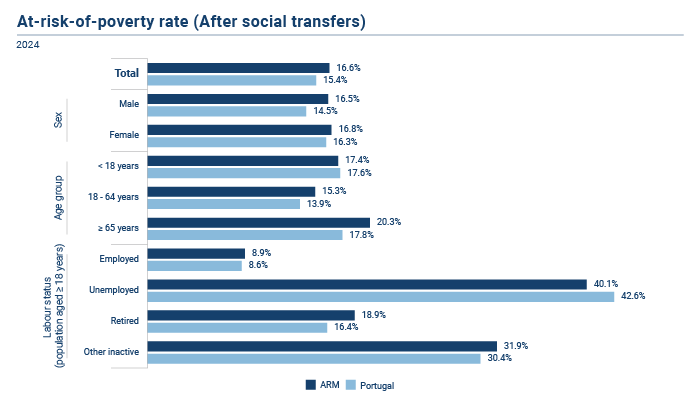
The SILC results indicate that, in 2024, in the Autonomous Region of Madeira (ARM), using the national poverty line set that year at 8 679 euros, the at-risk-of-poverty rate after social transfers stood at 16.6%, a value higher than that recorded at the national level (15.4%). Nevertheless, compared to 2023, a sharper reduction in this indicator was recorded in the Region (-2.5 percentage points – pp), compared to the decrease observed at the national level (-1.2 pp). It should be noted that the average net monetary income per equivalent adult increased by 12.8% in the Region, rising from 14 233 euros in 2023 to 16 051 euros in 2024.
In the ARM, the at-risk-of-poverty rate was slightly lower among men (16.5%) than among women (16.8%), corresponding to a difference of 0.3 pp, less pronounced than that observed at the national level (14.5% for men and 16.3% for women).
In the year under review, the at-risk-of-poverty rate was lower among persons aged 18 to 64, both in the Region and nationally, standing at 15.3% and 13.9%, respectively. This was followed by the under-18 age group, with rates of 17.4% in the Region and 17.6% nationally — the only age group in which the regional figure was below the national one. The population aged 65 or over recorded rates of 20.3% in the Region and 17.8% nationally. In both cases, this was the age group that showed the largest decrease compared to the previous year, falling by 2.5 pp in the ARM and 3.3 pp nationally.
Considering the labour market status of persons aged 18 and over, the at-risk-of-poverty rate for the unemployed population in the ARM fell from 45.6% in 2023 to 40.1% in 2024, a decrease of 5.5 pp. Nationally, the reduction was less pronounced (-1.7 pp), with the rate reaching 42.6% in 2024. By duration of unemployment, in the ARM, the group with a duration of less than one month ("0 months") recorded an at-risk-of-poverty rate of 14.3% in 2024, 2.1 pp lower than in 2023. In the group with a duration of "12 months", the rate stood at 42.9%, corresponding to a decrease of 6.6 pp compared to the previous year.
Regarding the employed population, the at-risk-of-poverty rate in the ARM stood at 8.9%, reflecting a decrease of 1.4 pp compared to 2023. Nationally, the rate fell from 9.2% in 2023 to 8.6% in 2024, a reduction of 0.6 pp.
For the retired population, the at-risk-of-poverty rate in the ARM remained above the national figure (16.4%), standing at 18.9% in 2024. Year-on-year, a decrease of 2.0 pp was recorded in the Region and 3.2 pp nationally.
The poverty risk among the resident population in the ARM in a situation of inactivity other than retirement stood at 31.9% in 2024, decreasing by 3.4 pp compared to the previous year. At the national level, this indicator remained unchanged at 30.4%.
In 2024, a lower at-risk-of-poverty rate was observed in the ARM among persons with upper secondary or higher education (9.8%), compared to those with at most basic education (22.4%), representing a difference of 12.6 pp. Nationally, the group with at most basic education recorded a rate of 21.3%, 1.1 pp below that recorded in the ARM.
The poverty intensity rate indicates how far the median available monetary income of the population at risk of poverty falls below the corresponding threshold. In 2024, this indicator continued to show relevant differences in the ARM according to labour market status. The retired population recorded the lowest value (18.5%), albeit reflecting a slight increase compared to 2023 (+0.7 pp). In contrast, the unemployed population recorded the highest poverty intensity rate (34.9%), representing a worsening of 3.7 pp compared to the previous year. The "Other inactive" group stood at 28.2%, standing out for the largest year-on-year change (+6.0 pp). Among the employed population, the poverty intensity rate was 23.4%, also recording an increase compared to 2023 (+2.4 pp).
For more information, please click on:
International Statistical Cooperation
 |
International Statistical Cooperation
|
Statistical Literacy
 |
Statistical Literacy
|
|
|
|
|
 |
 |
|



 |
|
|
 |

Copyright © 2026 Direção Regional de Estatística da Madeira. All rights reserved.
Address: Calçada de Santa Clara 38, 9004-545 Funchal, Madeira Island
Phone: +351 291 145 110 (National landline call)