











Newsletters
Subscribe to our newsletter and get statistical data as soon as it is available!...
In the 3rd quarter of 2022
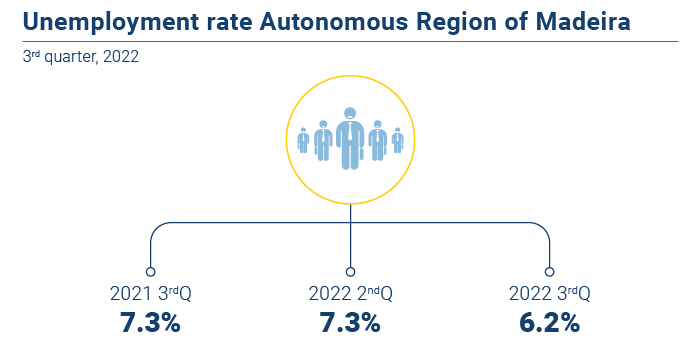
Unemployment rate in the Autonomous Region of Madeira stood at 6.2%
The Labour Force Survey results, for the 3rd quarter of 2022, indicate that the unemployment rate for the Autonomous Region of Madeira was estimated at 6.2%. This value decreased by 1.1 percentage points (pp) when compared to the previous quarter and compared to the same quarter of last year. Compared to the 4th quarter of 2019 (pre-pandemic COVID-19 period), there was a drop of 1.2 pp.
The estimated unemployed population in the Autonomous Region of Madeira stood at 8.3 thousand persons, dropping by 12.0% from the same quarter of last year (1.2 thousand persons) and 13.1% compared to the previous quarter (1.3 thousand persons).
The employed population was estimated at 125.2 thousand persons, representing a year-on-year increase of 3.6% (4.3 thousand persons) and a quarterly growth of 2.2% (2.7 thousand persons). Of the employed population, 12.4 thousand persons worked from home (10.1% of female employees and 9.7% of male employees). Note that according to the time series of the Labour Force Survey, the employed population for the 3rd quarter of 2022 is the highest ever in the Region.
The activity rate of working-age people (aged 16 to 89), in the 3rd quarter of 2022, was estimated at 61.3%, up by 1.3 pp to the same quarter of last year and 0.6 pp from the previous quarter. The activity rate for women was 55.9%, lower than that of men (67.6%) by 11.7 pp.
The inactive population stood at 119.3 thousand persons in the reference quarter, decreasing by 2.9% quarter-on-quarter and 1.3% from the previous quarter.
The unemployment rate for Portugal was estimated at 5.8%, up by 0.1 pp compared to the previous quarter and down by 0.3 pp compared to the same quarter of the previous year.
In the quarter under analysis, Área Metropolitana de Lisboa recorded the highest unemployment rate (7.6%), being the Centre and Alentejo at the other end of the scale(both at 4.3%).
In four of the 7 NUTS2 regions of the country, the unemployment rate fell in quarterly terms, with the largest drop being recorded in the Autonomous Region of Madeira (-1.1 pp). In year-on-year terms, the unemployment rate decreased in all regions of the country, except for Área Metropolitana de Lisboa, where it rose by 0.9 pp.
For more information, please click on:
International Statistical Cooperation
 |
International Statistical Cooperation
|
Statistical Literacy
 |
Statistical Literacy
|
|
|
|
|
 |
 |
|


 |
|
|
 |

Copyright © 2026 Direção Regional de Estatística da Madeira. All rights reserved.
Address: Calçada de Santa Clara 38, 9004-545 Funchal, Madeira Island
Phone: +351 291 145 126 (National landline call)