











Newsletters
Subscribe to our newsletter and get statistical data as soon as it is available!...
[Preliminary Note: Following the measures decreed by the competent authorities to contain the COVID-19 pandemic, Statistics Portugal decided, between the first fortnight of March 2020 and the end of the 2nd quarter of 2022, to suspend the face-to-face collection of information in the Labour Force Survey, replacing it exclusively with telephone interviews. This suspension had an impact on response rates and the profile of respondents, which led Statistics Portugal to increase the size of the quarterly sample of this survey, while restricting the sampling frame to dwellings for which this collection mode was feasible. In addition, Statistics Portugal provided in its Press Releases additional indicators to monitor the evolution of the labour market, always alerting when the impacts of the measures to contain the COVID-19 pandemic could interfere with the normal evolution or interpretation of the estimates released.
With the resumption of the mixed collection mode from the 3rd quarter of 2022 onwards, through the reintroduction of face-to-face interviews, there was a gradual reversal of response rates to the levels observed in the pre-pandemic quarters and year-on-year changes different from those expected in some indicators were shown, as presented in detail in the "Methodological note of the Labour Force Survey data: the context of the COVID-19 pandemic", published by Statistics Portugal on 19 May 2023.
Statistics Portugal then resumed the analysis of the impact of adopting an exclusively telephone data collection mode and, following its results, revised the estimates for the 2nd quarter of 2020 to the 2nd quarter of 20232 by incorporating the variable "completed level of education" into the process of calibrating the individual weights, in addition to the information usually used (monthly estimates of the resident population by sex, age group and region). The estimation of the results for the 3rd quarter of 2023, the last quarter affected by the suspension of face-to-face collection mode , was carried out in a similar way.
For more information on the context, methodology, and impacts of this revision, please consult the "Methodological note on the revision of Labour Force Survey data: The context of the COVID-19 pandemic," published alongside with "Labour Statistics of the Autonomous Region of Madeira – 3rd quarter 2023"]
In the third quarter of 2023
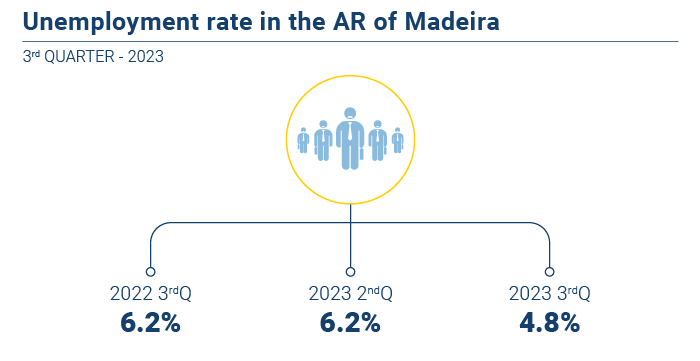
Unemployment rate in the Autonomous Region of Madeira was 4.8%
The results of the Labour Force Survey for the third quarter of 2023 indicate an estimated unemployment rate in the Autonomous Region of Madeira (ARM) of 4.8%, which is 1.4 percentage points (pp) lower than the previous quarter and the same quarter in the previous year.
The estimated number of unemployed populations, totalling 6.7 thousand persons, decreased by 19.1% compared to the same quarter of the previous year (approximately 1.6 thousand persons) and by 21.6% compared to the previous quarter (about 1.9 thousand persons).
The employed population reached a new high of approximately 132.2 thousand persons, increasing by 4.8% year-on-year (6.1 thousand persons) and by 1.7% compared to the previous quarter (2.2 thousand persons). Out of the employed population, 15.5 thousand persons worked from home (13.7% of employed women and 9.7% of employed men).
The labour force participation rate for persons of working age (16 to 89 years) in the third quarter of 2023 was estimated at 63.0%, 1.3 pp higher than the same quarter of the previous year and the previous quarter. The participation rate for women was 57.9%, which was 11.1 pp lower than that of men (69.0%).
The inactive population, estimated at 116.1 thousand persons, decreased by 2.0% compared to the same quarter of the previous year and by 0.1% compared to the previous quarter.
In Portugal, the unemployment rate for the quarter under review remained the same as the previous quarter (6.1%) but was 0.1 pp higher compared to the same quarter of the previous year.
In the reference quarter, Norte (6.7%) and Área Metropolitana de Lisboa (6.6%) had the highest unemployment rates, while the Autonomous Region of Madeira (both at 4.8%) and the Algarve (5.0%) in the opposite direction had the lowest rates. The Alentejo and the Autonomous Region of the Azores (ARA) had intermediate rates (5.9% and 6.0%, respectively).
Unemployment rates decreased in the third quarter in ARM (-1.4 pp), ARA (-0.6 pp), Área Metropolitana de Lisboa (-0.5 pp), and the Algarve (-0.2 pp). The other NUTS 2 regions recorded quarterly increases.
Year-on-year, the unemployment rate decreased in ARM (-1.4 pp) and Área Metropolitana de Lisboa (-1.2 pp). In the other NUTS 2 regions, the trend was in the opposite direction, with Alentejo recording the largest increase (+1.5 pp), followed by Norte (+0.8 p.p.) and the Centre (+0.5 pp). The Autonomous Region of Azores maintained a rate similar to that of the third quarter of 2022.
For more information, please click on:
International Statistical Cooperation
 |
International Statistical Cooperation
|
Statistical Literacy
 |
Statistical Literacy
|
|
|
|
|
 |
 |
|


 |
|
|
 |

Copyright © 2026 Direção Regional de Estatística da Madeira. All rights reserved.
Address: Calçada de Santa Clara 38, 9004-545 Funchal, Madeira Island
Phone: +351 291 145 126 (National landline call)