

- HomeHome
- DREMDREM
-
Statistical InformationStatistical Information
-
Economic
- Government
- Agriculture, Forestry and Fishing
- Construction and housing
- Trade
- Economic Accounts
- Enterprises
- Industry and energy
- Innovation and knowledge
- Prices
- Monetary and Financial Sector
- Short-term trends
- Transports and Communications
- Tourism
-
Social
- Culture, Sport and Recreation
- Education
- Health
- Justice
- Labour market
- Population and Social Standards
- Social protection
- Territory
- Multithemes
- Indicators System
-
Economic
- Dissemination CalendarDissemination Calendar
- MetadataMetadata
- LinksLinks
- Site MapSite Map
- Press release
- Dashboards
- Contact usContact us










Notícias (GB)
DREM releases updated Time Series on Communications with 2025 data (Read more...)
DREM releases the final results of the 2025 Tourism Statistics and updates the corresponding Time Series (1976-2025) (Read more...)
In 2025, the main obstacles to reconciling work and family life were long working hours and unpredictable or atypical working hours (Read more...)
In 2025, the number of inoculations administered in the Region increased by 2.5% (Read more...)
In June 2026, the Confidence Indicator in Manufacturing Industry and Services increased, while in Construction and Public Works and in Trade there was a decrease (Read more...)
DREM publishes a new edition of the Quarterly Statistical Bulletin covering the 1st quarter of 2026 (Read more...)
In May 2026, the passenger movement at the airports of the Autonomous Region of Madeira recorded a year-on-year growth of 5.5% (Read more...)
In the 1st quarter of 2026, the median rent for new lease agreements increased by 16.0% and the number of new agreements fell by 8.6% year-on-year (Read more...)
In 2024/2025, the 2nd cycle of Primary Education recorded the highest progression/completion rate (Read more...)
In May 2026, the median value of bank appraisals for housing in the Autonomous Region of Madeira stood at 2 598 euros per square metre (Read more...)
Notícias (GB)
DREM releases updated Time Series on Communications with 2025 data (Read more...)
DREM releases the final results of the 2025 Tourism Statistics and updates the corresponding Time Series (1976-2025) (Read more...)
In 2025, the main obstacles to reconciling work and family life were long working hours and unpredictable or atypical working hours (Read more...)
In 2025, the number of inoculations administered in the Region increased by 2.5% (Read more...)
In June 2026, the Confidence Indicator in Manufacturing Industry and Services increased, while in Construction and Public Works and in Trade there was a decrease (Read more...)
DREM publishes a new edition of the Quarterly Statistical Bulletin covering the 1st quarter of 2026 (Read more...)
In May 2026, the passenger movement at the airports of the Autonomous Region of Madeira recorded a year-on-year growth of 5.5% (Read more...)
In the 1st quarter of 2026, the median rent for new lease agreements increased by 16.0% and the number of new agreements fell by 8.6% year-on-year (Read more...)
In 2024/2025, the 2nd cycle of Primary Education recorded the highest progression/completion rate (Read more...)
In May 2026, the median value of bank appraisals for housing in the Autonomous Region of Madeira stood at 2 598 euros per square metre (Read more...)
Newsletters
Subscribe to our newsletter and get statistical data as soon as it is available!...
In 2021
Gross Value Added of the agricultural sector in the Autonomous Region of Madeira increased by 2.8%
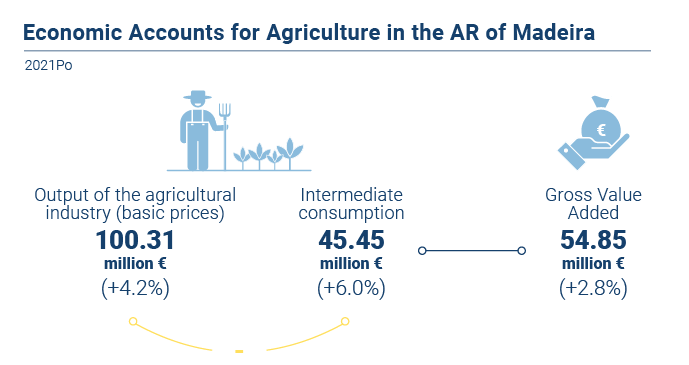
According to the latest Regional Economic Agricultural Accounts, made available by Statistics Portugal, the agricultural output in the Autonomous Region of Madeira stood at 100.3 million euros in 2021, increasing by 4.2% from 2020 in nominal terms.
In 2021, 82.5% of the total agricultural output came from crop output and 13.0% from animal output, with the remaining percentage corresponding to agricultural services and Non-Agricultural Secondary Activities. In Portugal, the share of animal output was higher (31.7%), but still, crop production was the most important component of agricultural output (63.0%).
In the Autonomous Region of Madeira, the main components of crop production in 2021 (82.8 million euros) were fresh vegetables (25.2 million euros, -0.8% than 2020) and tropical fruits (18,9 million euros, -2.7% compared to 2020).
The main share of animal production, whose total was 13.0 million euros (+10.2% than in 2020), was derived from poultry (including eggs) which accounted for 59.0% of that total.
Agricultural activity is inherent to the use of a series of goods and services, which constitute intermediate consumption. The intermediate consumption stood at 45.5 million euros, increasing by 6.0% from 2020.
The Gross Value Added (GVA) corresponds to the difference between production (at basic prices) and intermediate consumption. In 2021, the GVA reached 54.9 million euros, increasing by 2.8% between 2020 and 2021.
Gross Fixed Capital Formation (GFCF) stood at 7.7 million euros, rising by 9.2% from 2020.
International Statistical Cooperation
 |
International Statistical Cooperation
|
Statistical Literacy
 |
Statistical Literacy
|
|
|
|
|
 |
 |
|


 |
|
|
 |

Copyright © 2026 Direção Regional de Estatística da Madeira. All rights reserved.
Address: Calçada de Santa Clara 38, 9004-545 Funchal, Madeira Island
Phone: +351 291 145 126 (National landline call)